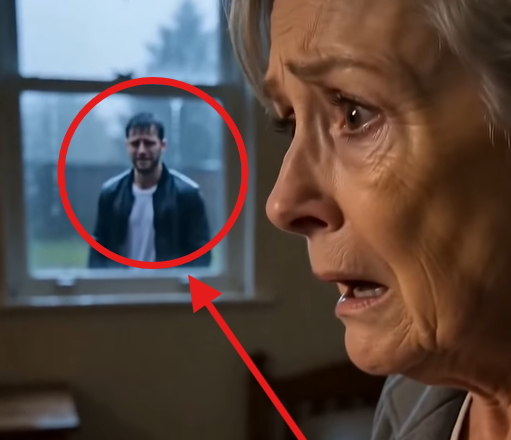
Not because he was standing there in the rain. Not because of the look on his face — that hard, unreadable expression she almost didn’t recognize. It was his hand. The bare finger where a ring used to be. That single detail told her everything the note hadn’t said yet.
She looked back down at the page with blurred eyes and kept reading.
His handwriting was uneven, pressed too hard into the paper in some places, faint in others — like a man who had stopped and started more than once before finally finding the courage to finish what he came to say. The words weren’t elegant. They weren’t rehearsed. They were raw, the kind of words that cost something to write.
“She made me choose.”
That line landed like a stone dropped into still water.
The younger woman standing in the doorway earlier had not simply been watching. She had been measuring. For months — maybe longer — she had been keeping a quiet, careful record of every dollar he spent helping his mother. Small bags of groceries. Medicine when things ran short. Rent when the bills piled up faster than the income came in. Every act of love had become an argument. Every visit home became a fight. Every kindness he showed his mother was reframed as weakness, as divided loyalty, as proof that he didn’t love his wife the way a husband should.
Then came the ultimatum. Clean and cold as a closed door.
Her. Or his mother.
He chose neither. Not exactly.
He sold the ring instead.
That was where the money came from. Not a business deal that finally paid off. Not luck arriving at the right moment. Not savings quietly set aside. The ring — the last valuable thing that still belonged only to him, that still held the original promise of who he thought he was building a life with — he had let it go. Quietly. Without drama. Without asking anyone’s permission.
The mother stood at the window and looked out through the rain, but he was already gone. Only the trembling gate remained, still shaking slightly as if the air itself hadn’t settled from his leaving.
She turned back to the note and read the final lines.
“You fed me when you had no food. You covered me when you had no blanket. I won’t let you grow old hungry while I stand under a roof. Forgive me for making it look ugly.”
That was what broke her open.
Not the cash tucked inside the envelope. Not the careful apology for showing up the way he did — rough, cold, his voice flat as pavement, refusing to meet her eyes. It was that last sentence. Those seven words. Because they explained everything she had witnessed and couldn’t understand until now.
The rough shove. The cold voice. The refusal to look at her. The way he had pushed the bag of rice into her hands like he wanted to be rid of it, like she was a burden he resented. She had stood in her own doorway and felt shame rising in her chest — not for anything she had done wrong, but for existing, for needing, for being old in a world that had little patience for it.
He had made himself cruel so the woman watching from the doorway would not see the truth.
He had chosen to look heartless in front of one person so he could still be a son in front of himself.
There are men who show their love loudly — who announce it, who wear it like a badge. And then there are men who bury their love so deep inside sacrifice and silence that no one ever sees it until something breaks. He was the second kind. He had hidden his devotion inside humiliation because it was the only form he had left that he could safely give without it being taken from him too.
The mother pressed the note to her chest and cried the way only mothers cry — quietly at first, the kind of tears that fall before you even realize they’ve started, and then with the full, aching weight of understanding too much all at once. The kind of grief that isn’t grief exactly, but something more complicated. Something that holds love and loss and gratitude and heartbreak all in the same moment without any way to separate them.
She thought she knew what kind of morning this was.
She was wrong.
Because then she noticed one more thing inside the envelope. Small. Easy to miss. A key, taped carefully to the inside fold of the letter, with one final line written beneath it in that same uneven hand.
“If I don’t come back, the locker is yours. I put everything there before she could take it.”
That changed the grief into something colder.
Because suddenly this was no longer simply the story of a son torn between a wife and a mother, trying to keep peace in a house that had run out of it. This was a man who had made preparations. A man who had quietly moved his most important things somewhere safe before the storm arrived — because he already knew the storm was coming and he already knew he might not make it through with everything intact.
The sack of rice he had carried to her door. The money folded inside the note. The ring sold in silence. The key left behind just in case.
None of it was charity. None of it was shame.
It was a goodbye dressed up as an ordinary morning. A final act of love wearing the mask of something ugly so no one would try to take it away before she received it.
She held the key in her palm and felt the full weight of what her son had done.
He had walked into the hardest moment of his life and made sure she would not go hungry through whatever came next — even if he wasn’t there to see it.