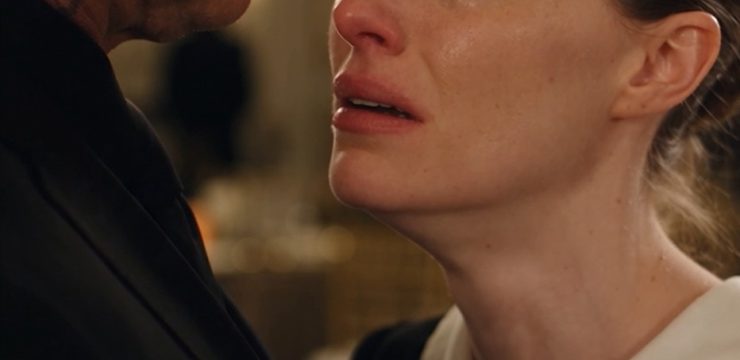
The morning started like something out of a nightmare no one saw coming. An ambulance pulled up slowly, its siren cutting off mid-wail as if even the sound didn’t know how to handle what was happening. Cars draped in white ribbons and fresh flowers rolled into the courtyard — the same decorations meant to celebrate a beautiful new beginning. Instead, they surrounded the entrance to the morgue.
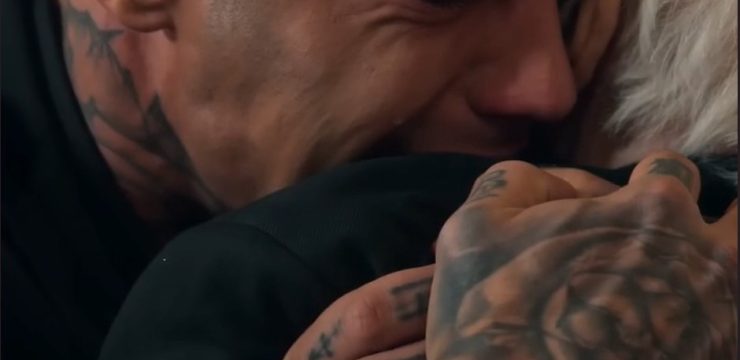
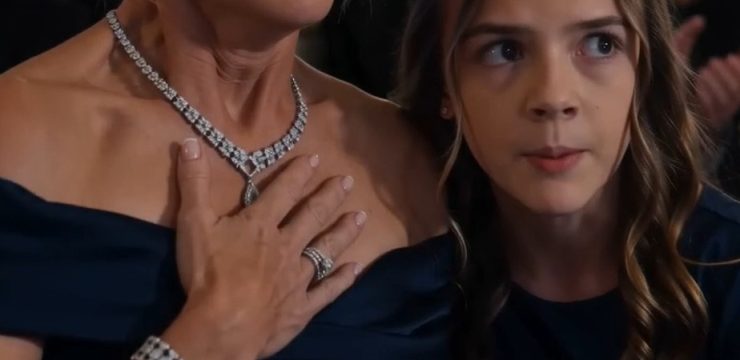
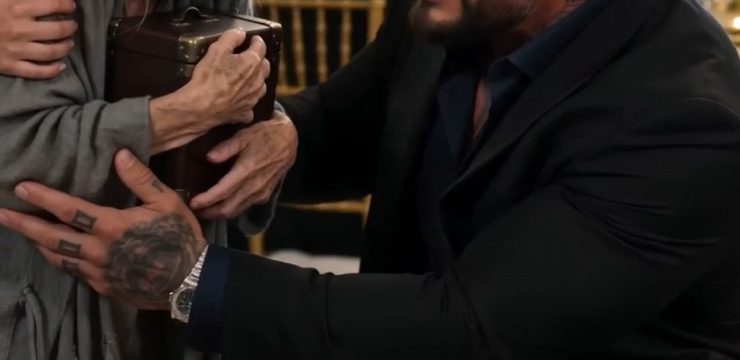
People dressed in their finest stood in stunned silence. Some wept quietly into handkerchiefs. Others simply stared ahead, hollow-eyed, as if the world had stopped making sense. The groom walked beside the stretcher, his jaw tight, his eyes fixed on the woman lying still before him. He wasn’t crying. He looked like a man watching a scene he had already rehearsed in his mind.
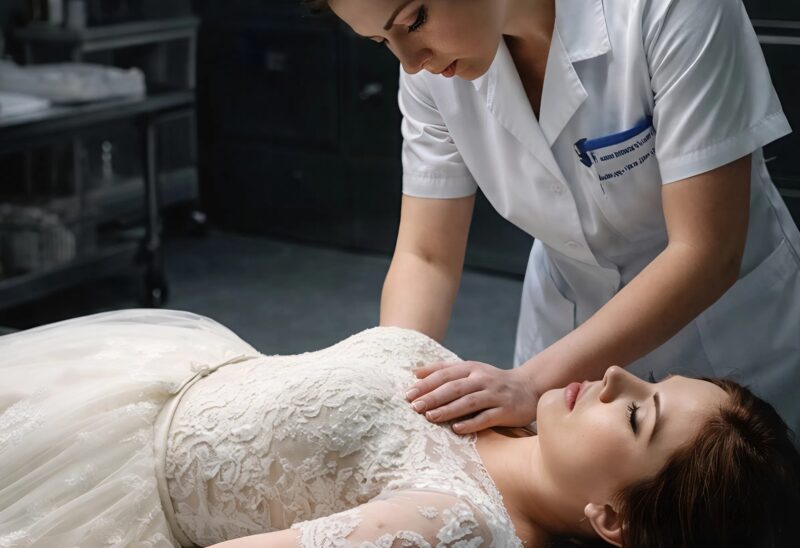
The bride was breathtaking, even in stillness. Her lace dress caught the pale morning light. Her hair was pinned with care. The bouquet she had carried down the aisle still rested gently on her chest.
Maya had only recently taken the job at the morgue. The first weeks had been hard — cold hallways, sleepless nights, dreams she didn’t want to remember. But the chief doctor had told her early on, “Don’t fear the dead. The ones who walk around smiling — those are the ones to watch.” She had held onto that. It helped her find a strange kind of peace in the quiet of her work.
When the family was escorted out, the room fell into heavy silence. The attending physician glanced at the paperwork, confirmed the listed cause of death — poisoning — and told Maya to finish her shift and head home without staying late. The autopsy was scheduled for the next day. Everything was, he said, already signed and settled.
Maya stood alone with the young woman.
Something felt wrong.
She stepped closer. The bride’s complexion wasn’t the ashen gray Maya had grown used to seeing. Her skin held color — a faint, warm blush across her cheeks that simply did not belong to a body gone cold. Maya reached out and touched the girl’s hand. She pulled back instantly. The skin was warm. Not room-temperature warm. Warm like a living person.
She touched her again, slower this time, pressing gently. And then she felt it — the softest, most impossible sensation rising beneath her fingertips. She leaned down and pressed her ear to the bride’s chest.
A heartbeat. Faint. But there.
Maya ran.
She burst into the doctor’s office, barely catching her breath. He listened with the weary patience of a man who had heard too many things. He followed her back, examined the young woman with practiced efficiency — checking the neck, the pupils, the chest with a stethoscope — and then straightened up, peeling off his gloves.
“Bodies retain heat in the first hours,” he said flatly. “You likely mistook a muscle contraction for a pulse. It happens after certain types of poisoning. You imagined it.”
He left. Maya stayed.
She stood there, staring at the bride’s face. Then she saw it — the faintest curl of the fingers. A tiny, almost imperceptible movement.
She leaned in close and whispered, “If you can hear me, give me any sign.”
Nothing. Silence.
But Maya’s gut wouldn’t let her walk away. She returned later that night, long after her shift ended, and checked again. The skin was still warmer than it should have been — far longer than science could easily explain.
She made a decision.
She brought a small camera from home and placed it discreetly in the corner of the room, angled at the table. She told no one.
She came back before dawn, slipped into the storage room, and pulled up the footage.
For a long stretch — stillness. Then it happened. The bride took a sudden, sharp breath, like someone breaking the surface of water after being held under too long. Her fingers curled. Her chest rose. Her eyes opened slowly, blinking against the pale light.
Maya pressed her hand over her mouth.
Minutes later, the doctor entered — but he wasn’t alone. The groom was with him. On the recording, Maya heard every word with terrible clarity.
“The dose was calculated precisely,” the doctor said, scanning the room. “Officially, it’s clinical death. The paperwork is already prepared.”
The groom glanced toward the door, visibly anxious. “We need to move quickly. No one can see this.”
Together, they helped the young woman to her feet. She was weak, leaning heavily between them, but she was conscious. They guided her out through a side service exit, away from any cameras.
Maya sat frozen in front of the screen.
The full picture assembled itself in her mind, piece by devastating piece. Days before the wedding, a substantial life insurance policy had been taken out in the bride’s name, with the husband as sole beneficiary. But beyond the insurance payout, the bride held a significant ownership stake in her father’s business — assets that could not be transferred while she was legally alive. Her official death would allow control to shift quietly into the hands of a trusted associate: the groom himself.
The plan was built on two pillars: collect the insurance and seize the assets. The bride, it seemed, had agreed to her own disappearance — willing to fake her death to escape pressure that had clearly become unbearable, with promises of a new life somewhere far away.
They had calculated everything carefully. Everything except Maya.
The young attendant who heard a heartbeat where she wasn’t supposed to. The woman who stayed when she was told to go home. The person who trusted what her hands and ears told her over what authority assured her was true.
Maya saved a copy of the recording to a secure drive.
And when she finally walked into the doctor’s office again, she did not go alone.