I’m a veterinarian, and I’ve received calls at every hour imaginable. People assume that holding a medical degree means you’re available around the clock — whether it’s a dog with a runny nose or something far more urgent. But the call that changed the way I see my work didn’t come in the middle of the night. It came on a quiet afternoon, and the voice on the other end of the line carried a kind of exhaustion that no amount of sleep seemed to fix.
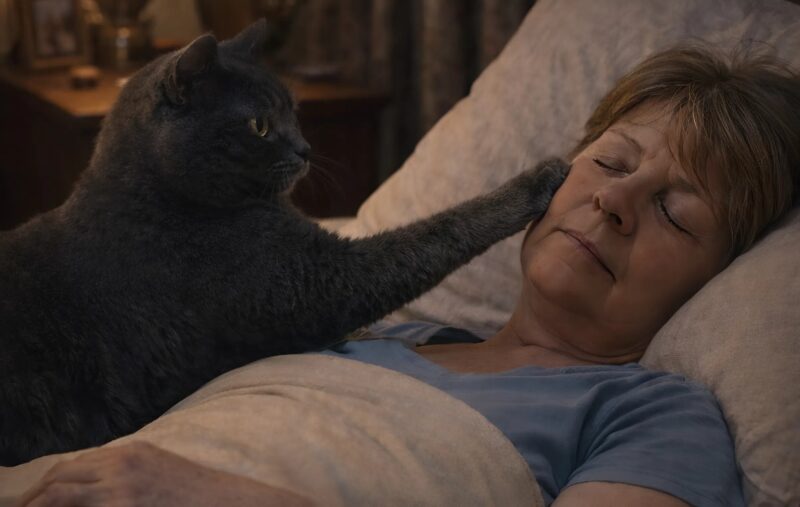
Her name was Anna. She had an appointment, she said. Her cat wouldn’t let her sleep.
Now, that phrase — “my cat won’t let me sleep” — can mean a dozen different things. A bored kitten knocking things off shelves at two in the morning. A hungry tom yowling for breakfast before sunrise. But something in Anna’s voice told me this was different. There was no frustration, no irritation. Only worry. Deep, quiet, bone-tired worry.
When she arrived at the clinic, Anna looked exactly like the kind of woman who had spent a lifetime keeping everything together. Mid-fifties, a neat haircut, a coat that matched her boots almost perfectly. She carried the cat carrier gently, the way you’d carry something fragile and irreplaceable. Inside sat Luna — a large, silver-gray cat with thick, beautiful fur and eyes that seemed to take in everything around her without missing a single detail.
“My husband chose her name,” Anna said softly, setting the carrier down on the exam table. “Luna. It’s lovely, isn’t it? But at night, she’s not Luna. She’s an alarm clock with claws.”
I asked her to tell me what was happening.
Anna took a slow breath. Every night, she explained, Luna would wake her in the early morning hours. It started gently — a soft tap on the cheek with one paw. If Anna didn’t respond, the tapping grew harder. Then came small nips at her hand. Then Luna would grab the edge of the blanket and pull. She wouldn’t stop, wouldn’t settle, wouldn’t give Anna a moment’s peace — not until Anna gave up, climbed out of bed, and went to sleep on the living room couch.
And the moment Anna left the bedroom? Luna would curl up on Anna’s pillow and sleep soundly until morning.
“How long has this been going on?” I asked.
“About three months,” she said. “At first I thought her personality had changed. Then I figured it was my own nerves. I even saw a therapist. He told me I had stress-related insomnia and gave me a sedative. But I wasn’t getting any better.”
I examined Luna carefully. Heart steady and strong. Breathing clear and easy. Weight perfectly normal. No signs of anxiety, no aggression, no neurological irregularities. She sat calmly on the exam table and watched Anna the entire time — not me, not the room. Anna.
That’s when something shifted in my thinking. A quiet alarm went off somewhere in the back of my mind.
“Anna,” I said, “when Luna wakes you up — how do you feel in those first few moments?”
She considered the question.
“Not good,” she admitted. “My heart starts racing. My mouth goes dry. Sometimes I feel like I can’t quite catch my breath. I always assume my blood pressure is spiking, so I take something for it and move to the couch. After a little while, I feel better.”
I kept my voice steady. “Has anyone ever mentioned that you snore? Or that your breathing sounds unusual at night?”
She looked slightly embarrassed. “A neighbor once said that through the wall, it sometimes sounds like I stop breathing completely — and then suddenly gasp.”
I looked at Luna. She hadn’t taken her eyes off Anna for a single second.
“I don’t think Luna is being difficult,” I said carefully. “I think she’s reacting to something that’s happening to you while you sleep. Animals — especially cats — are extraordinarily sensitive to changes in breathing patterns and heart rhythm. For Luna, what she’s sensing in the night isn’t normal, and she’s doing the only thing she knows how to do about it. She’s waking you up.”
Anna stared at me for a long moment. “Are you saying she’s been trying to help me?”
“I can’t say that with medical certainty,” I told her honestly. “But I am certain that the problem is not your cat. I want you to see your doctor. Get a full blood panel, have your heart evaluated, and seriously consider a sleep study. Please don’t wait on this.”
She nodded slowly, and I could see something shifting behind her eyes — not panic, but recognition. The kind that comes when pieces you didn’t know were missing suddenly fall into place.
She called me not long after that conversation. The exhaustion in her voice was gone.
Her blood sugar had come back dangerously elevated. Her cardiologist had found an irregular heart rhythm she hadn’t known about. And a sleep specialist confirmed what Luna had apparently understood long before any doctor: Anna’s breathing was stopping repeatedly throughout the night — a serious condition that had been quietly putting enormous strain on her heart.
“If Luna hadn’t kept waking me,” Anna said quietly, “I would have gone on blaming my nerves for months.”
She is now receiving proper treatment — medication, a carefully designed sleep therapy plan, and the kind of consistent care that has already begun making a real difference. She sleeps through the night more often than not these days.
And Luna? She still visits in the darkness. But now, instead of claws and blanket-pulling, she simply finds her place beside Anna, tucks herself close, and purrs.
Sometimes the most profound kind of loyalty doesn’t look like what we expect. Sometimes it looks like a silver-gray cat who refused to give up on the person she loved — long before that person knew how much she needed saving.