Nobody could explain it at first. A child that young, barely able to tie his own shoes, walking through the doors of a busy police station with one very specific request — he needed to speak to a female officer. Not just any officer. A woman in uniform. And he wouldn’t budge until he got exactly that.
It started like any other unremarkable afternoon at the station. Officers were shuffling papers, answering phones, and chasing deadlines that never seemed to end. The officer at the front desk was just about to pour himself a well-deserved cup of coffee when the main door swung open and a young couple walked in, hand in hand with their little boy.
The child couldn’t have been more than three years old. His eyes were swollen and red, the kind of red that tells you someone has been crying for a very long time — not a tantrum, not a scrape on the knee kind of cry, but something deeper. Something that came from a place adults rarely expect to find in someone so small.
His father stepped up to the front desk, visibly uncomfortable, searching for the right words.
“I know this is going to sound strange,” he said quietly. “But our son has been crying for hours, and the only thing he keeps saying is that he needs to talk to a female police officer. We don’t know what else to do. We’ve asked him over and over again, and he won’t explain. He just keeps asking us to bring him here.”
The desk officer stared at the boy for a moment, genuinely puzzled.
Word spread through the station almost instantly. Officers gathered, exchanged glances, offered theories. Maybe he saw something on television. Maybe it was a school project. But one look at the child’s tear-streaked face made it clear — this was no game.
There was only one woman on duty that afternoon. A young lieutenant was deep into a pile of paperwork in the back when a colleague knocked on her door.
“Lieutenant, you’re going to want to come see this. There’s a little boy out front. He specifically asked for a female officer. We don’t know why, but he won’t talk to anyone else.”
She set her pen down, raised an eyebrow, and walked out.
The moment the little boy saw her step into the room — her uniform pressed, her badge catching the light — something shifted in him that no one in that station will ever forget. The crying stopped. Just like that. Completely. As if the weight he had been carrying finally had somewhere to land.
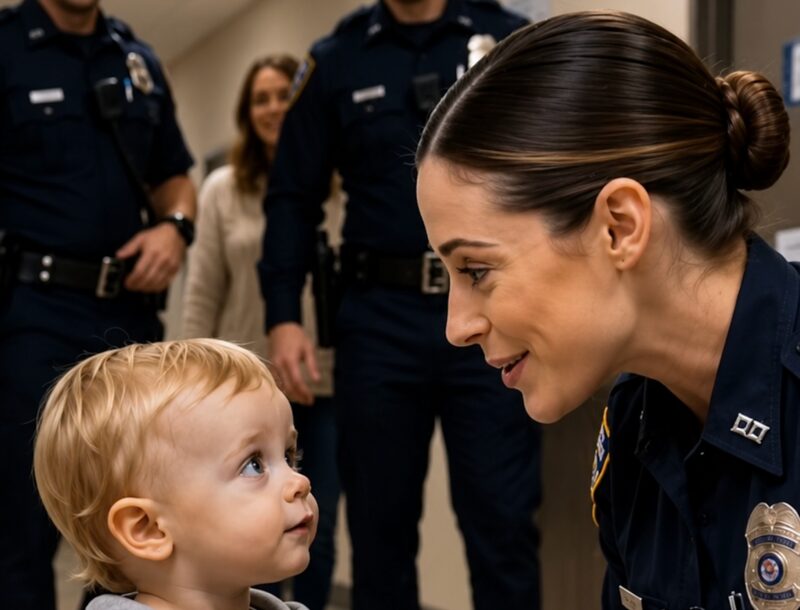
He released his mother’s hand. He walked slowly, steadily, across the floor toward the lieutenant. He looked up at her with eyes that held something far too ancient for a three-year-old face.
She knelt down to his level. She smiled — the kind of warm, steady smile that officers learn to give in difficult moments.
“Hey, buddy,” she said softly. “Did you want to tell me something?”
The entire room went still. You could have heard a pin drop.
The little boy reached into the front pocket of his small knitted sweater and pulled out a piece of paper, folded many times over with the careful, clumsy precision of a child who had been carrying it very gently for a very long time. He held it out to her with both hands.
She took it. Unfolded it slowly.
It was a drawing — crayon on plain white paper. A house. A little boy. A lady in a blue uniform. And right in the center of it all, a big red heart.
People in the room smiled. They assumed it was an innocent gift, a sweet gesture from a sweet child. But then the boy spoke.
“This is for you,” he said simply.
She thanked him warmly and asked, with genuine curiosity, “But why for me, sweetheart?”
He paused for a moment. Then, in a voice so calm it sent a chill straight through every adult in that room, he answered.
“Because you saved my mommy.”
The lieutenant looked up at his parents, visibly taken aback.
“I’m sorry — have we met before?”
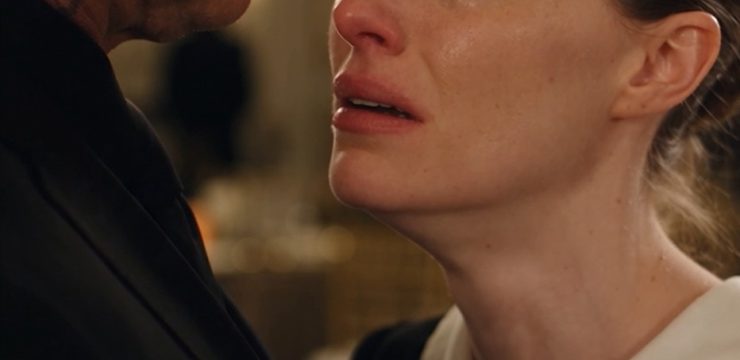
The mother nodded slowly. She was already crying.
“There was a car accident,” she began, her voice barely holding together. “It was bad. The car was completely crushed. I lost consciousness. My son was strapped in his car seat right next to me. The very first person to reach us — before the paramedics, before anyone — was a young female officer. She stayed with him the entire time. She held his hand. She kept telling him, over and over again, that his mommy was going to be okay.”
The lieutenant went still.
She remembered that accident. Of course she did. But the boy had been so quiet that night, so wide-eyed and frozen, that she had assumed he was too young to understand what was happening around him.
“I didn’t think he remembered,” she whispered.
“When we came home from the hospital,” the mother continued, wiping her eyes, “he wouldn’t stop saying that we had to go find the lady in the blue uniform and say thank you. We didn’t know who he meant, or where to find her. But he would not let it go. He cried until we brought him here.”
Nobody in that station made a sound.
The lieutenant felt her hands begin to tremble. She pulled that little boy into her arms and held him close.
And then he leaned up toward her ear and whispered something — something so quiet that only she could hear it clearly at first. But when she pulled back and repeated it to the room, the toughest officers quietly looked away.
“I was scared you didn’t know,” he had said. “You didn’t just save my mommy. You saved me too. Because without my mommy… I would have been so, so scared.”
Some moments in this life sneak up on you when you least expect them — in the middle of an ordinary afternoon, in a busy room full of people who thought they had seen everything. And then a three-year-old boy walks through the door with a folded drawing in his pocket and a heart full of gratitude, and reminds every single person in the room exactly why the work they do matters.
Not every thank-you comes with words that are perfectly formed. Some come in crayon. Some come with red, swollen eyes and a tiny hand reaching out. And those are often the ones that stay with you for the rest of your life.