Nobody wanted the job. Word had already spread quietly through the halls of the hospital — the kind of whispered warning that travels fast among medical staff. The patient was a millionaire, yes. The pay was exceptional, yes. But the duties were grueling, the room felt more like a shrine to a man already gone, and the patient himself had not moved, spoken, or shown any meaningful sign of life in over two years. Most nurses walked in for the interview and walked right back out.
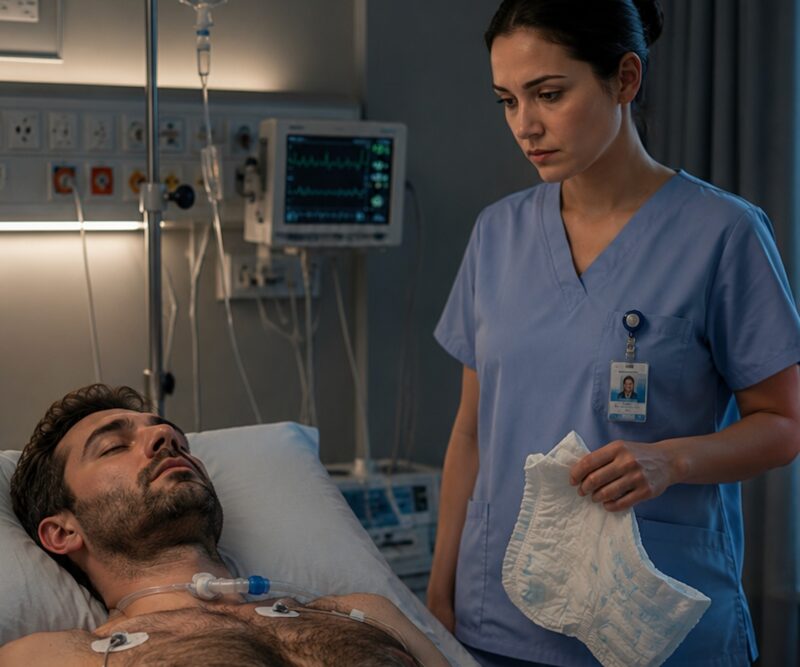
But Maya needed that job more than she needed pride.
Her mother had passed just months before, leaving behind a mountain of medical debt that felt impossible to climb. Her younger brother was still in school, counting on her. She had no savings, no backup plan, and no one else to lean on. When the hospital administrator told her the salary figure, she didn’t flinch. She signed the paperwork that same afternoon.
Walking into that room for the first time was unlike anything she had experienced in her years of nursing. It didn’t look like a hospital room — not really. The furniture was rich and heavy, the medical equipment was the most modern money could buy, and a security guard stood posted outside the door without exception, every hour of every day. At the center of it all lay a man who had once commanded boardrooms and made decisions worth millions. Now he lay perfectly still, kept alive by machines, surrounded by people who had quietly stopped expecting him to wake up.
The doctors were not unkind. They were simply realistic. After so many months without progress, hope had been replaced by routine. He was monitored, maintained, and managed. But no one truly believed the man inside that body was still fighting to come back.
Maya decided to treat him as though he was.
She spoke to him during her shifts. She told him about small, ordinary things — the weather outside, a funny moment from the hallway, the way the afternoon light came through the window. She knew he couldn’t hear her. Or at least, she told herself that’s what she knew. But something in her refused to treat him like furniture. She changed his IVs, monitored his vitals, repositioned him carefully to prevent bedsores, and performed every procedure with the same attention she would give any conscious patient.
Then one ordinary morning, everything changed.
She was performing a routine hygiene procedure — something she had done dozens of times without incident — when she caught the faintest movement from the corner of her eye. The fingers on his right hand. Just barely. Just for a moment.
She stopped breathing.
She stood completely still and watched. Seconds passed. And then it happened again — so slight that anyone glancing casually at the bed would have missed it entirely. But Maya had spent weeks in that room. She knew exactly what “nothing” looked like on that man. And this was not nothing.
She finished the procedure, kept her composure, and immediately called for the doctor on duty.
He barely looked up. “It’s just a reflex,” he said. “It happens sometimes. It doesn’t mean anything.”
Maya nodded politely. And then she went back to watching.
Over the following days, she noticed a pattern that made her heart race with quiet certainty. Every time she spoke to him softly, every time she took his hand and said his name, the monitor told a story the doctors weren’t reading — his heart rhythm shifted, almost imperceptibly, and his fingers responded. It was the smallest possible signal. But it was consistent. It was real.
She brought her observations to her supervisor. She was met with gentle dismissal, then mild frustration, then outright mockery from a few colleagues who had seen too many families cling to false hope. But Maya had not spent all those nights in that room to be talked out of what her own eyes had recorded.
She pushed. She documented. She requested. She insisted.
Finally, after exhausting nearly every channel available to her, she convinced the chief physician to bring in a visiting neurosurgeon — a specialist from outside the clinic with a fresh set of eyes and no preconceived conclusions about the case.
The specialist ordered a scan that, remarkably, had never been performed before. The results left the room silent.
Buried beneath two years of medical reports and resigned diagnoses was something no one had caught — a rare complication from an earlier surgery was creating pressure on a specific region of the brain. It was treatable. Modern neurosurgery had the tools. The window had not yet closed. It had simply never been opened.
The operation lasted the better part of a day. The surgical team worked with the kind of focused precision that only comes with high stakes. And then came the waiting — the slow, agonizing days of watching for any sign that something had shifted.
It had.
He opened his eyes on his own. Slowly, then with more awareness. And when the nurse who had refused to stop believing in him walked into the room, he reached out and gently — unmistakably — squeezed her hand.
When he was finally well enough to speak and learn the full story of what had happened, he was quiet for a long time. The kind of quiet that comes not from having nothing to say, but from feeling it too deeply for words.
“Everyone had already stopped fighting for me,” he said at last, his voice low and raw. “Everyone… except you.”
Maya thought about her mother, her brother, the debt she still owed, the job she had taken out of sheer desperation. She had walked into that room because she had no other choice. But she stayed — she truly stayed — because somewhere beneath the routine, she had recognized a soul still worth fighting for.
And that quiet certainty, that stubborn refusal to stop looking, had given a man back his life.