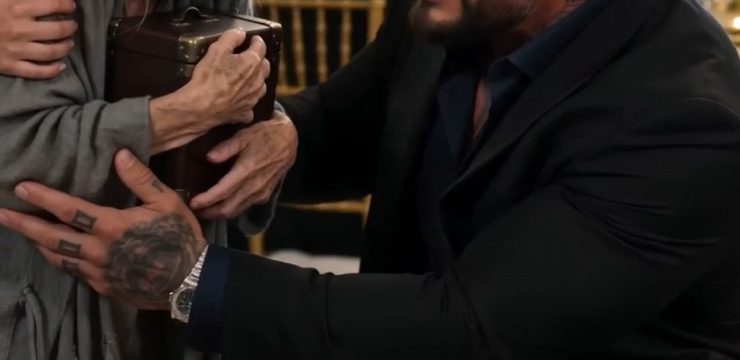
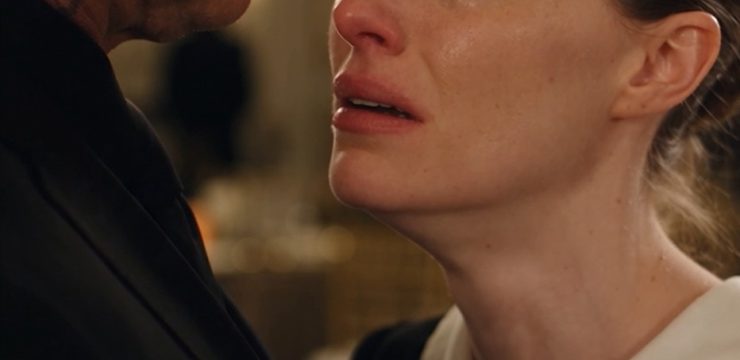
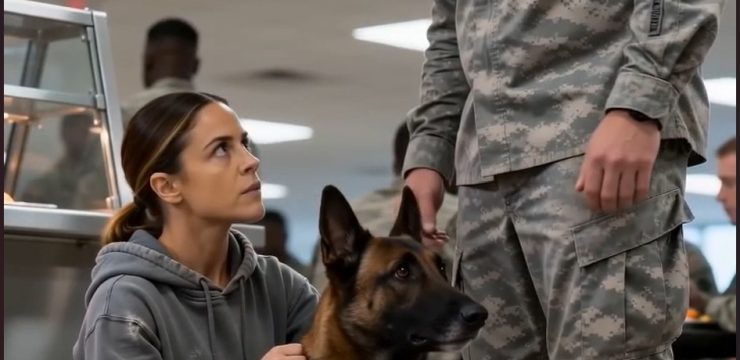
No one in that unit would ever forget what happened on the parade ground that morning. The sun was already beating down hard when the soldiers assembled in formation, standing shoulder to shoulder in silence. The air felt different — heavy, charged with something no one could quite name. Every soldier sensed it. Something unusual was coming.
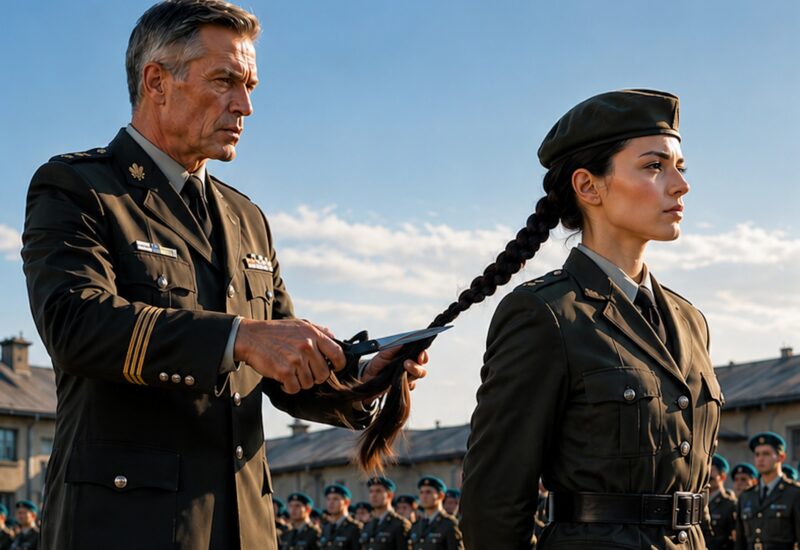
At the center of it all stood two people: a commanding officer with decades of rank behind him, and a young female recruit named Anna who had been with the unit for less than a week.
Anna was not an ordinary soldier. She had graduated at the top of her military academy class — a sharpshooter, disciplined, focused, and relentless in every drill. She never complained. She never lagged behind. By every measurable standard, she was exactly the kind of soldier any unit would be proud to have. But by her second day, she had already crossed a line that no one in that unit had dared to cross before.
During a rigorous training exercise, one of the younger soldiers took a hard fall attempting a jump. The impact was serious — he hit the ground with his full weight, injuring his back badly enough that he could barely move. The colonel barely glanced at the man on the ground.
“He’ll get up on his own,” the colonel said, his voice flat and cold. “He’s not going to fall apart.”
Without hesitation, Anna stepped out of formation and moved toward the injured soldier.
“He needs a doctor,” she said clearly.
“Return to formation!” the colonel ordered.
“He needs help first,” she replied.
Dozens of soldiers heard every word. To the colonel, it was more than disobedience — it was a public challenge to his authority, delivered in front of his entire unit. And a man like him could not let that stand.
Days later, he called the full unit to assemble again. When every soldier had taken their place, he called Anna forward. She walked out of the ranks calmly, her long, dark braid hanging nearly to her waist. Everyone in the unit knew how much she valued that braid. It was not vanity — it was identity, dignity, something deeply personal.
The colonel produced a large pair of scissors.
A low, nervous murmur moved through the rows. The soldiers understood immediately what was about to happen. Anna did not move. She stood perfectly straight, eyes forward, face unreadable.
The colonel grabbed her braid and spoke loudly enough for everyone to hear.
“This will teach you not to argue with people who outrank you.”
The scissors snapped shut. The thick braid fell to the ground with a quiet thud.
Silence swallowed the entire parade ground.
The colonel watched Anna’s face closely. He was waiting for it — the tears, the trembling lip, the breakdown, the quiet begging for forgiveness. He had seen it before. He expected nothing less.
But Anna did not move. Her face remained completely still. She continued staring straight ahead as if nothing at all had happened.
That calmness seemed to irritate him more than any outburst could have.
“Do you think you’re special?” he said, stepping closer.
She said nothing.
“You’re just a recruit.”
No reaction.
“People like you break faster than anyone else.”
Still nothing.
“Without that hair, you finally look like a real soldier instead of a spoiled little girl.”
An uncomfortable wave of tension rippled through the formation. Many soldiers shifted where they stood. Several looked down. The colonel was not disciplining her anymore — he was humiliating her. And everyone on that parade ground knew the difference.
“You think far too highly of yourself,” he continued. “Remember your place.”
Then Anna slowly turned her head.
For the first time since it all began, she looked directly into the colonel’s eyes. There was no fear in her expression. There was no anger either. What she carried in her gaze was something far more powerful — a composed, unshakable dignity that no pair of scissors could ever touch.
“You can cut my hair,” she said, her voice steady and clear. “But I will not let you play with my honor.”
The colonel smirked. “And what exactly are you going to do about it?”
What happened next unfolded in a matter of seconds, yet every soldier present would replay it in their mind for years.
The colonel reached out and grabbed her shoulder — not to guide her, but to shove her back into place. It was one motion too many. Anna had trained for years in military hand-to-hand combat techniques, and her body responded with precise, practiced instinct. She intercepted his arm, shifted her weight, pivoted — and used the colonel’s own force against him. One clean, controlled movement.
A moment later, the colonel was flat on the ground.
The entire parade ground erupted in a stunned, collective silence. Nobody laughed. Nobody cheered. Every person present simply stood there, wide-eyed, barely breathing.
Anna stepped back immediately and returned to attention.
No aggression. No triumph on her face. Just self-defense — clean, measured, and completely justified.
That was when a voice cut through the silence.
“Enough.”
A general who had arrived unannounced for an inspection had been watching from a distance. He had seen everything — from the scissors to the ground. He looked first at the colonel, then at Anna.
“A soldier is required to respect rank,” he said, his voice carrying clearly across the parade ground. “But a commander is required to respect the dignity of those under his command.”
Not a single person moved.
“Punishment does not give anyone the right to humiliate another human being.”
The colonel slowly lowered his gaze. For the first time in many years, he had absolutely nothing to say.
And Anna — still standing at attention, her head held high — had never looked more like a soldier in her life.