There are moments in life that remind us, often in the most unexpected ways, that appearances can be profoundly deceiving. That the quiet man sitting alone by the water may carry within him a lifetime of experience, discipline, and strength that no one around him can see. This is one of those stories — and once you read it, you won’t forget it.
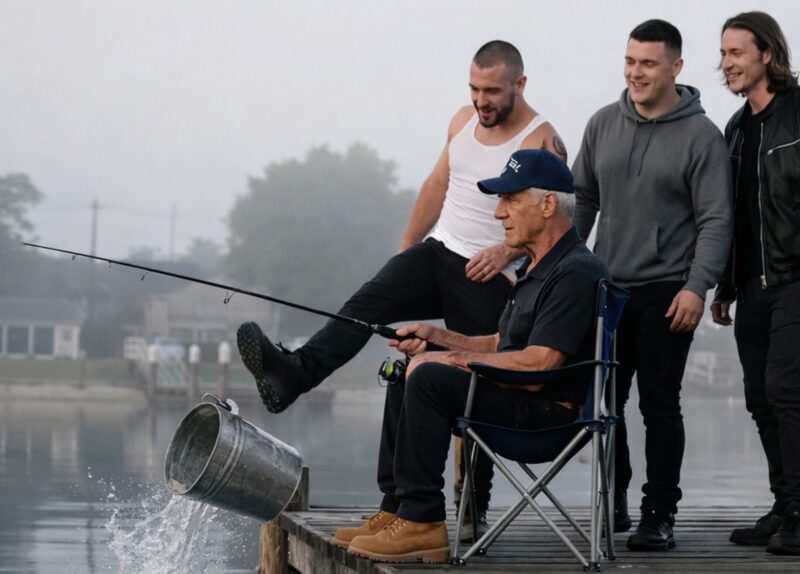
The morning was the kind that makes the world feel still. A cool mist drifted low over the surface of the lake, softening the edges of everything — the trees on the far bank, the color of the sky, the outline of a solitary figure seated at the end of an old wooden pier. An elderly man sat in a folding chair, fishing rod in hand, eyes fixed on the small float resting motionless on the water. Beside him, a metal bucket held a few fish he had already caught. He was in no hurry. He had nowhere else to be. This was his peace, and he wore it quietly.
The silence, as it often does, eventually broke.
Three young men came walking down the path toward the pier, talking loudly among themselves, laughing at things only they found funny. There was a particular kind of swagger in the way they moved — the careless confidence of people who had grown used to never being challenged, never being told no, never once being made to feel small. They spotted the old man immediately. And something about the sight of him — alone, unhurried, unbothered — seemed to irritate them.
“Hey, old man. You’re not from around here, are you?” one of them called out, smirking as he approached.
“Do you even know where you’re sitting?” added the second.
“This is our lake,” said the third, folding his arms with theatrical authority. “You want to fish here, you pay.”
The old man didn’t respond immediately. He slowly reeled in his line, checked it with the practiced patience of someone who had done this thousands of times, and only then turned his head slightly. His voice, when it came, was steady and measured — not defensive, not confrontational. Simply calm.
“The lake belongs to everyone,” he said. “It’s free. I have every right to be here.”
The young men exchanged glances and burst out laughing — the kind of laughter meant to humiliate, not to share joy.
“Did you hear that? He’s explaining our own rights to us,” one of them said, shaking his head in mock disbelief.
“I’ll say it one more time,” another said, his voice dropping to something harder. “Either you pay — or you leave.”
The old man turned back to the water. The float drifted gently. He said nothing.
And that silence — that absolute, unshakable silence — was what finally pushed them over the edge.
“Hey! We’re talking to you! Are you deaf?”
One of the young men stepped forward and kicked the bucket with full force. The metal rang out sharply against the still morning air. The bucket flew off the pier, fish and water scattering into the lake below. The ripples spread wide across the surface.
The old man didn’t flinch. He didn’t gasp. He didn’t even look at the bucket. He simply adjusted his grip on the rod and kept his eyes on the water — as though the three of them were simply weather passing through. Something that didn’t require his attention.
That response — or rather, that complete lack of one — was more unnerving to the young men than any anger could have been.
“Fine,” the closest one muttered, his voice low and dangerous. “Seems like he doesn’t understand words.”
He raised his fist and took a step forward with clear, deliberate intent.
What happened next was over before anyone could fully process it.
The old man stood up — not frantically, not in a panic — but with a precision and economy of movement that belonged to someone who had trained for decades. In one fluid motion, he caught the attacker’s outstretched arm, redirected it sharply, and the young man went down onto the wooden planks with a cry of shock and pain.
The second rushed forward. He received a short, controlled strike to the midsection that folded him in half, gasping.
The third stumbled backward, tried to turn and run, caught his foot on the edge of the planks, and splashed into the cold water below.
The old man stood straight. His breathing was calm. His expression had not changed. He looked down at the two on the pier and said quietly — almost gently:
“You still don’t know who you’ve messed with.”
One of them groaned and tried to push himself upright.
The old man let him get halfway there, then spoke again.
“I served in law enforcement for thirty years. I have dealt with men far more dangerous than you three will ever be.”
He took a single step forward.
That one step was enough. Neither of them moved again.
“Go home,” he said, his voice flat and final. “While you’re still able to walk out of here on your own.”
The arrogance was gone. The swagger, the laughter, the cruelty — all of it had evaporated in the space of a few seconds, replaced by something raw and honest: shame, confusion, and genuine fear. They looked at each other the way boys look at each other when they realize they have badly miscalculated.
Without a word, they left. Faster than they had come.
The old man returned to his chair. He sat down, picked up his rod, and looked back out over the water. The ripples from the fallen bucket had already faded. The mist still hung low over the lake. The float rested perfectly still on the surface.
As if nothing had happened at all.
There is something deeply moving about a story like this — not because of the confrontation itself, but because of what the old man represents. Dignity that doesn’t beg for recognition. Strength that doesn’t need to announce itself. A life lived with discipline and purpose, carried quietly into old age. He didn’t start the conflict. He didn’t escalate it. He simply held his ground — and when pushed beyond reason, he responded with exactly the force the situation required. No more, no less.
We live in a world that often mistakes loudness for power, and youth for invincibility. Stories like this are a reminder that true strength is earned over a lifetime — and that the most dangerous person in the room is very often the one you never saw coming.