Nobody expected her to stay. Nobody expected her to move. And absolutely nobody expected what happened next.
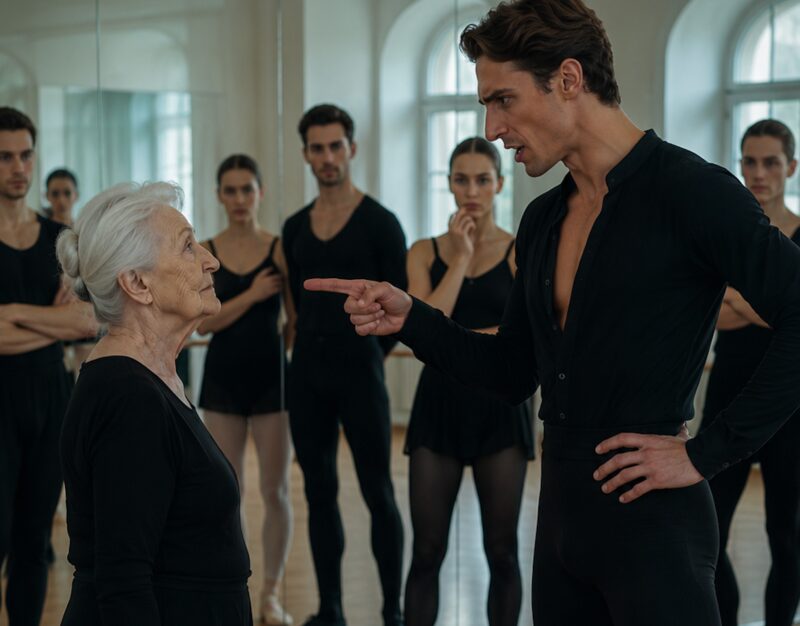
It was a morning like any other at one of the most respected ballet schools in the city. The large studio hummed with the familiar sounds of classical music, the soft thud of pointe shoes against hardwood floors, and the sharp, focused voice of Daniel — the school’s lead choreographer. Young, talented, and already building a reputation for excellence, Daniel was the kind of instructor students either loved or feared. He demanded perfection. He accepted nothing less. His classes were a serious environment, and everyone inside that studio understood it.
Dancers stretched at the barre. Some practiced turns with fierce concentration. Others worked through the mechanics of jumps, landing and rising again in a relentless cycle of repetition. Daniel moved through the room like a conductor, offering corrections with precision and authority.
“Higher leg.”
“Back straighter.”
“Again from the top.”
Then the door opened.
She stood in the doorway like she had every right to be there — because, as it turned out, she did. An elderly woman, somewhere around eighty years old, dressed in a black ballet practice dress, white tights, and neat ballet shoes. Her silver hair was pulled into a tight, elegant bun. She carried a small sports bag over her arm. Her posture was composed. Her eyes were calm.
For a brief moment, the entire room went still.
Then the whispers started.
Daniel crossed the floor and approached her with what he likely believed was professional concern. He told her, gently but firmly, that ballet was a serious physical discipline. That at her age, she risked injuring herself — her joints, her bones, her balance. He told her he couldn’t accept her into the class. That this was not a place for people like her.
“What kind of people?” she asked quietly.
He hesitated — but only for a second. Older people, he said. People who couldn’t stand on pointe, let alone complete turns or execute jumps.
That was when the laughter began.
It wasn’t loud, at first. A few smiles. A hand covering a mouth. A young dancer near the mirror shaking his head in disbelief. Someone muttered that she had probably confused the studio with a retirement club. Others laughed a little more openly. It was the kind of laughter that comes from a group of young people who have never been humbled — who believe that talent and ability belong only to the young.
The woman said nothing.
She simply placed her bag against the wall.
Then she walked to the center of the studio.
The room watched with a mixture of amusement and curiosity. Daniel asked what she was doing. She said she was going to show them something. She took her preparatory position.
Nobody laughed anymore.
Within seconds — within just a handful of breathtaking seconds — everything changed.
Her arms rose with a grace that seemed almost impossible. Every classical position she moved through was technically flawless. Her back remained perfectly straight. Her shoulders sat exactly where they should in classical ballet. There was not a single tremor of effort, not a single moment of hesitation. She moved as though the music were alive inside her body, as though decades had never passed.
Then she executed a series of turns.
The smirks disappeared completely.
She moved diagonally across the studio, each step light and deliberate and so precise that more than one student forgot to breathe. This was not the shuffling movement of an old woman out of her depth. This was artistry. This was mastery. This was something most of the young dancers in that room had not yet come close to achieving themselves.
And then came the moment that would live in that studio’s memory for years.
She stopped. She prepared herself. Slowly, deliberately — and then she executed a high grand battement. Her leg swept upward with a power and elegance that drew audible gasps from around the room.
Complete silence.
Then Daniel began to applaud.
One pair of hands. Then another. Then the whole studio was on its feet.
He walked toward her, and the embarrassment on his face was genuine and total. He apologized for everything he had said. She smiled and told him not to worry — that he had simply drawn his conclusions too quickly. Then he asked her who she was.
She told him she had begun studying ballet at the age of two.
She told him she had danced in the country’s leading theaters for nearly forty years.
And then she said her name.
One of the senior instructors, passing the open door at that exact moment, stopped dead in his tracks. He stared at her the way a person stares at something they never expected to see in real life.
“It’s really her,” he whispered.
Within moments, the recognition rippled through the room. Students who had laughed only minutes before now stood in something close to awe. Because standing before them was a woman whose name had once graced magazine covers, whose performances had sold out entire theaters, whose life had been given entirely and beautifully to the art of ballet.
She had not come to prove anything. She had not come out of spite or to embarrass anyone. She had simply come to dance — the same way she had always come to dance. With quiet dignity. With unshakable love for the art. With a lifetime of devotion that no amount of laughter could ever diminish.
Age had not taken her gift. If anything, it had deepened it.
And every single person in that room — especially Daniel — learned something that morning that no technique class could ever teach: true greatness does not have an expiration date.