The morning of the funeral was the kind of cold that settles deep into your bones. A heavy gray sky stretched over the old cemetery, bare tree branches swayed in the wind, and the damp earth — still soft from the night’s rain — clung to every shoe that walked across it. Nearly the whole village had come out that morning to say goodbye to a sixty-year-old farmer who had spent his entire life working the land with his hands and living by his word.
He was the kind of man people don’t make anymore.
Neighbors came because he’d sold them milk for years without ever shortchanging them. Former farmhands came because he’d treated them fairly. And some folks came simply because they respected a man who never pretended to be anything other than what he was — honest, hardworking, and quietly devoted to the life he’d built.
His wife stood closest to the coffin, her eyes swollen and red. Beside her, their adult son smoked in silence, turning away every now and then so the crowd wouldn’t catch the trembling in his jaw. The priest read his prayer in a low, steady voice. Women wept softly. The wind moved through the cemetery like it was paying its own kind of respect.
And then, from somewhere beyond the iron gates, came a sound that stopped everything.
A sharp, desperate neigh cut through the still morning air.
People turned. A few confused murmurs rippled through the crowd. And then — before anyone could fully process what they were seeing — a large dark-brown stallion came thundering through the cemetery gates, weaving between the headstones with a kind of frantic urgency that made several people stumble backward in shock.
It was Thunder. The farmer’s horse. His companion for nearly fifteen years.
The animal looked nothing like the calm, familiar creature the villagers had known. His eyes were wide and wild, his nostrils flared, and his wet mane was plastered against his neck. Several men immediately rushed forward to stop him, grabbing for the reins, shouting for others to help. But Thunder threw his head back violently, broke free every time, and let out a cry so raw and piercing it sent a chill straight through the crowd.
Someone yelled to get the horse out. Nobody could.
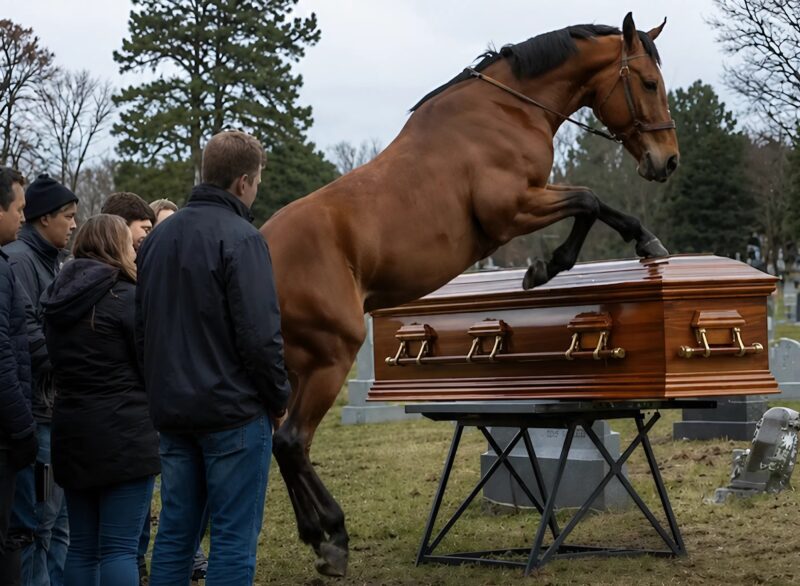
Thunder stopped abruptly right beside the coffin.
He began circling it, breathing hard, dropping his nose low to the polished wood lid. Sniffing. Circling again. Then he brought one hoof down — hard — against the top of the coffin.
The thud echoed across the cemetery.
People flinched. A woman whispered that the horse had lost his mind with grief. It seemed like the only reasonable explanation. But then Thunder struck the lid again. And again. Each blow harder than the last, each one more deliberate, as though the horse was trying to communicate something that no human in that crowd could yet understand.
Men grabbed at Thunder from every side, trying to pull him back, trying to reason with twelve hundred pounds of desperate animal. But he reared up on his hind legs and came down directly onto the coffin with both front hooves, pounding the lid with a force that made several people scream and jump back.
The wood began to crack.
One strike. Another. The cracks spread across the surface like a spider’s web.
And then — with a sound that silenced every voice in that cemetery — the lid split open.
For a long moment, nobody moved. Nobody spoke. Every person standing around that grave stared down into the coffin, and the color drained from their faces one by one.
Beneath the body of the farmer, wedged tightly underneath him, was a thick black bag sealed with layers of tape.
The farmer’s son went white as a sheet.
The men carefully lifted the body and pulled the bag free. When someone cut it open with a pocketknife, what spilled out caused the crowd to erupt in frightened, disbelieving murmurs.
Inside were thick bundles of cash, old folded documents, and several pieces of gold jewelry — pieces that had been reported stolen in a robbery at a jewelry store in a neighboring district not long before.
Police were called immediately.
The investigation that followed revealed a story far darker and more heartbreaking than anyone at that funeral had imagined. In the days before his death, the farmer had accidentally witnessed something he was never meant to see. The criminals responsible for the robbery had used his barn as a hiding place for the stolen goods, threatening to harm his entire family if he breathed a word to anyone.
He never did.
He carried that secret alone — terrified, trapped, and unable to protect his family any other way. A week later, the stress and fear caught up with him. He suffered a heart attack and died without ever telling a soul what he had seen, what had been hidden on his property, or the weight he had been forced to carry in silence.
But Thunder had been watching.
Night after night, the horse had seen his owner slipping out to the barn in the darkness, returning to that bag, living with a secret that was slowly destroying him. And when the day came that his owner was lowered into the earth — with that same bag, perhaps placed there by someone trying to bury the evidence alongside the only witness — Thunder knew.
He recognized the scent through the wood.
He did what his owner could not do.
After the police removed the evidence and the crowd slowly began to scatter, many people lingered near the grave, looking at Thunder in a way they had never looked at an animal before. The horse stood quietly beside the coffin now, calm and still, as though the urgency that had driven him through those gates had finally, mercifully, been released.
He had fought his way into that cemetery for one reason.
And he had not left until it was done.