Nobody noticed the way Gavin kept his eyes on that casket the entire time. While grown adults exchanged hushed condolences and dabbed their eyes with folded tissues, this little boy stood completely still in the back of the church, watching. Listening. Feeling something deep in his chest that every adult in that room had already decided to ignore. His mother was gone, they said. The doctors confirmed it. The paperwork was signed. The arrangements were made. And yet Gavin could not make himself believe it — not for a single second.
Sarah had been a warm, vibrant woman who filled every room she entered with laughter and light. She cooked big breakfasts with the windows open, sang along to the radio without caring who heard, and made her son feel like the most important person in the world every single day. Just one week before that awful afternoon, she had been perfectly fine. Then a sudden, mysterious illness brought her down fast, and before Gavin could fully understand what was happening, strangers in dark suits were directing him to a pew and telling him to sit quietly while they said goodbye to his mother.
His uncle Richard had taken charge of everything almost immediately. Richard was a man who always seemed more interested in the family’s financial affairs than in the people behind them. He pushed for a closed casket, a short service, and a fast burial. He told the family lawyer that Sarah had wanted something private and simple. Something about the whole arrangement felt deeply wrong to Gavin, but he was just a boy — and nobody was asking for his opinion.
When Gavin walked slowly down the center aisle toward the casket, Richard was on him in an instant, grabbing his arm and pulling him back with a firm, impatient hand. Gavin broke free. He stepped up close to the long wooden box draped in white roses and pressed his ear gently against the polished wood. What he heard next changed everything.
A soft tapping. Faint, desperate, unmistakable.
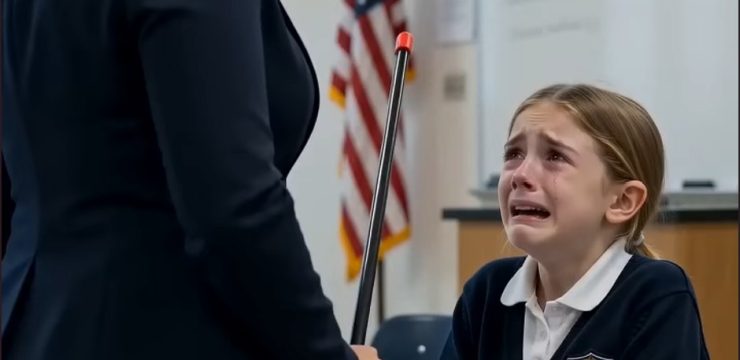
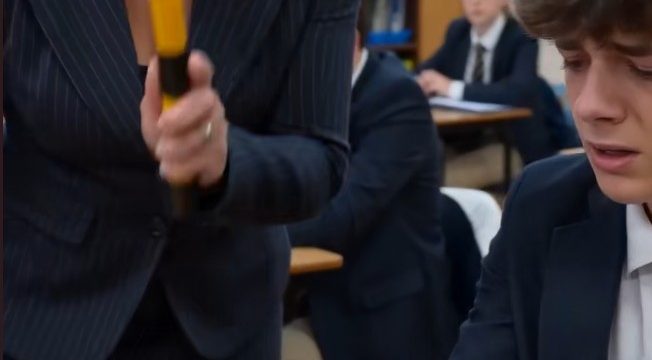
He stumbled back with his eyes wide and his voice cracking as he told everyone what he had just felt. The room erupted. Richard called it grief. He called it imagination. He waved over two security guards and told them to remove the boy before he could cause any more disruption. But Gavin had already made up his mind. He grabbed a heavy wooden post from a nearby flower stand and held it with both hands. His knuckles went white. His jaw was set. Every adult in that church saw a child on the edge — but what they were really looking at was someone who loved his mother more than he feared embarrassment or punishment.
He swung that post down with everything he had.
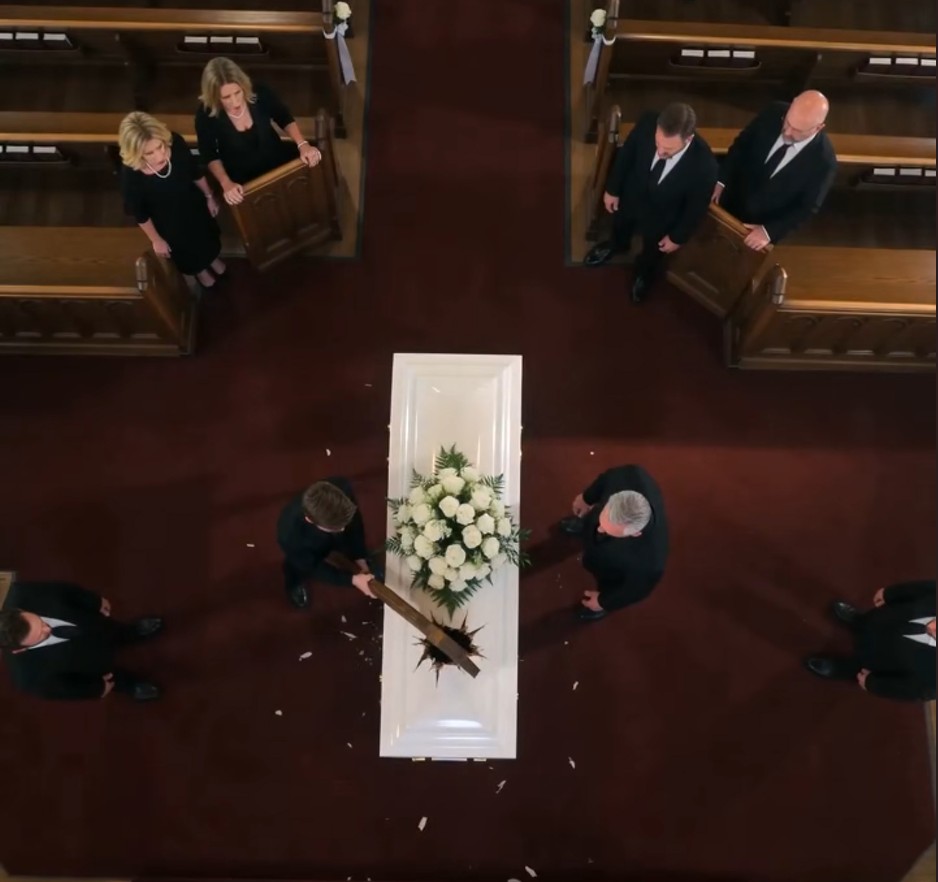
The impact echoed through the stone walls of the chapel like a thunderclap. Wood splintered. People screamed. Richard lunged forward in a fury. But Gavin swung again, and a long crack split the lid of the casket right down the center. The room fell into a stunned, breathless silence — and then everyone heard it. A scratching sound. Soft at first, then urgent and frantic, coming from directly beneath the broken wood.
A pale hand pushed through the shattered lid and reached toward the light.
The fingers trembled and grasped at the open air, and the entire church broke apart in shock and disbelief. Gavin dropped to his knees and grabbed his mother’s hand with both of his. He felt her squeeze back — weak, shaking, but real. Tears poured down his face as he pulled at the broken pieces with his bare fingers, calling out to her, telling her he was right there.
Strong men from the congregation rushed the platform and helped him pry the lid away completely. Sarah lay inside with her eyes open and her chest rising in shallow, desperate breaths. She was pale and disoriented, but she was alive. She was alive, and her son had refused to let anyone take her from him.
Paramedics arrived and quickly discovered a small empty medical bottle tucked inside the casket lining. The label identified it as a powerful sedative — one that could slow the heart and breathing to nearly undetectable levels, mimicking the appearance of death. Sarah, still weak but fully conscious, told the arriving officers that Richard had brought her a cup of tea just before she collapsed at home.
The family lawyer, standing nearby, confirmed what many had quietly suspected. Richard stood to gain full control over Sarah’s substantial estate if she died before her son came of age. He had arranged everything — the compliant private doctor who falsified the death certificate, the rushed funeral, the sealed casket — all of it designed to make sure no one looked too closely.
Richard was arrested inside the church, handcuffed in front of the family he had tried to betray, and walked out through the same doors he had planned to use to escape. The doctor who signed the false paperwork was arrested that same night. Both men faced serious charges. The family estate was secured. The legal records were corrected.
Sarah spent several days recovering in the hospital, but her strength returned steadily and completely. Gavin sat beside her every day, peeling oranges, holding her hand, and making her laugh the way she used to make him laugh. The town rallied around them. Neighbors brought food. Friends sent cards. The local newspaper covered the story, and people who had never met this family found themselves moved to tears reading about what a child’s love and stubbornness had accomplished.
Richard was eventually sentenced to twenty years in prison. The corrupt doctor received his own punishment. And on a warm, quiet afternoon not long after, Sarah stood in her front yard tending to her garden while Gavin tossed a ball across the green lawn, their dog racing joyfully behind it. Everything that had been taken from them was returned — their home, their safety, their future together.
Some people called Gavin a hero. He never thought of himself that way. He simply knew his mother, knew her laughter and her love, and knew in his bones that something was wrong when everyone else had already looked away. He was a boy who refused to say goodbye — and because of that, he never had to.