Time didn’t just slow down in that crowded courthouse lobby. It completely stopped.
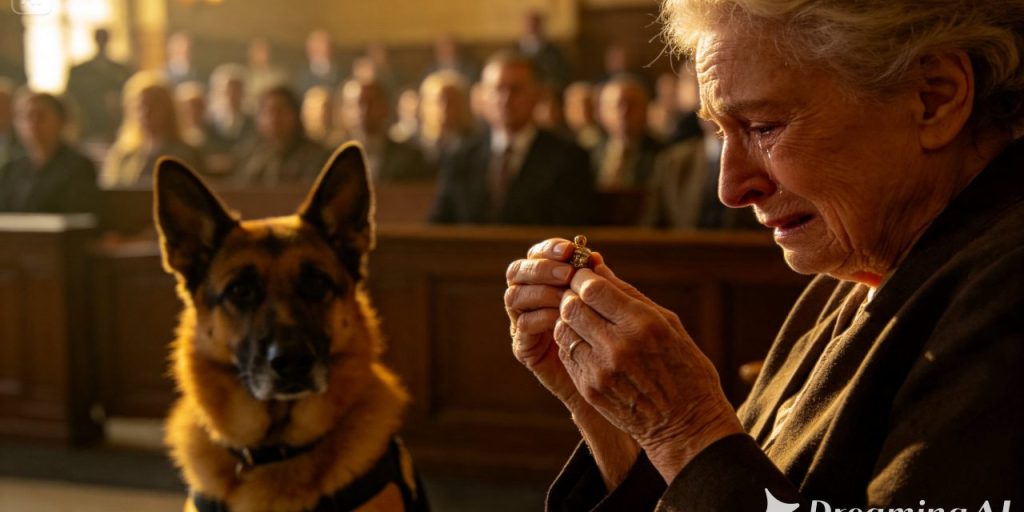
The chaotic morning rush — the buzzing metal detectors, the sharp clacking of dress shoes against polished marble, the echoing voices of frustrated attorneys — all of it faded into a thick, suffocating silence. All I could hear was the heavy, rhythmic panting of my K9 partner, Buster. All I could feel was the icy sweat prickling the back of my neck beneath my stiff collar.
I stared down at the elderly woman’s lap, my mind violently rejecting what my eyes were registering.
Resting on the faded floral fabric of her dress, beneath her trembling, age-spotted hands, was a thick, transparent plastic pouch. Not just any pouch. It was a standard-issue, tamper-proof county police evidence bag. And inside that bag was a charred, heavily damaged piece of a child’s stuffed rabbit, entangled with a blue-coated detonator wire.
My lungs forgot how to breathe.
I knew that wire. I knew that burnt stuffed animal. More importantly, I knew exactly why Buster had locked into a dead, silent sit — because he was trained to detect explosive compounds. Even sealed in plastic, a dog with his elite capabilities could catch the microscopic chemical traces clinging to the fabric like a ghost.
But Buster alerting to explosive residue wasn’t what made my blood freeze solid.
It was the bright yellow evidence tag stapled to the top of the bag. I didn’t need to lean in to read it. The black ink on that tag was my own handwriting. My badge number. My signature. Date of collection: exactly nine years ago. Case number: 884-Bravo. The Midland Bank bombing — the worst domestic terror incident in our county’s history, leaving three innocent people dead and tearing this community apart.
That specific evidence bag was supposed to be locked in the deepest, most restricted vault of the county evidence lockup three miles away. It was the crucial forensic piece that had supposedly been destroyed in a tragic basement flood six years ago — a flood that had conveniently crippled the defense’s appeal and shut the door on any further investigation.
Yet here it was, sitting in the lap of a sobbing grandmother in a public courthouse.
“Ma’am,” I whispered, dropping to one knee, my body shielding the bag from the forty-odd people swarming around us. “Where did you get this?”
She looked at me, her eyes swimming in fresh tears. “They told me it was gone,” she whispered. “They looked me in the eyes and swore to God it was destroyed.”
Nine years ago, a man named Arthur Pendelton had been arrested for the Midland Bank bombing. The trial was swift, brutal, and heavily publicized. Arthur was convicted and sentenced to life without parole. Looking at this woman’s face — the soft jawline, the slope of her nose, those deep brown eyes — I realized who she was.
“You’re Arthur’s mother,” I said, the words tasting like ash.
She nodded. “He didn’t do this. He would never hurt anyone. He was just a janitor at that bank.”
During the trial, Arthur’s defense attorney had demanded an independent chemical analysis of this exact evidence bag, screaming from the rooftops that the explosive residue didn’t match the compound used in the actual bombing. The very next morning, the police department announced a sudden pipe burst had completely destroyed the evidence. The most convenient plumbing disaster in the history of local law enforcement.
Looking at the perfectly dry, pristine bag in her hands, the terrifying truth hit me like a freight train.
There was no flood. There was no accident. The evidence had been deliberately stolen and hidden by someone wearing the exact same badge I wore on my chest.
She reached into her cardigan pocket and pulled out a folded piece of white printer paper. A note that had arrived with the package that morning. I unfolded it carefully, keeping it low from prying eyes.
Printed in blocky black letters: THEY LIED. TAKE THIS TO THE COURTHOUSE TODAY. GIVE IT TO THE K9 HANDLER WITH THE GERMAN SHEPHERD. HE IS THE ONLY ONE WHO DOESN’T KNOW THE TRUTH.
Someone knew the cover-up. Someone knew my exact patrol schedule and knew I would be running security sweeps in this lobby on this specific morning.
Before I could process another thought, the heavy metal door of Interview Room B rattled violently behind me. We had barely made it to safety before Captain Harris — the Chief of Detectives, my commanding supervisor nine years ago, the very man who had sworn under oath that this evidence was destroyed — was pounding on the door, demanding entry.
I had hidden the evidence bag inside Buster’s tactical K9 harness. Nobody touches a working police dog without the handler’s explicit permission. Even a corrupt captain wouldn’t dare reach for a hundred-pound trained attack dog.
Harris searched the room. He found nothing. But when he attempted to detain Mrs. Pendelton without probable cause, I stood my ground — loudly, deliberately, in earshot of the courthouse bailiffs. He was trapped by the public setting. He had no legal excuse to hold us.
As we escaped into the parking garage, Detective Miller — Harris’s enforcer — cornered us with his hand resting on his unholstered weapon, demanding we surrender the purse. I realized in that exact moment they were never going to let this go to trial. They intended to silence us both permanently and bury the evidence forever.
I dropped Buster’s leash and gave the command.
A hundred pounds of trained German Shepherd covered the distance in a fraction of a second. Miller’s weapon clattered to the concrete floor. His screams echoed through the empty garage.
A former investigative journalist named Marcus, the only reporter who had ever dared question the police narrative nine years ago, arrived within minutes and drove us directly to the FBI field office downtown.
An FBI Special Agent named Reynolds examined the evidence bag and immediately recognized it. He identified the anonymous sender as a dying evidence custodian named Sergeant Gable — the only man with access to the sub-basement vault — who, on his deathbed, had finally chosen conscience over corruption.
Harris had accepted a half-million-dollar bribe from a local organized crime syndicate to frame an innocent janitor for a bombing he had nothing to do with. He had used a rookie handler — me — to plant the final nail in Arthur Pendelton’s coffin. I had trusted my superior. I had followed orders. I had been a weapon aimed at an innocent man.
Captain Harris was arrested at his home in the early morning hours, dragged onto his manicured front lawn in handcuffs, surrounded by news crews. Detective Miller, from his hospital bed with a fractured arm, turned state’s evidence and confessed to everything. The entire corrupt empire collapsed in less than two days.
One week later, I stood outside the iron gates of the state penitentiary as Arthur Pendelton walked into the sunlight — thin, grey-haired, his face lined with nine years of stolen life. His eyes, deep and overwhelmingly kind, identical to his mother’s.
She dropped her flowers and ran to him. He collapsed to his knees, wrapping his arms around her as if she were the only thing tethering him to the earth.
Nine years of darkness. Wiped away by a dying man’s guilt and a loyal dog’s nose.
I resigned from the county police department that same afternoon. I couldn’t wear the badge any longer. But I didn’t leave the fight. The FBI offered me a position with their federal anti-corruption task force — and they specifically requested that Buster come with me.
We were a package deal. The handler who finally saw the truth, and the dog who was never afraid to bite the hand that fed him, as long as it meant protecting the innocent.