It was the second week of September, and the Texas heat was absolutely merciless. The thermometer outside my clinic window read ninety-six degrees, but the humidity made it feel like breathing through a hot, wet towel. As the school nurse at our small elementary school, my morning had already been a revolving door of dehydrated kids, bloody noses, and dizzy spells.
I was wiping down the examination cot when the heavy wooden door burst open.
Mrs. Gable, a second-grade teacher, stood in the doorway with sweat on her forehead and frustration written all over her face. Behind her, practically being dragged by the wrist, was a tiny seven-year-old girl in a bright yellow summer dress covered in little white daisies. And on her head — pulled down so low it nearly covered her eyebrows — was a massive, thick, dark grey winter beanie. Not a cute fashion accessory. The kind of heavy, fleece-lined wool hat you wear shoveling snow in a blizzard.
In ninety-six-degree heat.
“She’s been wearing it since she got off the bus,” Mrs. Gable said, exasperated. “She won’t take it off. She nearly had a breakdown when I tried to remove it at recess.”
The child — her name was Emily — immediately gripped the edges of the beanie with both hands, her knuckles turning white.
I told Mrs. Gable I had it from there and crouched down to Emily’s level.
Up close, the situation looked far more alarming. Her face was flushed a blotchy, dangerous red. Sweat soaked the collar of her yellow dress. Her breathing was rapid and shallow. The digital thermometer confirmed what I feared — her temperature had already climbed to 100.4 degrees, purely from the trapped heat baking against her head.
“Emily, you can keep the hat on,” I promised her gently, holding both hands up in surrender. “But I have to cool you down somehow.”
She gave me the tiniest, most reluctant nod.
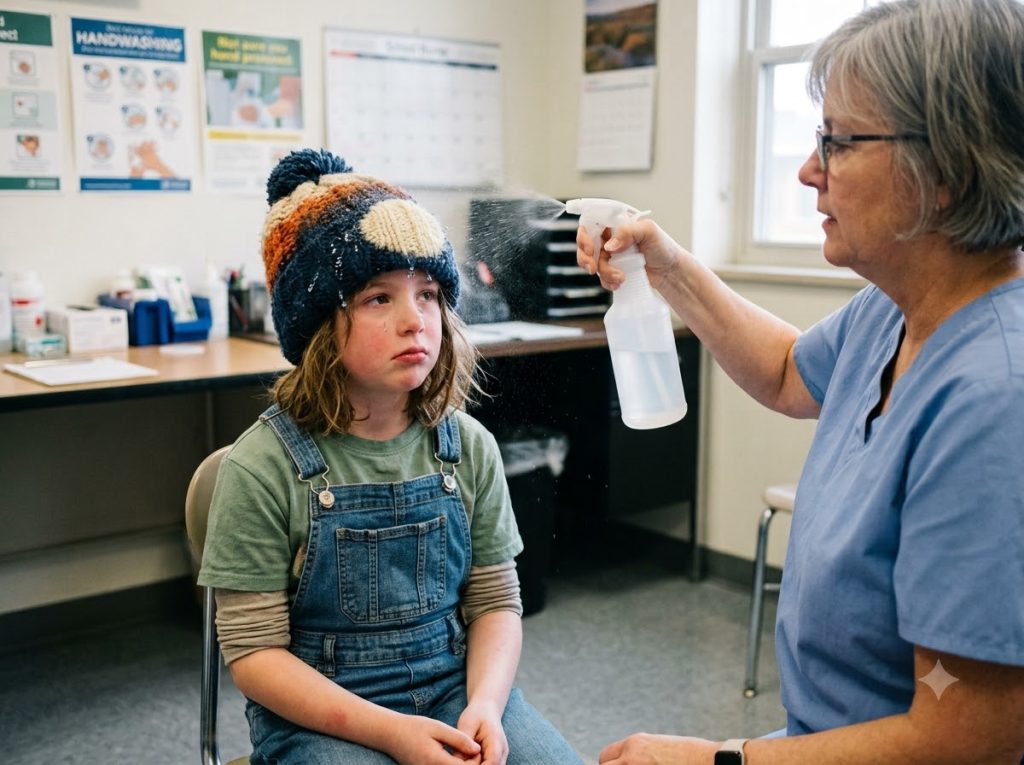
I filled a plastic misting bottle with ice-cold water and began spraying her face and neck. She exhaled shakily as the cool water hit her skin. Then I aimed the mist at the wool hat itself.
That’s when everything changed.
The dark grey wool turned a deep, wet charcoal as the water soaked in — everywhere except one perfect, half-dollar-sized circle just above her left ear. The water beaded up on that spot and rolled right off, as if the fabric had been chemically treated to repel moisture. I leaned in closer. The wool fibers in that circle were fused together, stretched taut over something rigid and domed underneath.
I pressed my fingertip gently against the spot.
It was rock hard. Not scalp. Not hair. Cold and unyielding, like metal.
A sickening click echoed in the quiet room.
Emily’s scream nearly stopped my heart.
She scrambled onto the cot, pulling her knees to her chest, clamping her hands over the hat with sheer terror.
“You pressed the button!” she wailed. “It’s going to spill! The red stuff is going to spill and burn me!”
I forced myself to stay calm despite every instinct in my body telling me to panic. Twelve years as a pediatric nurse had taught me that visible control was the only anchor a terrified child had in moments like these.
The clinic phone rang. The caller ID read: EMERGENCY CONTACT — FATHER.
He was calling less than three minutes after I had pressed that spot.
I answered. The voice on the other end was flat, unhurried, and deeply chilling. He identified himself as Arthur, Emily’s father. He told me I had voided his prototype. He explained, in clinical terms, that the device contained a thermal-reactive chemical compound that would activate upon contact with body heat. He told me the thick black wire I would find snaking down the back of her neck was connected to a secondary fail-safe. If the hat was lifted more than two inches, it would send an electrical current directly into her upper spine.
Then he hung up.
I used trauma shears to carefully cut a small triangle in the wool over the rigid spot. Beneath the fabric was a brushed steel cylinder, zip-tied directly into her hair, holding a small glass vial filled with thick, dark red liquid. The vial was cracked. The resin had already begun to ooze, hissing faintly as it made contact with her scalp. A small red LED light inside the casing blinked steadily.
The principal burst through the door before I could stop him, demanding she remove the hat. He grabbed it.
One hard pull was all it took.
The wire snapped taut. A mechanical click. The LED went solid red.
Emily’s body arched violently. She seized. White foam formed at the corners of her lips. Her heels drummed against the metal frame of the cot.
Principal Henderson staggered backward, hands trembling, finally understanding what he had done.
I cut the remaining zip-ties with the trauma shears, scooped the entire burning apparatus into the steel sink, and threw on the cold water faucet. I threw my body over Emily to shield her.
The countdown hit zero.
Instead of an explosion, an industrial incendiary compound inside the black battery pack melted everything — GPS trackers, circuit boards, hard drives — destroying all evidence of Arthur’s technology. It burned straight through the stainless-steel sink and set the floor tiles on fire. The sprinklers triggered. The fire alarm screamed. Police stormed the clinic seconds later.
Emily survived. Severe burns to her scalp, electrical trauma to her nervous system, and a raw, bleeding wound on her back where the device had been taped to her spine. But she was alive.
What the detective told me in the hospital waiting room hours later was the detail that broke me completely.
Emily’s mother had not gone away, as Arthur had told the school. She had been locked in a soundproofed basement room for three years, wearing the original prototype — a steel collar permanently fused to her neck and jaw by the same chemical resin. Arthur Gable, a former aerospace engineer who had unraveled into profound obsession and cruelty, had forced Emily to witness the first device fail on her own mother. That was why the little girl had worn a thick winter beanie in a Texas heatwave without a single word of complaint. She knew exactly what the red stuff did.
She had already seen it.
Both mother and daughter were admitted to the same hospital that night. When I finally walked into Emily’s room in the pediatric ICU, Clara Gable was already sitting beside her daughter’s bed in a pale blue hospital gown, her neck and jaw heavily bandaged where surgeons had removed the collar. Emily’s small hand was locked tightly inside her mother’s.
They held on to each other as if the whole world had finally gone quiet around them.
I stood in the doorway of that hospital room, listening to the steady heartbeat on the monitor, and I thought about what it means to trust someone with your life when every instinct tells you the danger is real.
Emily had trusted me.
And I was so grateful I had not let her down.