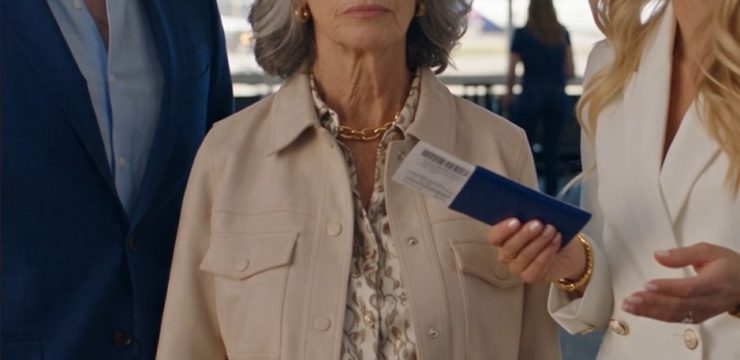
The doors to the ballroom were ten feet away when a hand closed around her arm — and a voice she’d known her entire life said the one thing that could make a decorated officer’s blood run cold.
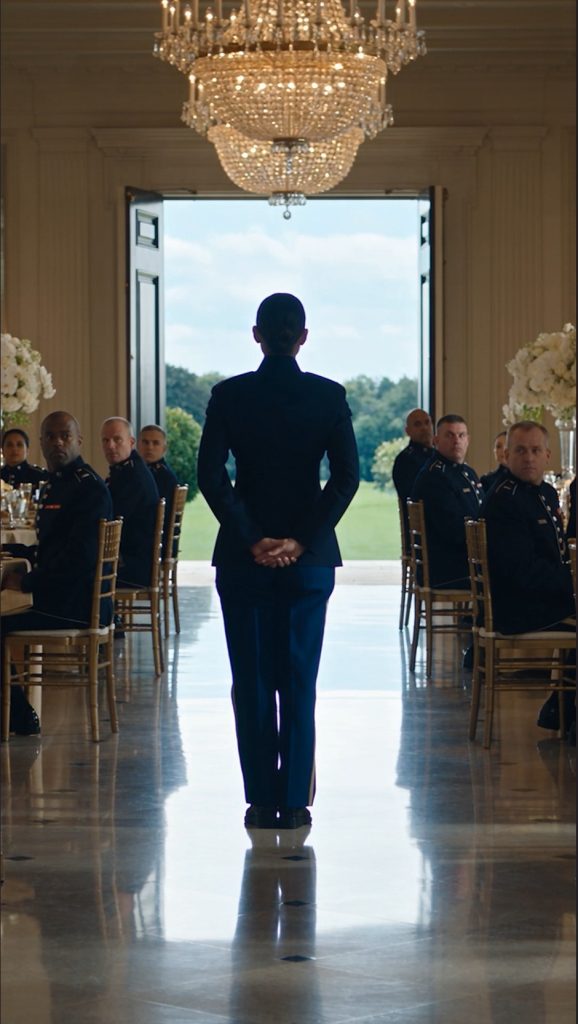
“That uniform means nothing in there.”
She didn’t flinch. Thirteen years in the Navy had trained that reflex out of her long ago. But something behind her ribs cracked — quiet, irreparable — the way metal fractures under pressure nobody ever sees.
Douglas Hale stood between his eldest daughter and the entrance to his youngest daughter’s wedding, his jaw set, his tuxedo immaculate, his eyes carrying the particular kind of shame that only surfaces when someone you love refuses to be small enough to fit your story.
Eight months. That’s how long Rebecca had been deployed overseas. Eight months of encrypted calls she couldn’t make, letters she couldn’t send, silence that stretched across oceans. And she had come home for one reason only — a promise whispered to Madison before she shipped out.
I’ll be there. No matter what.
But her family had never wanted all of her. They wanted the version that was easy to explain at dinner parties. At Thanksgiving, her father told relatives she “handled computer stuff for the Navy.” Nobody corrected him. Nobody asked what she actually did. Nobody wanted to know.
That afternoon, he’d watched her unzip the garment bag in the guest room and stared at the dress blues inside like they were something contagious.
“This day needs to stay elegant,” he said carefully. “Grant’s family moves in different circles.”
She found Madison in the bridal suite, tulle and nerves and borrowed pearls. Their eyes met in the mirror.
“Do you want me here?”
The silence lasted three seconds. Maybe four. But Rebecca had spent years reading silences in rooms where hesitation got people killed — and her sister’s pause told her everything.
“I just want today to go smoothly.”
That was the answer. Not yes, I need you. Not of course, you’re my sister. Just — smoothly. Like Rebecca in uniform was a wrinkle that needed pressing out.
She understood then, with a clarity that settled like ice water in her chest, exactly what her family wanted. Rebecca the sister could attend. Rebecca the officer needed to disappear.
She didn’t argue. She didn’t raise her voice.
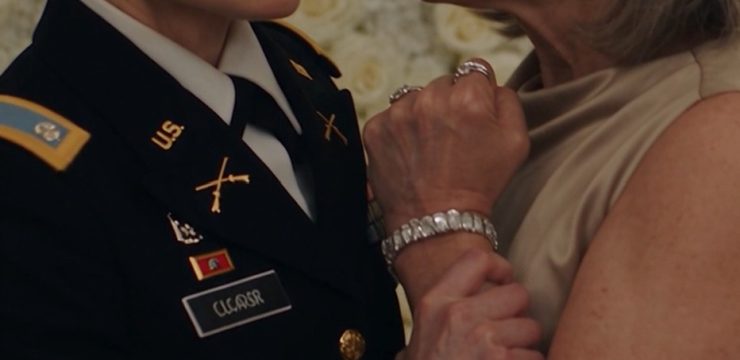
She put on the uniform anyway.
The ballroom at the Bellmere Country Club was all candlelight and white roses and the low hum of people performing wealth. When she stepped through the doors, the hum dimmed. Conversations thinned. Heads turned — not dramatically, but enough. The way a room shifts when something enters that wasn’t part of the script.
Her father was two steps behind her, smile stitched back on, already calculating damage control. But Rebecca wasn’t looking at him anymore. She was looking at the room — really looking — and what she saw made her breath catch.
Navy dress blues at table nine. A Marine dress uniform near the bar. Two retired officers seated beside the groom’s grandmother, their posture knife-straight, the kind of stillness that only comes from decades of standing at attention.
Her father hadn’t noticed any of them.
He leaned close, his whisper sharp against her ear. “Rebecca. I mean it.”
She kept walking.
The string quartet played something soft and forgiving. Guests shifted in their chairs. And halfway down the aisle, an older man in full formal dress uniform — medals catching the chandelier light, silver hair trimmed regulation-close — looked directly at her.
His eyes held hers for one long, unmistakable second.
Then he pushed back his chair, rose to his feet, and the entire room went silent.
Then another chair moved. A woman at table nine — Navy dress blues, lieutenant commander insignia — stood without a word. Then the Marine near the bar set down his glass and rose. Then both retired officers beside the groom’s grandmother pushed back from their seats, slow and deliberate, the way men stand when protocol isn’t a formality but a conviction.
Five people. Then seven. Then eleven.
Every service member in that ballroom was standing.
Not for the bride. Not for the ceremony. For her.
Rebecca’s throat closed. Her vision blurred at the edges. Thirteen years she had carried herself through deployments, through briefings in rooms without windows, through nights when the silence on a ship felt heavier than the ocean beneath it — and not once had she broken. But this — this quiet act of recognition from strangers who understood what the uniform cost — nearly undid her right there in the aisle.
Douglas Hale stopped walking.
His mouth opened slightly, then closed. He looked around the room the way a man looks around when the ground he was standing on turns out to be someone else’s floor. His rehearsed smile collapsed into something raw and unguarded — confusion first, then the slow, terrible dawning of a man realizing he had been wrong in front of everyone who mattered.
The older man — the first to stand — stepped out from his row. His medals clinked softly as he moved. He stopped in front of Rebecca, and the chandelier light caught the silver eagles on his shoulders.
“Captain Harold Moreau,” he said quietly. “Retired. Thirty-one years.” He extended his hand. “It’s an honor.”
Rebecca shook it. Her fingers trembled, but her grip held.
“Lieutenant Commander Rebecca Hale,” she said. “Thirteen years. Still serving.”
Captain Moreau’s gaze shifted — briefly, precisely — to Douglas, who stood frozen six feet behind her. The old captain said nothing. He didn’t need to. The look carried the weight of a verdict delivered without a single word spoken.
Then Moreau turned back to Rebecca and said, just loud enough for the nearest tables to hear: “Your father should know — Grant’s grandfather served on the USS Coral Sea. Nineteen sixty-eight. We were on the same carrier.”
A murmur rippled through the room.
Rebecca turned slowly toward her father. “You told me Grant’s family moves in different circles.”
Douglas said nothing. His face had gone the color of old paper.
From the bridal suite doorway, Madison appeared. She had been watching. How long, Rebecca couldn’t tell — but her sister’s mascara was streaked, and her bouquet hung loose at her side, white peonies trembling against her wrist.
“Becca,” Madison whispered.
Rebecca looked at her.
“I should have said yes,” Madison said. Her voice cracked on the last word. “When you asked if I wanted you here. I should have just said yes.”
The room held its breath.
Rebecca crossed the distance between them in three steps. She didn’t say it’s okay — because it wasn’t, not yet, not entirely. But she took her sister’s hands and held them, and Madison let out a sound that was half laugh, half sob, and pressed her forehead against Rebecca’s shoulder, careful not to crush the ribbons on her chest.
“You came anyway,” Madison breathed.
“I promised.”
Behind them, Grant appeared from the side entrance in his tuxedo. He took one look at his bride crying against her sister’s uniform and didn’t ask a single question. He walked to Captain Moreau, shook his hand, and said: “My grandfather would have wanted to be here for this.”
Moreau nodded. “He was a good man. She would have made him proud.”
Grant looked at Rebecca. “She makes all of us proud.”
Douglas Hale stood alone near the last row of chairs. Nobody had moved toward him. Nobody had spoken to him. The isolation wasn’t cruelty — it was simply the natural consequence of a room full of people who understood something he had spent years pretending didn’t exist.
His eldest daughter served. His eldest daughter sacrificed. And he had tried to make her hide it so the napkins would match the narrative.
He looked down at his shoes. Polished. Expensive. Perfectly appropriate for a man who had always cared more about the surface of things.
When he finally looked up, Rebecca was watching him.
She didn’t glare. She didn’t accuse. She just stood there in her dress blues, her sister’s hand still in hers, and waited — the way she had always waited — for her father to see her.
All of her.
Douglas took one step forward. Then another. His throat worked silently. When he reached her, his chin was trembling in a way she had never seen before — not at funerals, not at goodbyes, not even the day her mother left.
“I didn’t —” His voice broke. He tried again. “I didn’t know how to be proud of something I couldn’t understand.”
It wasn’t an apology. Not yet. But it was the first honest sentence he had spoken to her in thirteen years, and they both knew it.
Rebecca released Madison’s hand. She looked at her father — really looked — and saw not the man who had blocked the door, but the man behind that man: the one who was terrified that his daughter had chosen a life he couldn’t protect her from, and had turned that fear into something ugly because he didn’t know what else to do with it.
“You don’t have to understand it, Dad,” she said quietly. “You just have to stop being ashamed of it.”
Douglas’s face crumpled. Not dramatically — not the way it happens in movies. Just a slow unraveling, like a knot that had been pulled too tight for too many years finally letting go. His hand came up, hovered near her shoulder, uncertain — then landed, gently, on the gold insignia he had never once acknowledged.
“I’m not,” he whispered. “Not anymore.”
The string quartet began to play again. Guests slowly returned to their seats. Captain Moreau caught Rebecca’s eye from across the room and gave her one small, quiet nod — the kind of gesture that carries no ceremony, only respect.
The wedding continued. Madison walked the aisle with mascara-streaked cheeks and a bouquet she nearly forgot to carry, and when the officiant asked who gives this woman, Grant’s mother stood — and so did Rebecca.
Madison turned, surprised.
Rebecca smiled. “You didn’t think I flew eight thousand miles just to sit down, did you?”
Laughter broke through the room like sunlight through storm clouds, and for the first time all day, every person in that ballroom was breathing the same air.
Later that evening, after the toasts and the cake and the first dance, Rebecca stepped onto the terrace alone. The Virginia night was warm and thick with honeysuckle. She leaned against the railing and let the quiet settle around her like something she’d earned.
Footsteps behind her. She didn’t turn.
Douglas came to stand beside her. He didn’t speak for a long time. They watched the fireflies drift across the manicured lawn, two people learning how to share a silence that wasn’t filled with pretending.
“Your mother would have stood up too,” he said finally. “The second you walked in. She wouldn’t have even hesitated.”
Rebecca’s eyes burned. She blinked it away, but not fast enough.
“I know,” she said.
He reached into his jacket pocket and pulled out a small, creased photograph — yellowed at the edges, soft from years of handling. He held it out without looking at her.
Rebecca took it. In the photograph, a young woman in Navy whites stood on a flight deck, wind whipping her hair, laughing at something just off-camera. On the back, in faded ink: Lieutenant Junior Grade Catherine Hale. USS Eisenhower. 1987.
Rebecca stared.
“Mom served?”
Douglas nodded slowly. “Two years before you were born. She made me promise never to tell you. She was afraid —” His voice caught. “She was afraid you’d follow her. And when you did anyway, I didn’t know how to forgive either of you for it.”
Rebecca pressed the photograph to her chest with both hands and closed her eyes. The honeysuckle, the fireflies, the distant sound of her sister laughing inside — everything collapsed into this single, impossible, beautiful truth.
She hadn’t followed a stranger’s path.
She had followed her mother’s.
Douglas put his arm around his daughter’s shoulders — awkwardly, unpracticed, the way a man holds something precious that he is only now learning not to break — and Rebecca leaned into him.
They stood like that for a long time, the photograph between them, the music drifting from inside, the night holding them both in a kind of grace that neither had earned but both, finally, were ready to accept.