The folder was already open when I realized something was terribly wrong.
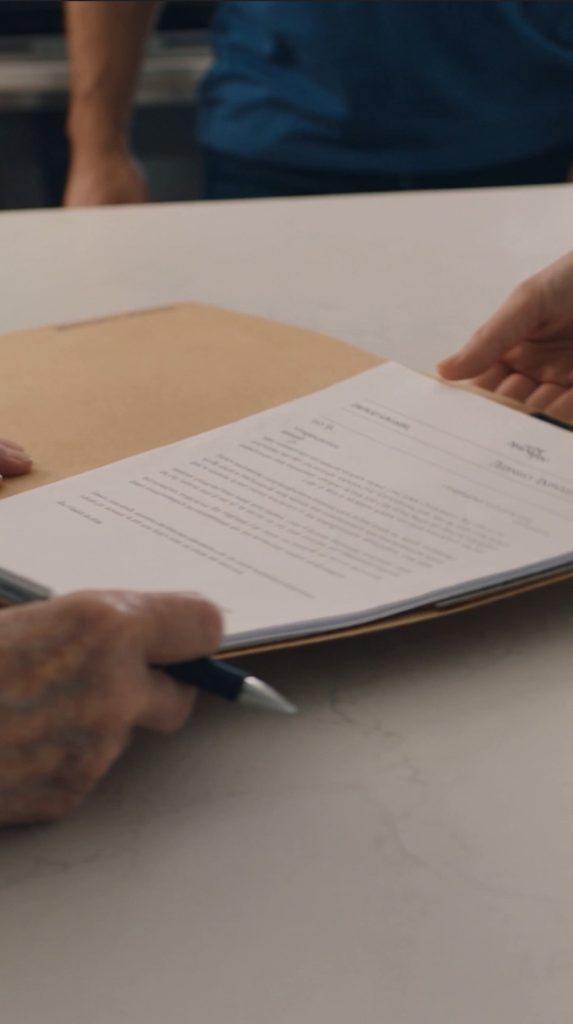
One sentence buried beneath pages of harmless-looking paperwork made my stomach tighten: if I signed, my son would have authority over my finances.
For several seconds, I didn’t move.
My daughter-in-law sat across from me at the kitchen table, watching quietly. Only moments earlier, she had slid the thick folder toward me with an easy smile, as though we were discussing insurance forms or a routine doctor’s appointment.
“These forms will make everything easier,” she had said.
Easier.
The word echoed differently now.
I looked back down at the page, reading the language again slowly, hoping I had misunderstood it. The folder was filled with documents that looked official, dense with small print, signatures, initials, and legal wording.
Most of it appeared medical.
But this wasn’t.
This page went further.
Much further.
My fingers rested against the edge of the paper while an uncomfortable silence settled over the kitchen. I could hear my son shifting in his chair nearby, but I kept my eyes on the document.
Something inside me had changed.
Only minutes before, I had trusted that the paperwork was exactly what I’d been told it was. Now every page suddenly felt different.
I closed the folder.
Not angrily. Not dramatically.
Just carefully.
Then I lifted my eyes and looked directly at my daughter-in-law.
“My lawyer will review this first.”
The room seemed to tighten around those words.
My son looked up immediately.
His face carried the kind of surprise that cannot be rehearsed—the quick widening of his eyes, the slight pause before he spoke.
“What lawyer?”
I turned toward him.
There was something about his reaction that unsettled me almost as much as the document itself. He didn’t look irritated that I wanted legal advice.
He looked confused.
I opened the folder again and turned the suspicious page toward him.
My finger came down beside the section that had stopped me cold.
“Why does this give you control of my money?”
For a moment, he simply stared at me.
Then his attention dropped to the page.
He reached across the table and took it from my hands.
I watched his eyes move across the wording once.
Then again.
His expression slowly changed.
The confusion didn’t disappear.
It hardened into something else.
Alarm.
He leaned closer to the document, as though reading it from a different angle might somehow change what it said. His jaw tightened. The easy atmosphere that had existed before the folder appeared was gone completely.
I looked from him to his wife.
She remained across the table.
Suddenly, nobody seemed to know what to say.
My son continued reading, and I could almost see the moment the meaning finally settled in.
Whatever he had expected to find inside those papers, this wasn’t it.
His eyes lifted from the page.
But he didn’t look at me.
He looked at his wife.
There was a question in his face before he ever spoke. A sharp, wounded confusion that made my chest tighten.
He raised the document slightly between them.
“You told me these were medical forms.”
The silence afterward felt heavier than everything that had come before it.
I watched my daughter-in-law’s face, waiting for her answer, while my son held the page in his hand as though it had suddenly become evidence of something none of us fully understood yet.
And in that moment, I realized I wasn’t the only person at that table who had been kept in the dark.
Nobody in that kitchen was prepared for what came next. 👇
Her lips parted, but no answer came.
My son lowered the page slowly. “Did you know this was in here?”
She glanced at me, then back at him. “It’s not what you think.”
His chair scraped hard against the floor as he stood. “Then tell me what I’m supposed to think.”
She reached for the folder.
I put my hand over it first.
The movement was small, but all three of us froze. Her fingers stopped inches from mine. For the first time since she had walked into my kitchen, the calm expression on her face disappeared.
“I said my lawyer is going to see it.”
My son looked down at the remaining papers. He began turning them over one by one, faster now, no longer trusting the headings. Medical release. Emergency contact. Health-care proxy. Then another financial page appeared beneath them.
He stopped.
At the bottom was a signature.
Mine.
Except I had never signed it.
The blood seemed to leave his face.
“Mom?”
“I didn’t sign that.”
His wife stood so quickly her chair tipped backward.
“It was a draft,” she said. “It doesn’t mean anything.”
My son stared at her. “A draft with my mother’s signature?”
“It was copied from another form. I was trying to save time.”
The room went completely still. I could hear the refrigerator humming behind me and the faint ticking of the clock above the sink.
My son looked at her again. “What else did you do?”
She shook her head. “Nothing.”
He didn’t blink.
“What else?”
Her eyes filled, but she looked away.
That was the answer.
I picked up my phone and called my lawyer.
My daughter-in-law whispered, “Please don’t.”
For one terrible second, I wanted to stop. Not because I believed her, but because I saw my son standing there with his marriage breaking apart in front of him.
Then I looked at the false signature again.
I pressed call.
My lawyer told me not to sign anything, not to let the folder leave my possession, and to contact my bank immediately. He asked us to photograph every page.
While my son was taking pictures, a folded sheet slipped from the back pocket of the folder and landed near his shoe.
He picked it up.
It was an email printout.
He read the first few lines, and his breathing changed.
The email described what would happen once the authorization was signed: access could be established immediately, funds could be moved, and account management could begin without waiting for medical incapacity.
At the bottom was a reply from my daughter-in-law.
How soon after signing can transfers be made?
My son closed his eyes.
When he opened them again, he looked at her with a quiet that frightened me more than shouting would have.
“Why?”
She began crying then.
“There’s debt.”
My son didn’t move. “What debt?”
“Credit cards. Loans.”
“How much?”
She looked down.
“More than we can pay.”
He stepped backward as if she had struck him.
She said she had borrowed to cover older borrowing, then borrowed again. She said she had panicked. She said she never meant to hurt me.
Then she said the sentence that changed everything.
“I thought once we got access, I could replace it before she noticed.”
My son stared at her.
“You were going to steal from my mother.”
“I was going to put it back.”
“You forged her name.”
“I was scared.”
“And you lied to me so I’d bring the papers here.”
She reached for him.
He stepped away.
That tiny movement broke something in her face.
My lawyer arrived less than an hour later. He sat at the same kitchen table, put on his glasses, and read every page. When he reached the copied signature, he stopped.
“This needs to be reported.”
My son sat with both hands locked behind his neck.
His wife whispered, “Please.”
He looked at her for a long time.
“I love you,” he said, his voice cracking. “But I will not protect you from what you did to her.”
That night, she left the house they shared with one suitcase. My son stayed with me. Neither of us slept much.
The bank froze every attempted change connected to the documents. Investigators later confirmed that an online request had already been started using information taken from copies of my identification. The forged page, the email, and the digital application all pointed in the same direction.
There was nowhere left for the lie to hide.
She eventually pleaded guilty to forgery and attempted financial exploitation. My son filed for divorce.
The day the plea was entered, he sat beside me on a courthouse bench afterward, staring at his hands.
“I brought her into your house.”
I turned toward him.
“I should’ve known.”
“No.”
He looked at me.
“You should have listened when I asked what the papers were,” I said. “And you did. The moment you knew something was wrong, you stood beside me. Don’t rewrite that part because you’re hurting.”
His mouth tightened.
“I feel stupid.”
“You were deceived. That isn’t the same thing.”
For several seconds he said nothing.
Then he leaned forward and covered his face.
I put my hand between his shoulders, the way I had when he was a boy with a fever, and felt him finally let himself cry.
Healing did not arrive all at once.
It came in ordinary pieces.
He changed passwords with me. He sat through meetings with the bank even when embarrassment made him want to disappear. He went through his own finances line by line and discovered how much of his marriage had been hidden behind bills he had never seen.
He found a counselor.
He moved into a small apartment.
And every Sunday afternoon, he came back to my kitchen.
Sometimes we talked.
Sometimes we didn’t.
Months later, when the legal case was finally over, my lawyer asked us both to come to his office. My son looked nervous the moment we sat down.
“There’s one more document we should discuss,” my lawyer said.
My son gave a tired laugh. “I’m starting to hate folders.”
For the first time in months, I laughed too.
My lawyer opened a thin file.
Years earlier, after my husband died, I had signed a carefully limited power of attorney. It named my son as the person who could act for me only if I became medically unable to manage my own affairs. Two physicians would have to certify it. Until then, I alone controlled everything.
My son stared at me.
“You already chose me?”
“I did.”
His eyes filled.
“Why didn’t you tell me?”
“Because I wanted you to be my son, not my caretaker, until the day I truly needed one.”
He looked down at the document.
His wife had tried to manufacture control that I had already been willing to trust him with, but only under conditions that protected both of us.
He had never needed to take anything from me.
I had already chosen to place my future in his hands.
He reached across the desk and covered my hand with his.
“I don’t want your money.”
“I know.”
“I never did.”
“I know that too.”
Truth did not erase what had happened.
It simply put each burden back where it belonged.
Her choices belonged to her.
His trust belonged to him.
My caution belonged to me.
And our relationship, bruised but intact, still belonged to both of us.
By spring, the divorce was final and my accounts were secure. My son had stopped apologizing every time he walked through my door.
One Sunday, he arrived carrying groceries and a small bunch of yellow flowers from the market.
“No folders?” I asked.
He held up both hands. “Not a single one.”
I smiled and let him in.
We cooked dinner together in the same kitchen where everything had begun. Late sunlight stretched across the table, warming the wood where that thick folder had once sat between us like a loaded weapon.
After we ate, he washed the dishes while I dried them.
Nothing dramatic happened.
No confession.
No courtroom.
No accusation.
Just water running, plates clinking softly, and my son standing beside me again without fear between us.
Before he left, he put the flowers in a glass jar near the window because I had forgotten to find a vase.
I watched him straighten one crooked stem with surprising care.
Then he kissed my forehead.
“See you next Sunday, Mom.”
“You’d better.”
He smiled.
The door closed behind him, but the house did not feel empty.
The folder was gone, the kettle was singing, and in the warm evening light, home finally felt like home again.