The metal clasp snapped with a crack that sounded like a gunshot. Three officers raised their weapons, an elderly veteran lifted one trembling arm to protect himself, and seventy pounds of trained muscle exploded across Terminal D.
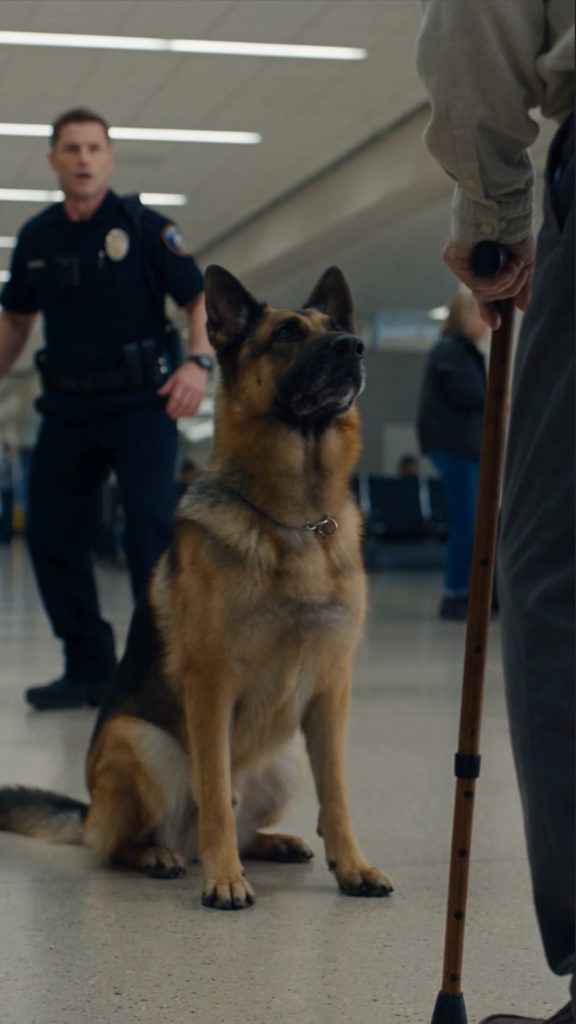
For five years, that dog had obeyed every command I gave him.
Until now.
They call Belgian Malinois “fur missiles” for a reason. Working beside one trained to detect explosives means holding the leash of something incredibly powerful—something you trust only because it trusts you just as completely.
My partner was Titan.
For five years, we had worked security at one of the busiest international airports in the country. Crying children never distracted him. Dropped food meant nothing. Crowds, alarms, rolling luggage, holiday chaos—he ignored all of it.
The second his working vest clicked into place, Titan changed.
He became focused. Precise. Almost mechanical.
He had never missed a threat.
And he had never disobeyed me.
Three days before Thanksgiving, Terminal D was overflowing. Security lines twisted through the building, passengers hurried toward gates, and the air carried the smell of burnt coffee, polished floors, and nervous sweat.
We were sweeping near Gate D24 when Titan suddenly stopped.
The leash went tight so violently it nearly ripped my shoulder from its socket.
“Titan. Heel.”
Nothing.
His ears flattened. A ridge of fur lifted along his spine. His eyes locked on something fifty yards away with an intensity I had never seen before.
Then came the growl.
Low. Primitive. Wrong.
It wasn’t his explosive indication. It wasn’t any trained alert I recognized.
“Titan. Leave it.”
He ignored me.
Then he barked.
The sound tore through the terminal, and hundreds of conversations died at once.
Following his stare, I saw passengers slowly moving aside.
An elderly man stood beyond them.
He wore a faded olive military jacket covered with old patches. His shoulders were rounded with age, one hand gripping a worn wooden cane while a weather-beaten canvas duffel hung from his shoulder.
He looked terrified.
“Sir, stay back!”
But he wasn’t coming toward us.
Titan was trying to reach him.
He clawed against the terrazzo, choking himself against his collar, coughing between desperate lunges. I pulled with everything I had, but something about the old man had shattered five years of perfect discipline.
My mind raced.
Explosive residue? Chemicals? Something on the military jacket?
Or was Titan losing control?
Working dogs could break down. Burn out. Develop trauma.
And if Titan attacked an innocent man—especially an elderly veteran—the consequences would be absolute.
“Titan, DOWN!”
He twisted so violently I nearly fell.
Around us, mothers grabbed their children. Travelers backed behind pillars. Phones rose into the air.
I hit my shoulder radio.
“Backup at Gate D24! K9 is out of control!”
Two TSA agents arrived first. Then three armed airport officers.
One looked from Titan to the veteran and moved his hand toward his weapon.
“Sir! Drop the bag! Put it down and step away!”
The old man stared at us, completely bewildered.
His hands shook as he slowly lowered the canvas duffel.
Titan saw the movement.
And something inside him broke loose.
He spun with terrifying force.
The heavy metal clasp on his leash snapped.
I slammed backward onto the floor, staring at the useless strip of leather still wrapped around my fist.
Titan was free.
“No!”
Weapons came out.
“Don’t shoot him!”
I scrambled after him, but Titan was already sprinting through the terminal, locked onto the frail man ahead.
The veteran raised one arm and braced himself.
People screamed.
I saw fingers tightening near triggers.
For one unbearable second, I knew exactly what everyone expected to happen.
I squeezed my eyes shut, waiting for gunfire.
Waiting for Titan to die.
Waiting for an innocent man to be torn to the floor.
But no shots came.
Instead, another sound moved through Terminal D.
A sound so unexpected that I opened my eyes—and felt every drop of blood in my body turn cold.
Nobody in that terminal was prepared for what came next. 👇
The sound was not a growl.
It was a whine.
Thin, broken, almost puppy-like.
Titan reached the old man and, instead of striking him, dropped so hard onto the polished floor that his chest hit first. His whole body trembled. Then he crawled the final few feet on his belly, pressed his head against the veteran’s boots, and made that sound again.
The veteran’s cane slipped from his hand.
“Dear God,” he whispered.
Every weapon stayed raised, but nobody moved. Titan rolled onto his side and pawed desperately at the man’s faded jacket, his tail striking the floor in frantic beats.
The old man sank to his knees.
“Titan?”
My breath stopped.
He knew his name.
I reached them as an officer ordered the veteran to keep his hands visible. I stepped between the muzzle and my dog without thinking.
“Lower it.”
The veteran was crying now, both hands buried in the fur around Titan’s neck.
“He remembers,” he said. “After all this time, he remembers.”
I stared at him. “Who are you?”
He looked toward the canvas duffel.
“My name is Arthur Cole. And before Titan belonged to this airport, he belonged to my son.”
The words seemed to hollow out the entire terminal.
An officer searched the duffel before handing it back. Inside were photographs, military records, a folded flag, and a battered leather collar with a metal tag.
Titan smelled the collar and pressed his face into Arthur’s chest.
The first photograph showed a younger Titan beside a soldier in desert camouflage.
On the back, in faded ink: Matthew and Titan. Kandahar.
I looked down at my partner.
Five years of records said he had come to us from a stateside training contractor.
Arthur’s documents said otherwise.
Then a voice cut through the circle behind us.
“That’s enough.”
Harlan Voss, the airport’s contracted canine operations director, pushed past the officers, his face pale.
I had known Voss for years. He had signed Titan’s transfer paperwork. He had personally told me Titan had never been deployed.
Arthur slowly stood.
“You.”
Voss stopped.
Arthur pulled a thick envelope from the duffel. “My son was killed after an ambush in 2020. Before he died, he filed a disposition request for Titan. If Titan survived him, he wanted the dog transferred to family or another military handler.”
Voss glanced toward the officers. “This is not the place.”
“No,” Arthur said. “It’s exactly the place. I spent five years being told the dog was dead.”
Silence rolled through Terminal D.
Arthur had copies of repeated requests for Titan’s location and official responses saying Titan had died from injuries overseas.
Then he produced a microchip transfer form.
Titan’s number.
Voss’s signature.
The officers looked at him.
Voss finally turned to me. “Get your dog under control.”
Titan lifted his head.
A low growl vibrated in his chest.
Not at Arthur.
At Voss.
Something inside me fell into place.
Titan had not lost control.
He had smelled home.
And somewhere inside that storm of old scents and memory, he had recognized the man connected to the moment that home had been taken from him.
Voss stepped backward.
An officer blocked his path.
“You sold him,” Arthur said.
Voss began talking fast—transfers were complicated, records changed, contractors followed federal instructions. But every sentence only tightened the circle around him. One officer took Arthur’s papers. Another called a supervisor.
A TSA agent who had been recording lowered his phone.
“I got all of that.”
Voss went white.
The terminal became so quiet that a boarding announcement three gates away sounded enormous.
He was escorted out through the same crowd he had walked through for years as though he owned the place.
No one applauded.
Hundreds of strangers simply watched as his access badge was removed and his wrists were secured behind him.
Arthur sat down afterward because his legs would no longer hold him.
I sat beside him.
Titan wedged himself between our knees.
For a long time, neither of us spoke.
Then Arthur touched the scar beneath Titan’s left ear.
“Matthew used to scratch him right here.”
Titan’s eyes closed.
I had scratched that same spot thousands of times without knowing why he always leaned into it.
Arthur gave a broken little laugh. “He hated thunder. Gunfire didn’t bother him, but thunder sent him under Matthew’s cot.”
“He still hates thunder,” I said.
Arthur looked at me, and the pain in his face shifted into something softer.
In a small interview room, he told me the years I had never known. Titan had been barely eighteen months old when he was paired with Sergeant Matthew Cole. They trained together, deployed together, slept within arm’s reach.
During an attack on their convoy, Titan pulled Matthew toward cover after Matthew was wounded.
Matthew survived six days.
Arthur had never been allowed to say goodbye to the dog his son mentioned in every call home.
Investigators confirmed enough of Arthur’s documents that same night to open a formal case. Voss was removed from duty. Over the following months, investigators uncovered falsified transfer records involving other working dogs and payments routed through companies tied to him.
His contracts were terminated. His security clearance disappeared. The charges that followed made the collapse permanent.
But that night, one question mattered more.
Arthur looked at me and said, “Matthew wanted Titan with family.”
My hand tightened around the replacement leash.
Titan was my partner. My shadow. The dog who had slept outside my hospital room when I broke my ankle on duty. The animal who knew my breathing well enough to wake before I did from bad dreams.
But Matthew had loved him first.
“If the paperwork says he belongs with you,” I said, forcing the words out, “I won’t fight you.”
Arthur stared at me.
Then he reached into the duffel.
“There’s one thing you haven’t read.”
He handed me a letter, its edges softened by years of handling.
Matthew had written it before deployment.
Near the bottom was a paragraph about Titan.
If I don’t come home, don’t make him spend the rest of his life waiting for me. If he finds somebody he trusts, let him stay. A dog like him needs a person, not a memorial.
I read it twice.
Arthur wiped his face.
“I didn’t come here to take him from you.”
I looked up.
“I came because I needed to know he hadn’t died alone.”
Titan rested his chin on Arthur’s knee.
“And now I know he didn’t.”
That was the sentence that broke me.
I bent forward with one hand over my face. Arthur rested a palm on my shoulder, and Titan pushed his head between us until neither man could pretend not to be crying.
The airport cleared me of wrongdoing. Titan passed every medical and behavioral evaluation.
Of course he did.
But I made a different choice.
Three months later, I signed his retirement papers.
His final walk through Terminal D was quiet. TSA agents lined the checkpoint. Gate staff stepped out from behind counters. Travelers paused as Titan passed in his working vest for the last time.
Arthur waited near Gate D24.
Titan saw him across the concourse.
This time, I unclipped the leash myself.
“Go on.”
Titan ran.
Not like a weapon.
Not like a police dog.
Like a dog going home.
That evening, Arthur showed me one final photograph from the duffel. Matthew sat on the floor of a training kennel, Titan asleep across his boots.
On the back, Matthew had written: He’ll choose his next person the same way he chose me—he’ll know before they do.
I stared at the words.
Five years earlier, there had been twelve handlers in the evaluation yard.
Titan had walked past eleven.
Then he sat on my left boot.
I had always believed I chose him.
I finally understood that I never had.
That Thanksgiving, Arthur ate dinner at my house.
Titan moved beneath the table, collecting pieces of turkey from both sides while Arthur told stories about Matthew and I filled in the five years that came after him.
Outside, rain tapped softly against the windows.
A distant roll of thunder crossed the dark.
Titan lifted his head.
He looked at Arthur.
Then at me.
And instead of hiding, he lowered himself between our chairs, stretched across both our feet, and fell asleep there while two men who had once believed they had lost part of their family finally understood that, somehow, it had found its way home.