The bag moved.
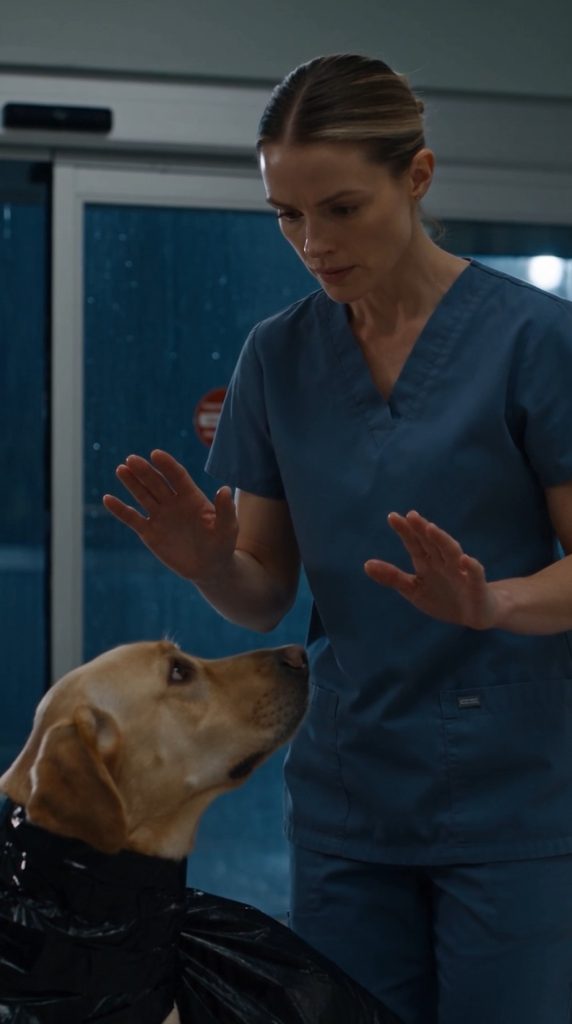
Just once. Barely enough to notice.
But in the middle of that rain-soaked emergency room, one exhausted nurse saw it—and the fear on her face made everyone around her stop talking.
Outside, the storm had swallowed the city.
Rain hammered the hospital windows so violently that the streetlights beyond the glass looked like trembling smears of gold. Water raced down the panes in endless streams, while inside the emergency department, the night had finally begun to settle into an uneasy calm.
The nurses were running on exhaustion.
One stood behind the desk checking patient files. Another was finishing paperwork beneath the harsh white lights. Two others spoke quietly nearby, their voices low, conserving what little energy they had left.
For the first time in hours, nothing urgent seemed to be happening.
Then a bark exploded through the entrance.
Everyone looked up.
The automatic doors slid apart, letting in a gust of cold rain—and a massive yellow Labrador came charging through them.
He was completely soaked.
Water poured from his fur, leaving dark streaks across the polished floor. His paws slipped against the tiles as he struggled for balance, his chest rising and falling hard with every breath.
But he did not stop.
Strapped tightly across his back was an enormous black plastic bag.
For a second, nobody seemed to understand what they were looking at.
Then the security guard moved.
“Hey! Stop!”
He hurried from his station, waving toward the entrance.
“Get that dog out of here!”
One of the nurses pushed back from her chair.
“Who let a dog into the ER? Someone take him outside.”
The Labrador barked again.
Not the sharp bark of an aggressive animal.
Not anger.
Something closer to panic.
He rushed toward the reception desk, stopped, then spun around and ran several steps back toward the doors. A moment later, he turned toward the staff again.
Bark.
Turn.
Wait.
Bark again.
It looked almost as though he were trying to lead them somewhere—or desperately trying to make them understand something they could not hear.
The guard reached for his collar.
The Labrador jerked sideways.
He did not growl. He did not snap.
He only moved out of reach and barked again, his body shaking from cold and exhaustion, his wide eyes moving rapidly from one face to another.
“Easy,” someone murmured.
Another nurse shook her head.
“He’s probably terrified because of the storm.”
That explanation made sense.
At least, it did to everyone except Emma.
She had been watching from behind the desk.
At first, she had noticed the same things as everyone else—the dripping fur, the muddy paws, the frantic breathing.
Then her eyes settled on the black bag.
Something about it felt wrong.
She leaned forward slightly.
The plastic was pulled tightly around whatever was inside, secured against the dog’s back as though someone had deliberately fastened it there.
Emma stared.
Her expression changed.
The conversations behind her faded into silence.
For one terrible second, she wondered if exhaustion was playing tricks on her.
Then it happened again.
The bag moved.
Not from the Labrador shifting his weight.
From inside.
Emma’s stomach tightened.
She slowly raised one hand.
“Wait.”
The guard stopped.
“Don’t touch him.”
Her voice was quiet, but something in it made everyone listen.
The Labrador stopped barking.
Completely.
He turned his head toward Emma and stared directly at her.
The desperation in his eyes was so intense that she felt a chill move through her.
Very slowly, she stepped around the desk.
The dog did not move.
One step.
Then another.
Water dripped from his body onto the floor between them.
Emma crouched beside him, her hands trembling as she reached toward the straps holding the black plastic bag in place.
No one spoke.
Even the guard had gone still.
Emma loosened the first strap.
Then the second.
The Labrador stood perfectly motionless.
She pulled back the wet plastic.
And the moment she saw what was inside, every trace of color disappeared from her face.
Someone behind her gasped.
Nobody in that emergency room was prepared for what came next. 👇
A sound came from inside the bag.
Not a cry. Not quite.
A thin, broken whimper.
Emma tore the plastic wider.
Inside, wrapped in a soaked gray sweatshirt and towels already darkening with blood, was a newborn baby.
For half a heartbeat, nobody moved.
Then training took over.
“Pediatric warmer. Now.”
Emma lifted the infant with both hands. The baby was frighteningly cold, her lips tinged blue, her tiny fists barely moving. One nurse shoved paperwork aside while another pulled the warming unit closer and called pediatrics.
Behind them, the Labrador gave one low, trembling sound.
Emma looked back.
He was staring at the child.
“She’s breathing,” Emma said softly. “We have her.”
The dog’s legs buckled.
The security guard caught him before he hit the floor.
As the team worked, Emma noticed something beneath the wet towels. A cracked phone. Beside it was a folded note sealed inside a sandwich bag.
She opened it.
PLEASE SAVE HER. FOLLOW COOPER. I’M STILL THERE.
No one spoke.
The Labrador lifted his head at the sound of his name.
Then he struggled upright and staggered toward the automatic doors.
Emma’s eyes met the charge nurse’s.
“Call police. Get an ambulance crew ready.”
Outside, Cooper ran through the storm.
Not quickly. He was exhausted. But he never hesitated.
A police cruiser and ambulance followed as he cut down two side streets and stopped at a narrow brick house near the river.
Then he began barking.
The front door opened.
A barefoot man stood there, his shirt half-buttoned. His face changed the instant he saw the uniforms.
“What is this?”
Cooper pushed toward the doorway.
The man blocked him.
“There’s nobody here.”
Then a weak voice came from somewhere inside.
“Help me.”
An officer pulled the man aside.
The ambulance crew followed the voice to a laundry room at the back of the house.
The door had been bolted from the outside.
On the floor lay a young woman beside blood-soaked towels.
She was conscious.
Barely.
“My baby?”
Emma dropped beside her.
“She’s alive.”
The woman’s eyes closed as a breath broke from her chest.
Cooper squeezed into the room and lay against her arm.
Her fingers found his wet fur.
“Good boy,” she whispered.
The man began shouting from the hallway.
“She’s confused. You don’t understand what she’s like.”
The woman’s eyes snapped open.
“Don’t let him come near me.”
The officer shut the door.
Back at the hospital, the baby was placed beneath warm lights while the mother, Leah, was rushed into surgery for severe bleeding.
Cooper refused to leave the corridor between them.
At 4:17 in the morning, Emma sat on the floor beside him with a hospital blanket around his shoulders. The security guard placed a bowl of water nearby without saying a word.
A detective appeared holding the cracked phone.
“There’s a recording on it.”
Leah’s voice was faint beneath the sound of rain.
She said Daniel had taken her keys, bank cards, then her phone. When she told him she planned to leave with the baby, he stopped letting her out of the house.
Then Daniel’s voice entered the recording.
“If you try to leave, no one is going to believe you.”
A pause.
“And if that baby causes trouble, I’ll handle that too.”
Emma’s jaw tightened.
The detective stopped the recording.
Leah had hidden the phone behind a loose panel in the laundry room, recording threats and the sound of Daniel locking the door from outside.
When labor began early, he refused to call an ambulance.
Leah gave birth alone.
While Daniel was upstairs, she wrapped her daughter in the driest things she could find, sealed the phone beside her, strapped the bag to Cooper’s walking harness, and whispered one word.
“Hospital.”
Leah woke after surgery with Cooper asleep beneath her hand.
When Emma asked how he had understood, Leah looked at the dog.
“He belonged to my dad.”
Her father had been a paramedic.
For nearly six years, Cooper had also been a certified therapy dog.
At this hospital.
“My dad brought him through those doors every Thursday,” Leah whispered.
Emma went still.
Cooper had not wandered into the emergency room.
He knew the entrance.
He knew the smells.
He knew where people went when they needed help.
Daniel denied everything.
He claimed Leah had imagined the confinement and said the laundry-room bolt was for storage.
Then investigators found the hidden keys, Leah’s bank cards in his desk, and messages in which he had begun telling relatives she was unstable weeks before she tried to leave.
A neighbor’s camera also showed Daniel repeatedly leaving the house while Leah never did.
The evidence accumulated quietly.
Piece by piece.
Until his explanations collapsed under the weight of his own actions.
The last time Leah saw him before court, police were escorting him through the hospital corridor.
He stopped when he saw her.
For months, she had learned to shrink beneath that look.
This time she didn’t.
Daniel opened his mouth.
Leah raised one hand.
“No.”
Nothing more.
The officer guided him away.
He looked back once.
She did not.
Months later, Daniel pleaded guilty after prosecutors presented the recordings, medical evidence, financial records, and proof of Leah’s confinement.
When the sentence was handed down, Leah sat between Emma and her aunt.
Her hands trembled beneath the courtroom bench.
Then the door shut behind Daniel.
Just a quiet click.
Leah stared at it.
For the first time, a locked door meant he was the one who could not follow her.
Healing came more slowly.
It arrived the first night Leah slept four hours without waking.
The first morning she opened a window simply because she wanted fresh air.
The first afternoon she walked through a grocery store alone and realized nobody was waiting outside to demand where she had been.
Ava grew stronger.
The blue faded from her lips. The wires disappeared one by one. Her tiny cry grew loud enough to make the nurses laugh.
Cooper recovered too.
The security guard began bringing him biscuits.
“I owe you,” he muttered, scratching behind his ear.
Cooper accepted the apology immediately.
On the morning Ava was discharged, sunlight filled the lobby.
Leah held her daughter beside the same automatic doors where Cooper had charged in through the rain.
Emma came down to say goodbye.
“I keep thinking about what would’ve happened if you hadn’t seen the bag move,” Leah said.
Emma looked at Cooper.
“I keep thinking about what would’ve happened if he’d listened when we told him to leave.”
Leah laughed, then covered her mouth as tears came.
Emma stepped forward and held her.
A year later, they returned on a rainy afternoon.
Not because anyone was sick.
Leah carried a framed photograph for the emergency department. It showed Ava sitting in the grass with both hands buried in Cooper’s fur, laughing with her eyes closed.
On the back, Leah had written:
He knew where home was before I did.
Emma read it twice.
Through the glass, Cooper lay near the entrance, older now, his muzzle beginning to whiten. Ava sat beside him in a yellow raincoat, offering him pieces of cracker.
The automatic doors opened.
Cooper lifted his head.
For a moment, everyone remembered the storm, the barking, the black bag, the terror of not knowing what was inside.
Then Ava leaned against his shoulder.
Cooper lowered his head across her tiny boots.
Rain tapped softly against the glass as Leah stood beside Emma, watching her daughter laugh in the place where both their lives had been given back to them.
This time, nobody tried to make the dog leave.