The smell of roasted meat and warm bread filled the room, but the little girl on the floor wasn’t eating any of it.
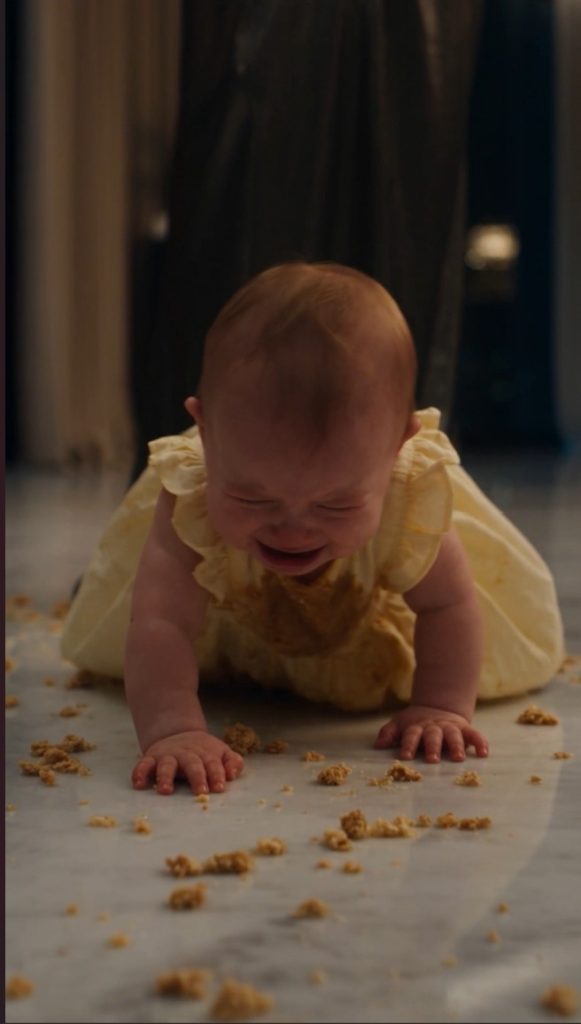
She was two years old, filthy, sitting beside the dining table with scraps scattered around her knees. And while she picked food from the floor with her tiny fingers, the adults around her kept eating.
For one frozen second, I couldn’t move.
Lily’s hair was tangled against her cheeks. Dirt marked the knees of her clothes, and something dark had dried near one sleeve. She looked up at me without crying, which somehow made it worse.
Then I saw the table.
Diane sat comfortably in front of a full plate, surrounded by the rest of Ryan’s family. Serving dishes crowded the table—food enough for everyone, still steaming beneath the lights.
Everyone except Lily.
My stomach tightened.
“What is she doing on the floor?”
The room went quiet for barely a second.
Then Diane laughed.
Not nervously. Not apologetically.
She glanced down at my daughter as though Lily were an inconvenience she had already stopped noticing.
“If she acts like an animal,” Diane said, “she eats like one.”
Something inside me went completely still.
I looked at Ryan.
My husband wouldn’t meet my eyes at first. He stared at the table, jaw tight, as though the real problem was not what had happened to Lily—but what I might do now that I had seen it.
“Don’t make a scene,” he warned quietly.
That sentence hurt almost as much as the sight of our daughter.
I bent down and lifted Lily from the floor. She was lighter in my arms than I expected. Her small body pressed against me, and she immediately curled inward, resting her face against my shoulder.
I could feel crumbs clinging to her clothes.
Nobody moved.
Nobody apologized.
Diane simply watched me, still seated in front of her dinner.
I stepped toward her.
Before anyone understood what I was doing, I took Diane’s plate and dumped the entire dinner into her lap.
She screamed and shot backward.
Chairs scraped against the floor.
Ryan was on his feet immediately.
“What the hell is wrong with you?”
His hand closed around my arm.
I turned and slapped him.
The sound cut through the room.
Everyone froze.
Ryan stared at me, stunned, one hand slowly rising toward his face.
I stared straight back at him.
“You starved your own daughter.”
His expression changed.
Not enough.
I held Lily tighter and looked around the kitchen. Then something caught my attention—a cabinet I knew well.
I crossed the room and opened it.
Inside were containers of toddler food.
Unopened.
Untouched.
Food I had bought myself specifically for Lily.
For a moment, nobody said anything.
The cabinet door stayed open between us like evidence.
My hands began shaking, but I forced myself to reach for my phone.
One photograph.
Then another.
Lily’s condition.
The scraps on the floor.
The dinner table.
The untouched food.
Ryan realized what I was doing.
“Put the phone down.”
I ignored him.
His voice hardened.
“I said put it down.”
I backed away while holding Lily against my chest and called the police.
That was when the room changed.
The anger disappeared from Ryan’s face and something sharper replaced it.
Fear.
He came toward me.
I moved back.
“Don’t do this,” he said.
But he reached for me again.
I shoved him.
Hard.
Ryan stumbled backward and crashed against the dining table. Plates jumped, glasses tipped, and Diane shouted as food and silverware scattered across the surface.
I didn’t wait.
I carried Lily toward the door, her arms locked around my neck.
Behind me, voices collided—Ryan calling my name, Diane yelling, chairs scraping across the floor.
Then came another sound.
Sirens.
Closer.
Closer still.
Red and blue light flashed across the windows as I stepped outside with my daughter trembling against my chest.
A police car stopped in front of the house.
The doors opened.
And as the officers started walking toward us, Ryan appeared in the doorway behind me.
Nobody in that house was prepared for what came next. 👇
One of the officers stopped halfway up the path when he saw Lily.
His eyes dropped to the crumbs stuck to her shirt, then to the dark smear on her sleeve. The other officer looked past me toward Ryan, standing in the doorway with one hand braced against the frame.
“Ma’am,” the first officer said quietly, “is the child hurt?”
“I don’t know.”
The words broke on the way out.
Lily had stopped trembling, but only because she had gone completely still. Her fingers were twisted into my collar, and when the officer stepped closer, she buried her face against my neck.
Ryan came down one step.
“This is a misunderstanding.”
I turned.
“A misunderstanding?”
“I didn’t know my mother was doing that.”
From inside, Diane shouted, “Oh, for God’s sake. She missed one proper meal.”
The officers looked at each other.
Then one told Ryan to stay where he was.
That was when fear finally appeared on my husband’s face.
I unlocked my phone with shaking fingers and showed them the photographs.
The scraps.
The untouched toddler food.
The cabinet.
Lily on the floor.
“Who was responsible for her today?” the officer asked.
Ryan opened his mouth.
Diane answered first.
“I was.”
The silence that followed was so clean I could hear the patrol car’s engine ticking as it cooled.
A paramedic arrived and asked to examine Lily. I whispered, “Mommy’s right here,” and loosened my arms.
She cried the instant someone else touched her.
Just one broken sound that almost dropped me to my knees.
She was hungry, dehydrated, and bruised near one hip. Nothing immediately life-threatening, the paramedic said, but everything needed documenting.
I looked at Ryan.
He looked away.
That tiny movement told me more than any confession could have.
“Ryan.”
He didn’t answer.
“Look at me.”
Slowly, he did.
“You knew.”
Before he could speak, Diane rushed onto the porch.
“He knew she was difficult,” she snapped. “That child throws food, screams, refuses to sit still—”
“She’s two.”
My voice came out almost calm.
Diane faltered.
“She is two years old.”
Then Ryan said the sentence that ended our marriage.
“I told Mom she could be stricter.”
For a second, the porch seemed to tilt beneath me.
He started explaining too quickly. Lily had tantrums. Diane believed children needed consequences. He thought withholding snacks might teach her to behave.
“Snacks?” I whispered.
“I didn’t tell her not to feed her all day.”
Diane laughed once.
“You absolutely did.”
Ryan went white.
Even the officer nearest him turned his head.
“You called me this morning,” Diane continued, anger outrunning caution. “You said, ‘If she throws another fit, don’t give in. She needs to learn.’ You said your wife babies her.”
Ryan stared at her.
“Mom.”
“No. Don’t ‘Mom’ me now.”
I felt something inside me go cold.
Ryan stepped toward me.
“I didn’t mean—”
“Stop.”
He stopped.
Then I remembered the old tablet at home, the one linked to Ryan’s messages.
I told the officer.
Ryan’s face changed again.
“No.”
The word slipped out before he could catch it.
Within an hour, the messages were no longer memory against denial.
There they were.
Ryan saying Lily needed to be “broken of the habit” of crying for me.
Ryan complaining that I made him look weak because I always stepped in.
Diane replying that a hungry child learned faster.
And Ryan answering with a thumbs-up.
I stared at that tiny blue symbol until it blurred.
There had been no misunderstanding.
There had been a choice.
And my daughter had paid for it.
Ryan sat at the dining table while the officers read the messages. The same table where his family had eaten while Lily scavenged beside them.
No one touched the food now.
One relative began crying.
Another whispered, “I thought she’d eaten earlier.”
I looked at them.
“Did any of you ask?”
Nobody answered.
That silence belonged to them.
When police led Diane outside, she turned toward me.
“You’re destroying this family.”
I looked down at Lily, wrapped in a gray emergency blanket.
“No,” I said. “I’m ending what you did to mine.”
Ryan was taken out separately.
At the bottom of the steps, he looked back.
“Please don’t take her away from me.”
For one terrible heartbeat, I remembered him holding Lily the night she was born, crying into her tiny hat.
Then I remembered the thumbs-up.
I closed the door.
The months that followed were filled with hearings, medical appointments, and nights when Lily woke crying if she couldn’t see me.
The messages destroyed every attempt to call what happened an accident.
Investigators found more conversations showing Diane had used food as punishment before and Ryan had dismissed my concerns when Lily returned from visits unusually hungry.
Diane was barred from contact with Lily.
Ryan lost unsupervised access and later entered a court-approved agreement that required counseling, parenting intervention, and supervised contact subject to Lily’s welfare.
The family stopped defending Diane when they saw the full record.
Not everyone apologized.
But Emma did.
Ryan’s younger sister came to my apartment one rainy afternoon carrying a cardboard box.
Inside were Lily’s yellow cup, two sweaters, a stuffed rabbit, and the little moon-shaped night-light from the old house.
Emma stood in the doorway, soaked at the shoulders.
“I should have picked her up.”
I said nothing.
“She dropped food,” Emma whispered. “Diane told me not to interfere. I knew it felt wrong.”
Her hands tightened around the box.
“I still sat there.”
“I’m sorry.”
I didn’t tell her it was okay.
It wasn’t.
But I let her sit on the floor while Lily watched from behind my leg.
Emma didn’t reach for her.
She placed the stuffed rabbit between them and waited.
Weeks later, Lily carried it to her.
That was how trust returned.
Not with speeches.
With waiting.
With food always available.
With adults who listened when Lily said no.
Almost six months after that night, I found something Emma had tucked beneath the rabbit.
An old grocery receipt.
Stapled to it was a note in Ryan’s handwriting.
Buy whatever Lily likes. Keep extra at Mom’s so she never goes without.
I sat at the kitchen table staring at it.
Anger came back so hard I could barely breathe.
Once, Ryan had known exactly what kind of father he wanted to be.
He had bought the food.
He had prepared for Lily to be safe.
Then, little by little, he had chosen resentment over tenderness, control over patience, his mother’s approval over his daughter’s trust.
The cabinet I opened that night had contained more than evidence of neglect.
It held proof that cruelty had been a choice.
Strangely, that freed me.
I stopped asking whether I had missed some hidden warning or failed to prevent what happened.
The food had been there.
The adults had been there.
Love had once been there too.
They had simply chosen not to use any of it.
A year later, Lily and I moved into a small house with pale morning light in the kitchen.
Emma remained in our lives carefully, on Lily’s terms.
Ryan continued supervised visits only when professionals considered them appropriate. I never promised Lily what their relationship would become.
What I could promise was simpler.
Breakfast.
Lunch.
Dinner.
A snack whenever she was hungry.
A mother who believed her.
On her fourth birthday, Lily climbed onto a chair beside me while I frosted a crooked strawberry cake.
She stole a berry from the bowl.
I pretended not to notice.
She giggled so hard she nearly dropped it.
Emma was setting paper plates on the table when she froze and looked toward the open pantry.
On the lowest shelf sat snacks in clear containers where Lily could reach them herself.
Emma’s eyes filled.
Neither of us said Diane’s name.
Lily padded to the pantry and returned carrying two crackers.
She held one out to Emma.
“For you.”
Emma crouched.
Her mouth trembled before she smiled.
“Thank you.”
That evening, after the candles were blown out and everyone had gone home, I found Lily asleep on the couch with the stuffed rabbit under one arm.
A half-eaten piece of cake sat on the coffee table.
Crumbs dotted the rug.
Once, the sight of my daughter beside food on a floor had split my life in two.
Now there were crumbs everywhere because she had eaten until she was full, laughed until she was tired, and fallen asleep knowing nobody would punish her for either.
I carried her to bed.
She stirred as I tucked the blanket beneath her chin.
“Mommy?”
“I’m here.”
Her eyes stayed closed.
“Can I have pancakes tomorrow?”
I pressed my lips to her forehead.
“As many as you want.”
She smiled in her sleep.
Then I switched on the little moon-shaped night-light, left her door open, and walked back toward the kitchen, where a bowl of strawberries waited on the table and the pantry door stood wide open in the warm, quiet house.