The laughter died the moment the woman unfolded the patch. Beneath a winged skull was a name no one dared speak after midnight. And when a voice came from the darkest corner of the bar, the men who had mocked her couldn’t even bring themselves to turn around.
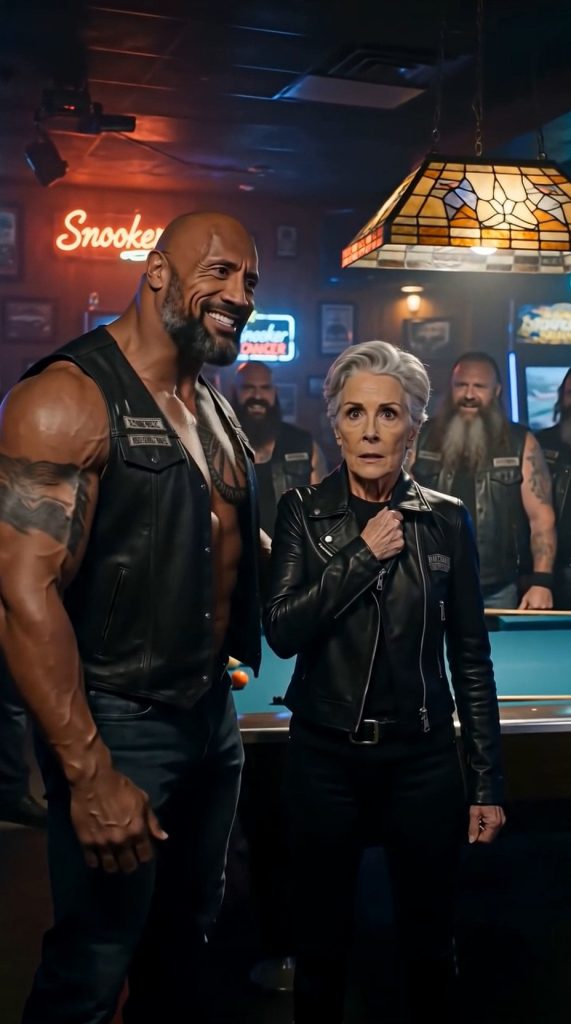
Only moments earlier, the room had been full of laughter.
She had walked into the biker bar alone, wearing a weathered brown leather jacket and holding something close against her chest. Around her stood men with hard faces and the easy confidence of people accustomed to being the ones others stepped aside for.
She looked out of place. They made sure she felt it.
The bald biker was the first to speak. He leaned forward with a smirk, glancing at the men behind him as though he already knew they would enjoy what came next.
“Lady, you got ten seconds to get outta here before things get uncomfortable.”
Laughter rolled through the room. A few men watched her, waiting for an apology, an excuse, any sign that she understood the warning.
She gave them none.
Her fingers tightened around the thing she was carrying. It was a small movement, almost invisible, but it seemed to steady her. She had come too far to turn around because a stranger raised his voice.
“I drove four hundred miles to be here tonight,” she said.
She didn’t shout. That was what made it difficult to laugh at her. There was no plea in her voice, no attempt to win their sympathy—only the quiet certainty of someone who had made a decision and intended to see it through.
The laughter thinned. The bald man was still smiling, though less comfortably now.
Then she lowered her hands and began to unfold what she had been protecting against her chest.
It was an old leather patch, worn soft and dark with age. A skull with wings emerged from the folds. The stitching had faded, and the surface still carried the grime of roads traveled long ago.
A few of the men leaned forward. One appeared ready to say something, then stopped.
At the bottom was a single name.
DUTCH.
The change in the room was immediate. A biker rose sharply from his seat. Another went perfectly still, as though even drawing breath might call attention to him.
The bald man’s smirk disappeared.
They all knew that patch. They knew the name, too. Dutch hadn’t merely belonged to the club; he had helped found it. And since his disappearance, the story of him had become something the men kept buried beneath uneasy silence.
After midnight, they didn’t speak of him.
Now a woman none of them had welcomed was standing in front of them with his patch in her hands.
No one asked her to leave again.
From the back corner, where the light barely reached, a low voice cut through the silence.
“Where did you get that?”
Every man recognized the speaker. Yet not one of them turned toward the darkness. The woman did. She lifted her eyes from the patch and looked straight into the corner, as though she had been waiting for that question all along.
“He gave it to me the night he disappeared.”
A slow, heavy bootstep sounded from the shadows.
The bald biker moved backward. All the confidence had drained from his face, replaced by a fear he could no longer disguise.
But the woman hadn’t finished.
Keeping the patch in one hand, she reached for something else and brought it into the dim light: a rusted motorcycle key. Dark, dried stains remained caught deep in its grooves.
For a long moment, no one spoke. The patch had brought Dutch’s name back into the room. The key raised a question no one had the courage to ask. 👇
The key struck the wooden counter with a sharp metallic click.
From the shadows emerged a broad-shouldered man with silver hair and an old scar cutting through his left eyebrow. His leather vest carried the insignia of the club president.
Mack Sullivan.
For eighteen years, Mack had ruled the club with the kind of authority that made even its most violent members lower their voices.
Now he was staring at that key as though something buried beneath the earth had suddenly found its way home.
“Who are you?” he asked.
The woman studied him for several seconds.
“You really don’t recognize me, Mack?”
Something shifted behind his eyes.
“Evelyn?”
She gave a small nod.
“Dutch’s wife.”
A low murmur spread through the bar.
The bald biker, whose name was Silas, gripped the back of a chair. His knuckles whitened.
Mack’s gaze moved from Evelyn’s face to the patch.
“You shouldn’t have come here.”
“That’s what you told him, too,” she answered.
Mack’s jaw tightened.
Evelyn placed both hands on the counter. They were trembling now, though her voice remained steady.
“Eighteen years ago, my husband came home bleeding. His shirt was torn, his face was bruised, and he could barely stand.”
The room became unnaturally quiet.
“He told me someone inside this club was stealing money from the families of dead riders. Money meant for widows. For children who’d already lost their fathers.”
A younger biker glanced toward Mack.
Evelyn continued.
“Dutch had found the records. He knew who was responsible. And that night, someone tried to stop him from telling the truth.”
Mack slowly shook his head.
“Your husband stole from this club and ran. Everybody here knows that.”
“No,” Evelyn whispered. “Everybody here was told that.”
She picked up the key.
“He was holding this when he came through our door. There was blood on his fingers. He gave me his patch and told me to keep it safe.”
Her voice caught for the first time.
“I begged him to stay. I told him we could leave town together. But he said there was someone he still trusted, someone who could help him get the evidence to the police.”
Her eyes returned to Mack.
“That someone was you.”
Silas looked down.
Mack’s expression hardened.
“You’re bringing accusations into my house after eighteen years?”
Evelyn reached inside her jacket.
“I’m bringing something you thought would never be found.”
She removed a folded photograph and laid it beside the key.
The picture showed an old motorcycle, its metal eaten by rust, lying beneath broken concrete and dirt.
Dutch’s motorcycle.
Three weeks earlier, workers demolishing an abandoned mill had discovered it concealed beneath the foundation of a storage building.
The motorcycle’s identification number had survived.
So had the metal compartment beneath its seat.
Inside, investigators found a damaged leather satchel containing financial records, handwritten figures, and documents connecting Mack to years of stolen club funds.
The discovery had reopened Dutch’s disappearance.
Mack stared at the photograph.
For the first time, he seemed unable to find the right words.
Then Silas spoke.
“I told you they should’ve burned the bike.”
Every head turned.
The words seemed to surprise Silas himself.
Mack’s face went pale.
“Shut your mouth.”
But the damage was done.
Evelyn turned toward Silas.
“You were there?”
He swallowed.
He looked around the room, searching for a friendly face. The men who had laughed at Evelyn only minutes earlier watched him without speaking.
“I was nineteen,” Silas said. “Mack told me Dutch was planning to destroy the club. Said we had to stop him before he ruined everything.”
Mack stepped toward him.
“Silas.”
The younger man flinched at the sound of his name.
“I helped move the motorcycle,” he whispered. “I didn’t know what he’d done until afterward.”
Evelyn’s fingers curled around the edge of the counter.
“What happened to my husband?”
Silas closed his eyes.
For several seconds, the only sound was the low hum of the refrigerator behind the bar.
“He confronted Mack at the mill. They argued about the money. Dutch said he was going to the police.”
Silas’s breathing became uneven.
“There was a gunshot.”
Evelyn pressed her lips together.
Silas stared at the floor.
“When I got there, Dutch was on the ground. Mack told me it had been an accident. He said if I talked, I’d be next.”
Mack lunged forward.
“You lying little—”
Two bikers moved between them.
One of them was an older member named Frank, who had ridden beside Dutch when the club was founded.
“Don’t,” Frank said quietly.
Mack stopped.
Frank looked at Evelyn, then toward the photograph on the counter.
“For eighteen years,” he said, “you told us Dutch ran off with our money.”
Mack’s eyes darted around the room.
“You think this woman and a frightened kid know what happened better than I do?”
Silas suddenly raised his head.
“I know where you buried him.”
The words landed with terrible finality.
Evelyn’s knees weakened, and Frank pulled a chair behind her before she fell.
She didn’t sit.
“Tell me,” she whispered.
Silas looked directly at her.
“Beyond the mill. Near the old creek bed.”
Evelyn covered her mouth.
She had spent eighteen years imagining roads Dutch might have traveled, towns where he might have settled, hospitals where an injured stranger had arrived without identification.
Some nights, she had even hated him for leaving.
Now those years collapsed into one terrible truth.
He had never abandoned her.
He had been trying to come home.
Outside, tires crunched across the gravel parking lot.
Mack turned toward the window.
Blue and red lights washed over the motorcycles parked beneath the streetlamps.
Evelyn watched the realization cross his face.
“The sheriff already knows,” she said. “They found his remains near the creek last week. I came because the men who called him a thief deserved to hear the truth.”
The front door opened.
Two deputies entered, followed by the county sheriff.
Mack backed away.
For years, his word had been law inside those walls. Now the men who once obeyed him silently stepped aside.
The sheriff approached with an arrest warrant.
“Mack Sullivan, you’re under arrest.”
Mack looked desperately toward Frank.
“Brother, you know me.”
Frank stared at him for a long moment.
Then he removed the club president’s insignia from Mack’s vest.
“I thought I did.”
Mack’s shoulders sagged.
The handcuffs closed around his wrists.
As the deputies led him toward the door, no one shouted. No one cheered.
The room was silent enough to hear Evelyn struggling to steady her breathing.
Silas sat down and buried his face in his hands.
“I should’ve told somebody,” he whispered.
Evelyn looked at him.
“Yes,” she said.
She did not offer forgiveness. Not then.
But she didn’t look away, either.
In the months that followed, investigators recovered additional evidence from the mill and the club’s old financial accounts. Silas cooperated, accepting his own criminal responsibility and giving testimony that helped establish what had happened.
Mack was convicted of murdering Dutch and stealing the money entrusted to him.
The court sentenced him to spend the rest of his life in prison.
The man who had built his power on silence would never again command that room.
On the morning of Dutch’s funeral, dozens of motorcycles gathered outside the small church.
Some riders were men Evelyn recognized from photographs. Others were younger, sons and daughters of people Dutch had once helped.
Frank approached her carrying the old leather patch.
“We want him buried with this,” he said.
Evelyn touched its worn edges.
For eighteen years, the patch had lived inside a drawer beside her bed.
Whenever she thought about throwing it away, she remembered Dutch’s hand closing over hers.
Keep it safe.
She looked toward the casket.
“No,” she said gently. “I think he’d want you to remember what it stood for.”
Frank’s eyes filled.
He nodded once.
That afternoon, the club voted to remove Mack’s name from its records and restore the money that could be recovered to the families it had originally been meant to support.
Silas’s testimony did not erase his part in the crime. But it finally ended the lie he had helped maintain.
And for the first time in eighteen years, Dutch’s name was spoken openly.
Weeks later, Evelyn received a small package from the investigators.
Inside was a thin envelope recovered from Dutch’s motorcycle satchel. The paper had been protected within a leather sleeve, though its edges were stained and brittle.
Her name was written across the front.
She sat at her kitchen table for several minutes before opening it.
The letter was dated the day Dutch disappeared.
His handwriting leaned slightly to the right, just as she remembered.
He wrote that he was frightened, not for himself, but for Evelyn and their young daughter, Lucy.
He apologized for leaving the house that night when Evelyn had begged him to stay.
And near the bottom, he had written:
“If I don’t make it back, tell Lucy I wasn’t trying to be a hero. I just couldn’t look her in the eyes someday if I let children like her lose what their fathers left them.”
Evelyn pressed the letter against her chest.
For years, she had wondered whether Dutch’s final thoughts had been about escaping, surviving, or finding a way back.
Now she knew.
He had been thinking about his family.
But the letter contained one more surprise.
Folded behind it was a faded photograph of Dutch standing beside a group of children in front of the club’s old garage.
On the back, he had written:
“One day, these kids will be grown. I hope they remember that somebody was there when they needed help.”
Evelyn turned the photograph over again.
One of the children was Frank’s son. Another was a girl whose father had died in a motorcycle accident. Others were children whose families Dutch had quietly helped through difficult years.
She recognized several of their faces.
They were among the riders who had attended his funeral.
Then she noticed something she had missed.
A little girl stood beside Dutch, clutching his enormous hand.
Lucy.
Her daughter.
And written beneath the photograph were six words:
“Everything I Built Was For Them.”
Evelyn began to cry.
Not with the desperate grief that had kept her awake through eighteen winters, but with the release of someone finally seeing the whole shape of a life she had feared was lost to shame.
Dutch had not founded the club simply to ride motorcycles.
He had wanted to build a place where people without protection could find someone willing to stand beside them.
And despite Mack’s betrayal, that part of him had survived.
The following spring, Evelyn returned to the clubhouse.
This time, nobody laughed when she entered.
Frank opened the door and greeted her with a hug.
The walls had been repainted. The old photographs had been restored, and a framed portrait of Dutch hung above the counter.
Beneath it was the original patch.
The club had also opened a small repair workshop where young people could learn mechanical skills without paying for instruction.
They had named it Dutch’s Garage.
Evelyn watched through the open workshop door as an older mechanic patiently guided a teenager’s hands over an engine.
Nearby stood Lucy, now grown, with her own son beside her.
The boy looked up at the portrait.
“Was Grandpa really the man who started all this?”
Evelyn knelt slowly beside him.
“Yes, sweetheart.”
“Was he brave?”
She thought about the letter. The bloodstained key. The eighteen years of unanswered questions.
Then she smiled through her tears.
“He was scared sometimes. But he still tried to do what was right.”
The boy considered that answer.
Then he slipped his little hand into hers.
Outside, the afternoon sun warmed the parked motorcycles, and the smell of fresh coffee drifted from the clubhouse.
Frank stepped beside Evelyn.
“You know,” he said, “Dutch always told us the most important part of a ride wasn’t how far you went.”
Evelyn looked toward him.
“What was it?”
Frank’s voice softened.
“Making sure everybody got home.”
For a moment, she couldn’t speak.
Then Lucy came closer and placed an arm around her mother’s shoulders.
The little boy reached for Frank’s hand.
Together, they walked into the garage, where the sound of tools and quiet laughter filled the open doorway.
And above them, beneath the old winged skull, Dutch’s name finally rested in the place it had always belonged—not in a whispered story about a missing man, but in the warm, living memory of a family that had found its way home.