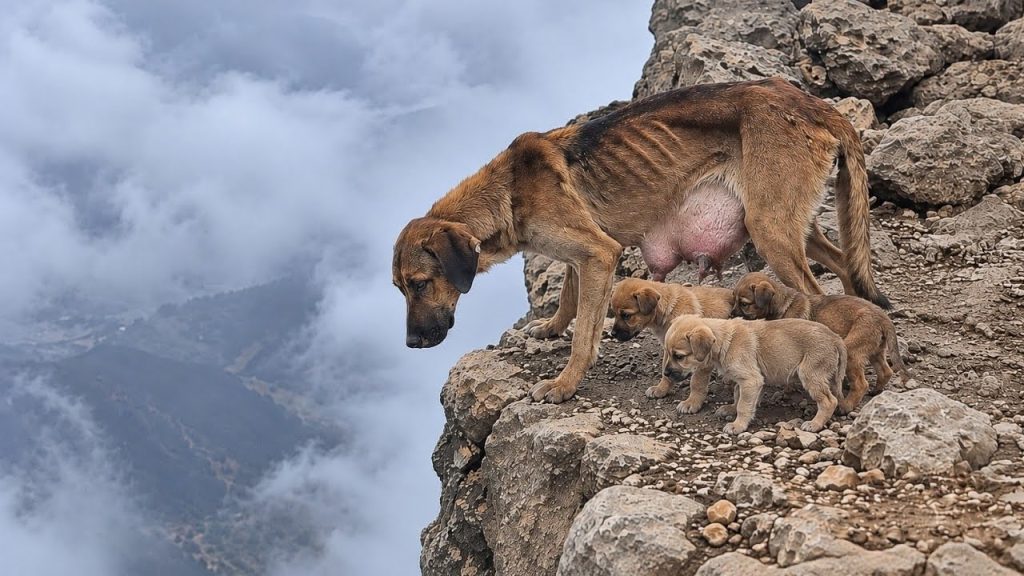
The mountain was Rucu Pichincha in Ecuador, rising above the city of Quito. Its slopes can challenge even prepared climbers. For a mother dog trying to keep three young lives alive, the conditions were especially harsh. There was no simple path to safety, only difficult terrain and dangerous weather.
How the family came to be there remains unknown. Perhaps the mother had wandered too far, or perhaps someone had left her behind. Neither explanation has been established. What mattered was what a hiker discovered: a dog and her puppies in desperate need of help, dangerously close to a cliff’s edge.
The hiker’s discovery changed the direction of their story. Word reached animal protection authorities, and people who could help began working together. An organization called Amigos de Lucas joined Quito’s municipal animal care unit, local authorities, and volunteers to arrange a rescue. Their efforts became a shared responsibility, with lives at stake.
Reaching the dogs was no ordinary rescue call. At that elevation, every stretch of mountain posed a challenge. Poor visibility complicated the effort. They were trying to bring an exhausted mother and three vulnerable puppies away from danger.
When the team reached the mother, they found that she was severely weakened. She could not walk down the mountain by herself. That changed everything. Finding her was only the beginning. To save her, the rescuers would have to make sure she could complete a journey her body could no longer manage.
Anyone who has loved a dog can understand the anguish of seeing a mother so weak, with three puppies depending on her. A dog cannot explain how long she has struggled or what brought her to a lonely place. She can only endure what is in front of her, until someone recognizes that she needs help.
Those who came to the mountain did recognize it. They continued their efforts despite the challenging landscape, determined to get the entire family to safety. Their work meant that the dogs would not have to face the mountain alone any longer. The same slopes that had kept them trapped now became the path their rescuers had to overcome.
One part of the rescue stands out for its quiet compassion. Because the mother was too weak to descend on her own, a rescuer carried her on his shoulders for five kilometers down the mountain. Five kilometers of difficult ground, with another living creature depending on his strength. It was a practical act of care, but also a powerful expression of what kindness requires.
Whatever else was on the rescuer’s mind as he walked, his compassionate action spoke clearly. Her weakness would not be the reason she was left behind. Where her own legs could not take her, another person provided the means to go forward. Sometimes compassion is not a grand speech. Sometimes it is the willingness to shoulder a burden, literally.
The rescuers succeeded in bringing the mother and all three puppies away from the perilous cliff. Their next need was medical attention. Once the family reached veterinary care, examinations revealed the toll of the conditions they had endured. The dogs were dehydrated, malnourished, and severely exhausted. The journey off the mountain had removed one immediate danger, but their physical condition still required care.
These findings were a painful reminder that exposure and a lack of nourishment do not leave an animal unharmed. Cold weather and harsh surroundings can take away strength little by little. For a mother caring for puppies, the stakes are shared among several fragile lives. The rescue had given them access to people qualified to assess their needs and begin helping them.
The rescuers named the mother Cumbre. In Spanish, the word means summit or peak. It was chosen in memory of the extraordinary place where she had been found. There was something fitting about naming her for the mountain, though the name now represented more than the height of Rucu Pichincha.
Cumbre would no longer be known only as a nameless dog stranded high above the world. Her name held both the hardship of the place and the compassion that brought her down from it. It acknowledged what she had survived without pretending that anyone knew every part of her past. Some stories have unanswered questions, even when their most urgent chapter has changed.
No one could say with certainty why Cumbre and her puppies had ended up on that mountain. There was no confirmed account of abandonment, no clear explanation of how they arrived. Speculation could not help them. The decision to act, however, had already made a difference that was real and immediate.
The rescue did not guarantee recovery or adoption. What lay ahead for Cumbre and her puppies remained uncertain. Still, a meaningful change had taken place. Instead of remaining on a freezing mountainside, the little family had been brought down to receive medical attention. They had been found, carried through danger, and given a chance that had seemed painfully distant.
It is easy to think of a rescue as one dramatic moment. Cumbre’s experience reminds us that help can be a series of difficult choices: noticing suffering, asking for assistance, bringing people together, and refusing to let exhaustion end the effort. Each choice mattered, especially to a mother who could not make the journey alone.
Somewhere on Rucu Pichincha, the distance between despair and hope measured five difficult kilometers on a rescuer’s shoulders. For Cumbre and her three puppies, those kilometers opened the way toward care and safety. The mountain was high, the weather harsh, and the path uncertain. Yet people came for them. And sometimes, that is where a second chance begins.