His belly was so swollen that it dragged against the cold ground. Each step was difficult. Even breathing had become a struggle. Yet the dog remained chained, carrying a burden no animal should have to bear alone.
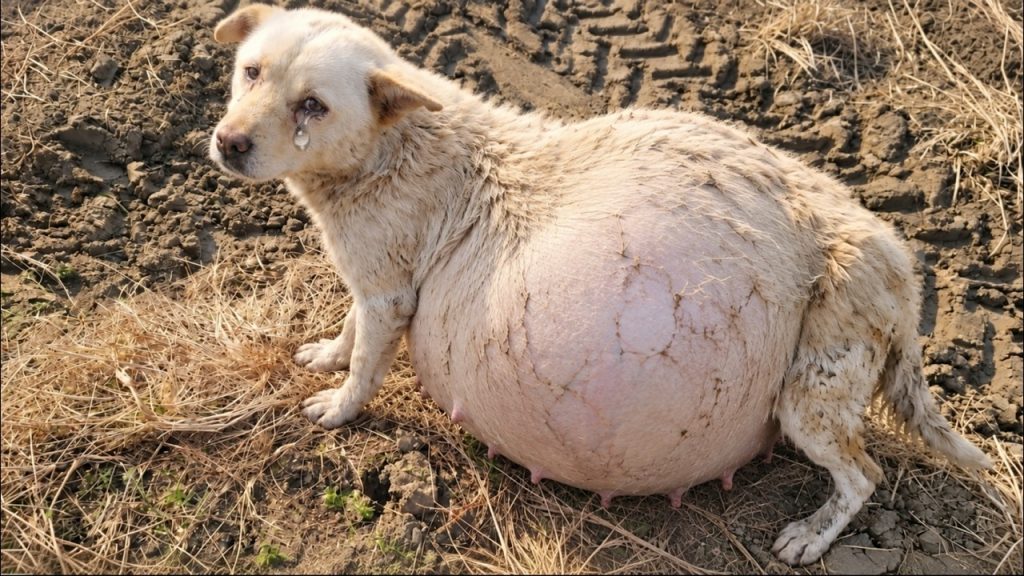
His name was Haenguni, a name that means Lucky. When he was found, there was little about his condition that seemed fortunate. Neglect had left him in desperate need of medical attention. The enormous swelling was impossible to overlook, but its cause was even more troubling than it appeared.
For a dog, the freedom to move comfortably matters. So does the ability to rest without pain and take an easy breath. Lucky had been deprived of those ordinary comforts. His swollen abdomen pressed heavily against him, turning movement into an exhausting effort. The chain made his circumstances even more distressing. He needed help beyond anything that could be offered where he had been found.
Lucky was rushed to a veterinary hospital, where the seriousness of his illness became clear. Veterinarians diagnosed him with stage 4 heartworm disease. It was advanced, and his body showed the consequences. At admission, he weighed 43.2 kilograms. Astonishingly, about 15 kilograms of that weight came from fluid collected inside his abdomen.
Those numbers describe more than a medical problem. They help explain why walking and breathing had become so difficult for him. Imagine carrying that much extra weight inside a body already struggling with serious illness. Lucky could not simply be relieved of it all at once. Removing so much fluid too quickly could send him into shock, creating another dangerous crisis.
His veterinary team therefore drained the fluid carefully, in several sessions. Every step of the process had to balance the urgent need to ease his suffering with the danger of changing his condition too suddenly. The treatment was not a quick solution. It demanded patience, close attention, and an understanding of just how fragile he had become.
Gradually, the pressure in his abdomen eased. With less fluid weighing him down, Lucky could breathe more comfortably. What many healthy dogs experience without a second thought was a meaningful improvement for him. It was a moment of relief, but it was not the end of his struggle. The illness responsible for his suffering still had to be treated.
Heartworm treatment is difficult even when a dog has strength to spare. For Lucky, whose disease had already reached stage 4, the challenge was especially severe. He endured intense, painful injections as veterinarians worked to treat the infection. There was no easy path through that part of his care, only the necessary treatment and the determination to continue.
His hospitalization stretched beyond 200 days. That length of time speaks to the seriousness of his condition and the care he continued to require. Lucky’s life was no longer defined by the chain where he had been discovered, but freedom from that neglect did not mean freedom from illness. His caretakers had to face one medical challenge after another with him.
At last, Lucky survived the heartworm treatment. It was an important victory for a dog who had arrived in such frightening condition. But recovery did not unfold into the uncomplicated happy ending everyone would have wished for him. The damage associated with his illness remained, and new concerns made his future uncertain.
Fluid continued to accumulate inside his abdomen, a condition known as ascites. Veterinarians also discovered a tumor in his spleen. Even after he had survived the treatment for heartworms, his body remained vulnerable. The swelling that had once made his condition so alarming could return, bringing discomfort and the need for more medical intervention.
There was no permanent cure available for Lucky’s recurring fluid retention. He would need ongoing medication, along with repeated procedures to drain his abdomen whenever the swelling became dangerously severe. His care could not be measured by a single hospital visit or one successful treatment. It had become a continuing effort to help him live as comfortably as possible.
The prognosis was limited. That reality cannot be softened into a promise that everything will be fine. Lucky faces serious health problems, and his medical needs have not disappeared. But neither has the part of him that reaches toward the people caring for him. Despite everything his body has endured, he still shows affection. He still smiles in the way that makes a dog’s gentle nature so unmistakable.
There is something deeply moving about that contrast. Lucky has known confinement, physical suffering, painful treatment, and ongoing uncertainty. Yet he continues to respond to kindness. He has not stopped offering warmth to the people around him, even when his own days require so much care. His resilience does not erase his pain. It simply makes his need for compassion more urgent.
The cost of keeping Lucky comfortable has grown alongside the demands of his treatment. Long hospitalization, medication, and repeated draining procedures bring overwhelming veterinary bills. Donations are being sought to help cover those expenses so that his caretakers can continue providing the medical attention he depends on. For Lucky, that support means more than numbers on a bill. It means another opportunity to be cared for.
His story has no certain ending yet. He still needs treatment, and there may be difficult days ahead. What has changed is that he is no longer facing those difficulties without people willing to help him. The dog once chained to the ground now has caretakers who recognize that his life matters, even when his needs are complicated and his future is uncertain.
Lucky’s name may have sounded painfully out of place when he was first found. Today, it carries a different kind of meaning. Being lucky does not always mean escaping illness or receiving a perfect ending. Sometimes it means being seen, receiving care, and finding gentleness when it is needed most. Whatever comes next, Haenguni deserves every possible measure of comfort, dignity, and love.