The wind came in without mercy that afternoon, pressing hard against the black umbrellas held by trembling hands. Rain had softened the earth beneath everyone’s feet, and the air carried that particular heaviness that only grief can produce — thick, suffocating, impossible to breathe through without feeling it in your chest.
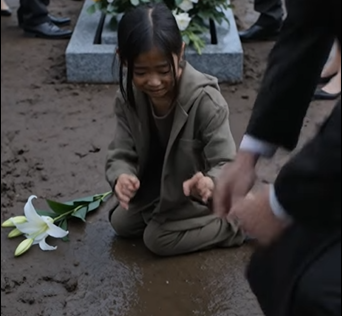
At the edge of the burial plot, a little girl knelt alone in the mud.
She was small, perhaps six or seven, dressed in a torn coat that was clearly not warm enough for the weather. In her hands, she clutched a single flower — broken now, its stem snapped clean — pressing it against her chest as though releasing it would mean losing the last piece of something irreplaceable.
Her mother had sent her here. Her mother, who could not come herself.
The priest stood at the head of the coffin, his hands wrapped around a pale silk ribbon. He had not yet been told why the child was there. He only knew that the widow — the man’s official wife — had struck the little girl’s hand away when she tried to place that flower on the casket. The slap had been quiet but sharp. The crowd had seen it. Nobody had spoken.
The widow was the first to break the silence.
“It means nothing,” she said, her voice too fast, too controlled. “A cruel trick. Nothing more.”
But the priest was no longer listening to her.
With fingers that would not stop shaking, he gently moved the funeral arrangement away from the lower edge of the coffin — and there, beneath the polished main memorial plaque, he found something almost no one had noticed until that moment.
A smaller engraving. Hidden, intentional, carved close to the base where flowers would cover it.
A child’s name. A daughter’s name.
The same name that was stitched inside the silk ribbon he was holding.
A low, stunned murmur moved through the mourners like a wave.
The little girl looked up through tears that had been falling long before anyone arrived.
“My mother told me,” she whispered, her voice impossibly steady for someone so young, “that if the name was already waiting there, then he knew the truth before he died.”
The priest closed his eyes for one long moment, as though the weight of those words required him to be still before he could carry them.
What was becoming clear — what the coffin itself seemed to be insisting upon — was this: the man being buried had, in public, mourned only one family. But in private, in the quiet language of engraved stone and hidden ribbon, he had claimed a second daughter. A child no one in the official family had ever acknowledged. A daughter who had been kept invisible, unnamed in every gathering, absent from every photograph.
And now that daughter was here.
Kneeling in the mud, still holding her broken flower.
The widow took one slow step backward.
“That plaque was private,” she said softly.
But those words — meant to close the conversation — only forced it wider open.
Because if the plaque was truly private, sealed from public knowledge, then the only way the child could have known the name engraved upon it was if someone had told her. Someone who had once stood close enough to the man to know where he had hidden his love.
Her mother.
The priest unfolded the silk ribbon along its full length and found, stitched carefully inside the seam where no careless eye would find it, more writing.
He read it aloud, his voice breaking on nearly every word:
“If they refuse to let my flower touch his coffin, tell them he carved our daughter’s name beside his heart before they erased us both from the family.”
The gasp that moved through the crowd was not dramatic — it was the kind that happens when people suddenly understand something they had been looking at without seeing.
Every eye turned slowly to the little girl.
The same deep-set eyes as the man in the coffin. The same shape of the chin. The same expression — that particular kind of quiet sorrow that people carry when they have loved someone who could not fully love them back in the open, in the daylight, in the proper spaces where love is supposed to live.
The child reached into her coat and produced one final object — a small silver charm, caked in dirt, worn smooth from years of handling.
The priest cleaned it gently with the edge of his vestment.
He went pale.
It was a broken piece of a rosary. The dead man’s rosary — one he had worn faithfully for years, one that the family had later claimed had been buried alongside another woman he once mourned. A rosary that was not supposed to exist anymore.
The little girl swallowed hard before speaking again.
“My mother said he broke it in half the night he promised he would not leave us.”
The mourners were no longer murmuring. They were simply standing still, watching the widow with a kind of collective, wordless recollection — because many of them were now remembering the same quiet truth: she had controlled every element of this funeral. The arrangements, the plaques, the flowers, the sealed family documents. She had decided what the world would see.
And what it would not.
The priest turned toward her slowly, something ancient and heartbroken in his expression.
And before she could retreat another step from the coffin, he asked the question that would never fully leave the people standing in that cemetery:
“You did not strike this child because she brought a lie.”
He paused.
“You struck her because she brought back the daughter this family tried to bury in silence.”