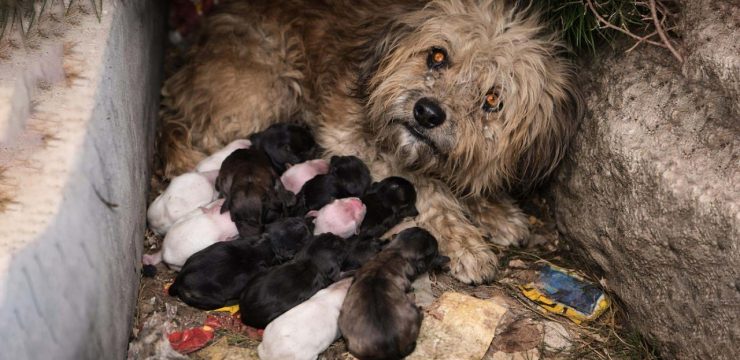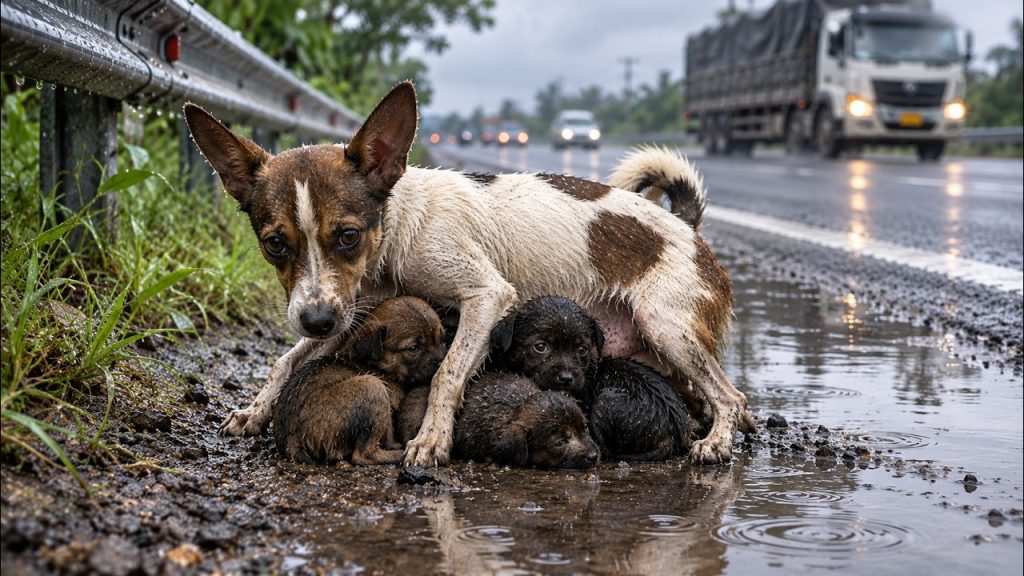
The mother was white with brown patches. She had settled among dry leaves in a quiet, neglected garden, keeping her babies against a mossy wall. The tiny puppies had dark or brown coats and were newly born. Their eyes were closed. They depended on her for everything, despite her uncertain surroundings.
When a person approached, she growled, barked, and showed her teeth. Her reaction was fierce, but it was also understandable. She had vulnerable puppies to protect, and she had no reason to know whether a stranger meant to help. Each warning guarded her family.
Then she began to move them.
One by one, she picked up the puppies in her mouth and carried them across the cluttered yard. Past scattered objects, fencing, and fallen leaves, she sought another place away from the approaching person. She settled them near a pile of bricks and bushes, seeking whatever cover she could find.
Yet the new hiding place offered little real protection. The ground was damp, and the space was open to the elements. Leaves and branches could partly conceal her puppies, but they could not make a roof or a dry floor. With colder weather drawing closer, the weakness of that shelter mattered. The mother could not make that corner warm.
The person who found them recognized that a different kind of help was needed. Trying to force the frightened mother into an unfamiliar space could only add to her distress. Instead, the rescuer began building something she could choose for herself: a sturdy wooden shelter, placed right there in the garden.
The work started with simple materials. Wooden pallet boards became walls, while a gray plastic pallet was set aside to form a raised base. A hammer, nails, and a handheld drill helped turn loose pieces into a real structure. The work had one purpose: to give a mother and her babies a more protected place to rest.
Another person helped hold the frame while three wooden walls were brought upright and secured. Crosspieces reinforced the top. The builders then positioned the shelter beside the brick wall, near the dog’s familiar corner. Inside, the plastic pallet formed a floor that lifted the resting area above the damp ground.
A corrugated roof completed the structure. The rescuer set the roofing panel in place and fastened it with screws, creating a barrier against rain and wind. The shelter was not elaborate. It did not need to be. What mattered was that the little family would no longer have to rely on a bare corner of the garden when the weather turned rough.
Even with the building finished, one important question remained. Would the mother accept it?
Her first instinct had been to defend her puppies from human contact. She had already carried them away once, searching for somewhere she considered safer. No one could simply assume that a newly built wooden house would feel welcoming to her. The mother needed to enter willingly. For this mother, kindness was not a hand reaching toward her puppies, but a space that asked nothing of her.
So the rescuer let her make that decision.
A soft, velvety cushion was placed inside the wooden house. There was no struggle to take the puppies from their mother, no attempt to separate them from the dog who knew them best. Instead, she was allowed to investigate the space and decide whether it could become her family’s new resting place.
The answer came in a series of small, unforgettable movements.
She took one puppy in her mouth and carried it inside. Then she returned for another. Again and again, the little mother crossed between the exposed garden and the waiting cushion, moving her babies to the sheltered space herself. What she had done earlier out of fear, she now did toward a place that offered comfort.
She did not abandon her protective instincts. She simply found somewhere better to use them.
Once inside, her posture softened. The same mother who had greeted an approaching person with bared teeth now stood in the wooden house looking noticeably calmer. Her face seemed almost to smile. Then she went back to gather the puppies who were still outside, determined to bring the whole little family together.
Soon the newborns lay close against one another on the soft cushion. Their eyes remained closed as they slept, stirring now and then and making the faint sounds of very young puppies. The mother stayed nearby, sniffing and licking them with the attentive care she had shown from the beginning. Only their surroundings had changed. Her devotion had been there all along.
For her, the difference was profound. The yard still existed beyond the doorway, with its scattered leaves, exposed corners, and damp ground. But she no longer had to make a bed for her babies against the open wall. Wood surrounded them, a roof covered them, and a soft place held their small sleeping bodies.
Eventually, with the puppies resting together, the mother sat down and then lay beside their cushion inside the shelter. After all her anxious guarding and careful carrying, she could finally rest close to them in a space made for their protection.
There was no grand ceremony marking this change. A few boards, a raised floor, a secure roof, and a cushion had made the difference. More important still was the patience that allowed a frightened mother to accept help without losing control of her babies.
She had always known how to love her puppies. What she needed was a safer place to show it. And because someone offered that place with care, a family once exposed to the coming cold could sleep together under a roof of their own.