For one long second, the entire ballroom forgot how to breathe.
Not the elegantly dressed guests clutching their champagne flutes. Not the musicians standing silent in the corner with their instruments lowered. Not even the silver-haired man frozen beside the grand piano, his knuckles white against the polished wood.
Because in that moment, the melody drifting through the room was no longer just a song.
It was evidence.
A lifetime ago, before the tuxedos and the galas and the carefully constructed image of a generous, successful man, he had loved a woman. She was quiet and brilliant and full of music that the world hadn’t discovered yet. She played that exact melody on broken upright pianos in cheap apartments and borrowed rehearsal rooms. She wrote it while she was pregnant. She called it their daughter’s song before the child had ever taken a single breath.
Then the child came early.
There were complications. There were bills that stacked like accusations on the kitchen table. There was a fear so large it swallowed him whole. And there was a choice he made — a choice he dressed up as practicality but was, in the deepest part of himself, nothing more than cowardice.
He told her he would come back. He promised that when he had money, when he had power, when he had something real to offer them both, he would return and make it right.
He did go back. But he went back too late.
The apartment was empty. The neighbors said she had left, but no one could say where. No forwarding address. No trace. No answer to any question he asked. It was as if the world had simply closed over her like water over a stone.
So he buried the song instead.
He never played it again. He never allowed her name to be spoken in his presence. He built a life grand enough and loud enough that silence began to look like strength, and absence began to look like peace. He convinced everyone around him — and almost convinced himself — that he was a man who had simply moved forward.
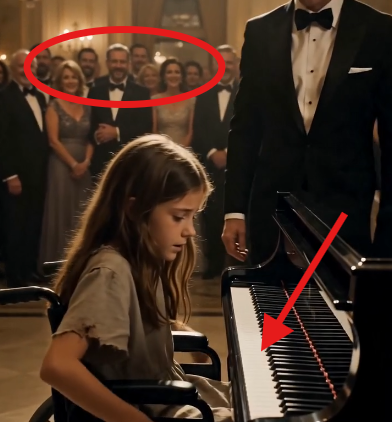
And then a young girl in a worn dress sat down at his piano at the most prestigious charity gala of the season and began to play that melody. Note for note. Pause for pause. Including the small, particular hesitation her mother always placed between the third and fourth bars — a habit so personal, so specific, that no sheet music in the world could have taught it.
His voice came out rough when he finally spoke.
“What was your mother’s name?”
The girl answered without fear, without hesitation, and without looking up from the keys.
And it was her.
No mistake. No strange coincidence. No trick of memory or grief.
The room tilted beneath his feet.
He looked down at the silver-stitched initials on the hem of the girl’s dress — initials he recognized as his own, stitched into a folded blanket he had left behind in a half-painted nursery — and he finally understood what everyone else in that ballroom could not: this child had not simply learned the song from the woman he had once walked away from.
She had carried the proof of him with her since the day she was born.
The girl’s fingers slowed, but she did not stop playing.
“My mother said you left before you ever saw me,” she said quietly.
That line landed harder than any accusation could have. Because it wasn’t cruelty. It was simply the truth, spoken plainly by someone young enough to still believe the truth was enough.
He had seen an ultrasound photograph. He had seen a half-painted nursery wall and a folded blanket with his initials stitched carefully into the corner. But he had never seen his daughter. Not until this moment. Not until she sat in front of him in a room full of strangers and played the song her mother wrote for her before she was even born.
A woman near the back of the crowd began crying quietly. The others had long since stopped watching a spectacle. They were watching something far more devastating — a man’s carefully preserved life cracking open in front of them, slow and irreversible as a fault line giving way.
He lowered himself onto the piano bench beside her. He didn’t consider how it looked. He didn’t think about the cameras or the guests or the reputation he had spent decades building.
His hand hovered over the keys, trembling more than hers ever had.
The girl turned to face him fully for the first time. Not with anger. Not with softness either. With something far more difficult to bear — a quiet, absolute certainty that had been with her far longer than this evening.
“She said if you heard the song and still walked away,” the girl told him, “then I should never call you father.”
That was the moment it finished him completely.
Because suddenly this was no longer only about emotion. It was about something older and heavier than feeling. It was a moral reckoning delivered without drama by a child who had simply arrived carrying everything he had left behind.
The whole room held its breath while he looked at the daughter he had abandoned before he ever knew her face.
Then, with fingers that could not quite stop shaking, he placed his hand beside hers on the keyboard.
And together, they played the final line of the melody.
The note rang through the ballroom like a door opening — quietly, slowly, heartbreakingly late.