For one long second, nobody in the funeral parlor moved.
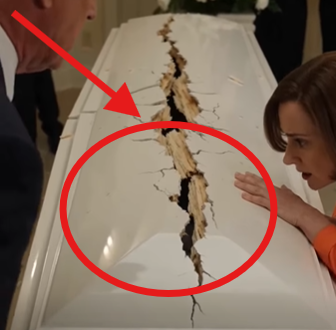
Not the mourners draped in black, clutching their handkerchiefs and their grief. Not the maid standing near the doorway, her knuckles white around the handle of the axe she had used to crack open the lid. Not even the older man — the one who had organized everything, who had directed the grief, who had insisted, again and again, that the coffin remain closed.
Nobody moved.
Because the ring changed everything.
It was not simply a hand pressing through the splintered wood. It was his ring on that hand. Heavy. Unmistakable. A family signet engraved with a crest that every single person in that room recognized as belonging only to him. The maid’s eyes traveled from the hand to the man, then slowly back again, and in that moment, the horror in the room shifted its shape entirely.
This was not a miracle.
This was a secret detonating at the worst possible moment.
The hand pushed harder through the broken lid. Then came another weak knock from the inside — and then a sound that hollowed out every soul present: a choked, desperate breath from someone who had almost run out of them. The older man stumbled forward. The commanding posture crumbled. The fury dissolved. What remained was something far more revealing — a man coming apart at the seams.
Two mourners rushed forward together and pulled the cracked lid aside.
Inside lay Emily.
Pale. Dazed. Alive.
Her lips were cracked and dry. Her breathing came in ragged, shallow pulls. Her wrists bore the bruises of ribbon and funeral fabric pressed too tightly against skin that was still, impossibly, warm. Her eyes opened slowly — confusion first, then terror — and then they locked onto the older man with a clarity that needed no words.
The room went absolutely still.
Because in that silence, every person present began to understand the most devastating truth of all: Emily had not been buried by mistake. She had been prepared for burial while her heart was still beating.
The maid broke first. Tears streamed down her face — not tears of sorrow, but of fury and relief colliding at once.
“I told you,” she whispered, her voice barely holding together. “I heard her scratching when I came in with the flowers.”
Emily tried to pull herself upright, but her body refused. One of the women in mourning caught her shoulders and held her with trembling hands.
The older man sank to his knees beside the coffin.
Not from grief.
From the weight of being seen.
Because the ring on Emily’s wrist had already told the room what his mouth never would. He had placed it there — or someone loyal to him had. A final gesture dressed up as sentiment. A last act of ownership disguised as farewell. A lie wearing the face of love.
Emily’s hand trembled as she yanked the ring free and hurled it at his chest. It struck his suit jacket and fell to the polished floor with a sound that rang out sharper than the axe ever had.
One mourner, barely able to form the words, whispered: “What did you do?”
The older man opened his mouth. Emily’s voice came first.
“He said it would be easier if they thought I was gone.”
No one breathed.
She steadied herself and forced the next words out.
“He said I knew too much.”
And there it was — the real burial. Not a woman in a coffin. A witness.
Emily had stumbled onto something she was never supposed to find. Financial documents. Wire transfers. Forged signatures. Proof, painstakingly assembled, that the older man had been draining estate funds for years — siphoning wealth through false trusts and accounts that existed only on paper. She had confronted him before the will could be read. She had told him she would expose everything.
So he solved the problem the way powerful men sometimes do when they believe consequences belong only to other people: not with outright violence, but with something slower and more surgical. He made her disappear in a way that would be mourned too quickly and questioned too late. A sudden illness. A closed coffin. Grief directed carefully away from suspicion.
The maid looked at him now with something far colder than hatred.
“You put your ring on her hand,” she said quietly, “because you believed dead women cannot speak.”
Emily’s voice cracked, but she kept going.
“You told them I was sick. You told them not to open the lid. You told them to let me go.”
That was the moment the room finally broke wide open.
Because they all remembered. The rushed preparations that nobody questioned. The insistence on a closed casket that had seemed, at the time, like grief. The way mourning had been carefully stage-managed from the very beginning. The way every instinct toward suspicion had been gently, expertly redirected.
The older man tried once more to speak. But there are moments when words become meaningless — when the evidence already alive in the room renders language obsolete.
A woman, pale and breathing, sitting up in her own coffin.
A ring lying on the floor where she had thrown it.
A maid who had stood alone in her certainty, who had picked up an axe because she was the only person willing to believe that a sound no one else wanted to hear might mean something.
And a room full of mourners who came to grieve a death — and instead became witnesses to something far more profound:
the moment a burial failed,
and the truth refused to stay buried with it.