The bakery was warm. The kind of warm that smells like butter and sugar and everything a childhood is supposed to feel like. But the two children standing near the pastry case didn’t belong to that warmth. They were borrowing it — just long enough to ask for something they could barely afford.
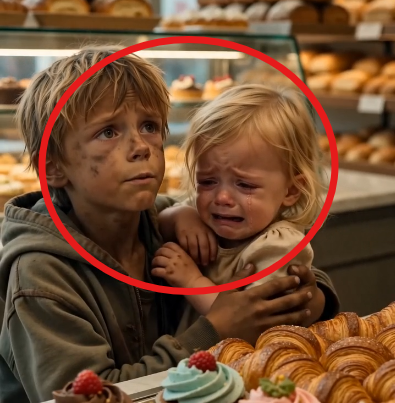
The boy was maybe ten, possibly older, though hunger has a way of making children look younger than they are. He held his little sister against his side with the practiced grip of someone who had been doing it for a long time. The toddler — round-faced, wet-eyed, clutching his sleeve — hadn’t said a word since they walked in.
They were asking for day-old bread. The kind the bakery would otherwise throw away.
That was when the older man noticed the pendant.
It hung around the boy’s neck on a thin silver chain — a small, delicate thing that didn’t belong to a child in worn-out shoes. The man went still. His coffee cup stopped halfway to his lips. Something passed across his face that the other customers couldn’t quite name.
He had seen that pendant before.
The boy felt the stare and pulled his sister closer. He had learned, the hard way, that attention from strangers rarely led anywhere good. But the man didn’t move toward them aggressively. He moved the way people move when they’re afraid of what they might find — slowly, carefully, like someone walking toward the edge of something they can’t take back.
“Where did you get that?” the man asked softly, nodding toward the pendant.
The whole bakery had gone quiet without anyone deciding to make it so.
The boy’s answer was measured, every word chosen with the caution of a child who had learned that information could be used against you.
“My mother gave it to me.”
“Your mother.” The man repeated it like a prayer. “Where is she?”
The boy swallowed. His lips trembled once before he steadied them.
“She told me if she didn’t come back… to keep Lily safe.”
The man looked at the little girl.
“Lily?”
The boy nodded.
And the man staggered back half a step as if the single word had physically struck him. Because that name — Lily — had once lived inside a little girl’s daydream. His daughter’s daydream. She had announced it at the dinner table when she was barely seven years old, completely certain, the way only children can be: I’m going to name my daughter Lily someday.
He had laughed at the time. He couldn’t remember now if he had told her it was a beautiful choice.
He couldn’t remember a lot of things he wished he had said.
The woman behind the counter set down the pastry box without a sound.
The man forced his voice to work. “What was your mother’s name?”
The boy hesitated. He had protected that answer through cold nights and empty cupboards and every door that had been closed in their faces. He did not give it away easily.
But something in the man’s expression — the rawness of it, the grief too old and too real to be performed — cracked something open in him.
“Anna,” the boy whispered.
The man did not shout. He did not collapse. He simply inhaled — sharp, short, like a man surfacing from water — and then his face fell apart in the quiet way that real grief does. Not dramatically. Just completely.
His daughter Anna had walked out of his life after a painful family falling-out. He had searched for her in every way a father could. He had hired people. He had followed rumors to dead ends. He had held onto hope long past the point where hope made sense. And slowly, the world had asked him to let go.
He had never fully managed it.
And now here were her children — dirty hands, tired eyes, asking for bread that no one else wanted.
He covered his mouth with one trembling hand.
The boy watched him, trying to decide whether this was grief or danger. He had learned that the two could look almost identical.
“I’m her father,” the man said finally.
“No.” The boy’s voice was flat. Protective.
“I am,” the man said, and his tears were in his voice now, not just his eyes. “I’m your grandfather.”
The little girl — Lily — looked between them with wide, uncertain eyes and pressed herself harder against her brother’s side.
The boy didn’t believe him. Couldn’t let himself. Not after everything. Not after learning that the people who made promises were usually the same people who disappeared.
“She never told me about you,” the boy said.
The grandfather nodded slowly, painfully.
“She had every reason not to.”
That single sentence landed differently than any explanation could have. Because it wasn’t a defense. It was an admission. And the boy was old enough — had been old enough for a while now — to recognize the difference.
The man looked at the pendant again. Then at the dirt on the children’s hands, the wear in their clothes, the particular exhaustion that lives in the eyes of children who have been carrying things no child should have to carry.
He stepped closer. Carefully. The way you approach someone who has every reason to run.
“I was too late for her,” he said, his voice barely holding. “Please don’t make me too late for you.”
The boy’s eyes filled completely.
He wanted to stay hard. He had worked so hard to stay hard.
But Lily had already turned toward the pastry boxes with quiet, certain interest. And the man was crying — not for show, not from guilt alone, but from recognition. From the specific devastation of seeing your child’s face in a stranger’s eyes.
The woman behind the counter had begun filling boxes without being asked. Bread. Rolls. Pastries. Anything within reach. Nobody stopped her.
The boy looked down at his sister. Then back at the man who claimed to be his grandfather.
“If you’re really her father,” he said, his voice breaking at the edges, “why didn’t you find us?”
The man lowered his head.
“I was looking for my daughter,” he said. “I never knew she had left me two reasons to keep searching.”
The boy’s face shifted. Just slightly. Just enough to let a fraction of light in.
The grandfather slid the pastry box gently toward Lily. She took a piece of bread in both hands with complete toddler confidence, leaned her head against her brother’s shoulder, and said, through a full mouth and without a single moment of hesitation:
“I like Grandpa.”
And for the first time in longer than he could remember, the boy almost smiled.