The Old Man Who Walked Into a Salon With Nothing But a Crumpled Dollar Bill
The whole salon went silent the moment he stepped through the door.
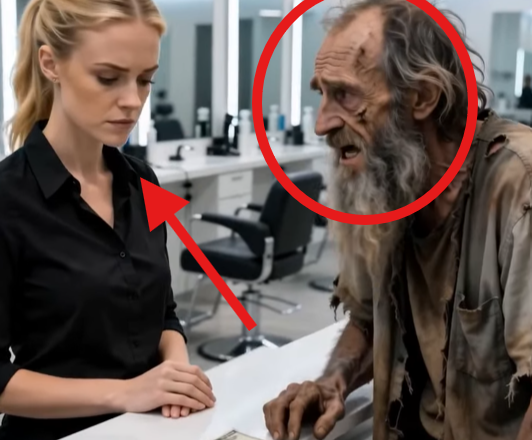
His coat was torn at the seams. His shoes didn’t match. His beard was long and tangled, the kind of unkempt gray that made people look away instead of look closer. He shuffled toward the front desk, and the receptionist barely glanced up before her face twisted into something between annoyance and disgust.
“Don’t waste your time,” she muttered to the young barber standing nearby, just loud enough for the old man to hear. “He can’t even pay you.”
The barber said nothing.
He walked over, took the old man gently by the arm, and led him to an empty chair like he was escorting royalty. He shook out a clean cape and fastened it around the man’s shoulders with the same care he’d give any paying customer, maybe more.
The old man caught his reflection in the mirror and studied the young man behind him for a moment.
“You’re kind,” he said quietly.
The barber offered a soft smile, the kind that comes from somewhere deep and personal.
“My father needed help once,” he replied. “Somebody gave him a chance when nobody else would. I never forgot that.”
The scissors began their slow rhythm. Gray strands drifted down onto the tile floor, one after another, like snow falling on a quiet street. With every pass of the comb, every careful trim, something in the old man’s face started to shift.
It wasn’t just a haircut. It was an unveiling.
Underneath the matted beard and the layers of dirt and neglect, there was a jawline that looked almost… familiar. The receptionist, who had gone back to her paperwork, slowly stopped typing. Her eyes lifted toward the chair.
One of the other stylists leaned toward a coworker and whispered, “Wait… do you see that too?”
Nobody answered. Nobody could look away.
The barber finished trimming the last strand of hair, brushed the loose pieces from the man’s shoulders, and turned the chair to face the mirror directly.
The old man sat there for a long moment, just staring at himself. Not at the haircut. At the man underneath it. Like he was meeting someone he hadn’t seen in years.
Then, slowly, he reached into the lining of his torn coat and pulled out something that didn’t belong to a homeless man at all.
An old, weathered gold key.
The receptionist’s face drained of color. The young barber’s brow furrowed, confused.
“What is that?” he asked.
The old man rose from the chair, steadier now than when he’d walked in.
“This salon,” he said, his voice low but firm, “used to belong to my wife. She built it from nothing. Every chair, every mirror, every doorframe — it was hers. After she passed, I couldn’t bear to step foot in here again. I let other people run it while I disappeared from the world. I stopped shaving. I stopped caring what people thought of me. I just… wanted to disappear.”
The room had gone completely still. Nobody moved. Nobody dared.
He turned his gaze to the receptionist, who suddenly looked very small behind her desk.
“I came in today with one dollar in my pocket,” he said. “Just one dollar. I wanted to see, with my own eyes, what kind of people were running my wife’s dream. Whether they still understood what she stood for.”
She opened her mouth to speak, but nothing came out. There was nothing she could say that would undo the words she’d already spoken.
The old man turned back to the young barber, and something in his expression softened completely.
“You didn’t see a homeless man sit down in your chair,” he said. “You saw a person. You saw someone worth your time, your kindness, your respect — even when you thought I had nothing to give you in return.”
He placed the gold key into the barber’s palm and closed the young man’s fingers around it.
“This is my surprise for you.”
The barber’s eyes welled up immediately. His hands were shaking.
The old man smiled, the first real smile anyone in that salon had seen from him all day.
“As of today,” he said, “this place belongs to the only person in this room who remembered what it means to be human.”
Stories like this one have a way of staying with us long after we’ve read them. They remind us that we never truly know who’s sitting in front of us — the tired stranger, the quiet customer, the person everyone else has already written off. Kindness costs nothing, yet it carries the heaviest weight in moments like these. The young barber didn’t help an old man because he expected anything back. He helped him because his father had once been on the other side of that same kindness, and he never forgot the lesson.
That’s the part of this story worth carrying with you: the people who give without conditions are usually the ones life chooses to reward in ways they never saw coming.