The old man kept his hand low, resting just beneath the edge of the table. It was a small gesture — barely noticeable — but it was enough to block the younger man’s view of what was happening near the floor.
His eyes, however, never left the photograph.
A young woman smiled up at him from the worn and faded image, her arms wrapped around a newborn baby swaddled in a red blanket. The kind of smile that belonged to someone who still believed the world was full of good things. The kind of smile that breaks a person in half when they realize it’s gone.
His chest tightened. He knew that smile. He had spent years — long, hollow years — trying to forget it.
The younger man standing nearby noticed the silence stretching too long. He straightened his collar. His white shirt was pressed perfectly, the kind of clean that tries too hard.
“What are you hiding?” he asked, his voice low but edged with something cold.
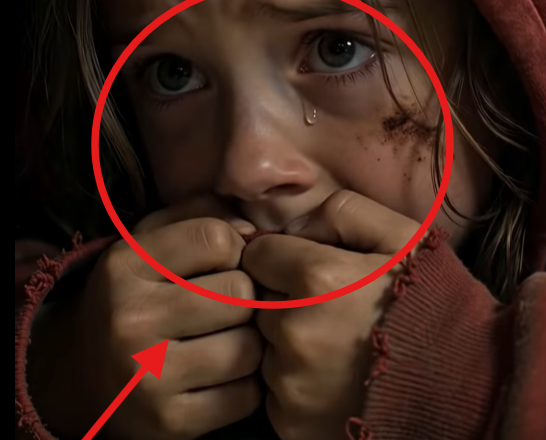
The old man reached down slowly and picked up the photograph. He turned it over once in his rough, weathered hands, then looked at the small girl crouching quietly beneath the table. Her eyes were wide. Her chin was trembling.
His voice dropped to something almost gentle.
“Where did you get this?”
The girl swallowed hard. She looked like she hadn’t eaten in a while. She looked like she hadn’t slept either. But she held herself together the way children do when they’ve learned too early that falling apart isn’t safe.
“My mom gave it to me,” she whispered. “She said if I ever got scared, I should find the man with grey eyes in the old bar.”
The old man stopped breathing.
Just for a second. Just long enough for the world to tilt slightly beneath his feet.
The younger man shifted his weight and stood up straighter.
“She’s confused,” he said quickly, his tone dismissive. “She belongs with me.”
Around the room, the locals sitting near the bar didn’t move aggressively — but they shifted. The way men do when something unspoken passes between them and they understand, without a single word, that they are being called to stand.
The old man did not look at them. His eyes stayed fixed on the child.
“What’s your mother’s name, sweetheart?”
The girl’s lips trembled. She pressed them together first, like she was deciding whether it was safe to answer. Then, barely louder than a breath, she said it.
“Anna.”
The name moved through him like a current.
Anna.
His daughter.
His only daughter, who had walked out of his life one quiet evening and never come back. Not because she had stopped loving him. But because she was running — running from a man who knew how to wear kindness in public like a well-fitted suit, and how to use fear like a weapon behind closed doors.
She had told him that much before she disappeared. She had looked him in the eye and said, I have to go, Dad. He’ll find me if I stay. And then she was gone. No phone calls. No letters. Nothing but the silence that follows when someone you love chooses to vanish rather than stay in danger.
The old man looked down at the photograph again. At the baby wrapped in red. At Anna’s face, bright with hope.
Then he looked at Ellie.
She had Anna’s jaw. Anna’s way of watching a room before deciding to trust it.
“What’s your name?” he asked quietly.
“Ellie.”
His hand closed around the edge of the table. Slowly. Steadily.
That was the name Anna had chosen — months before she disappeared, she had told him, laughing softly over coffee, If I ever have a daughter, I’m going to call her Ellie. He had teased her about it. He had kissed the top of her head and said it was a beautiful name.
He had never imagined he’d hear it like this.
The younger man took a step backward, angling himself toward the door. Casual. Calculated. The kind of movement that pretends to be nothing.
The old man finally stood.
He rose slowly, the way mountains don’t rush and rivers don’t apologize. Every inch of his six-foot-two frame unfolded from that barstool like a door opening that couldn’t be closed again.
The whole room rose with him.
Not loudly. Not with chairs scraping or voices raised. Just a quiet, collective rising of men who had lived long enough to recognize when something real was happening in front of them.
He stepped forward and placed himself — deliberately, completely — between Ellie and the man in the white shirt. He didn’t touch the man. He didn’t need to. He simply became a wall.
And then he spoke.
His voice was calm. The kind of calm that doesn’t come from peace, but from a man who has already decided what he is willing to do and has made his complete peace with it.
“You’re going to sit back down,” he said. “And you’re going to tell me exactly where my daughter is.”
No one in the bar moved.
Ellie, still crouched beneath the table, reached out and wrapped her small fingers around the hem of the old man’s jacket.
He didn’t look down. But his hand moved to cover hers — without hesitation, without even thinking — the way hands reach for the people they were always meant to protect.
The younger man’s composure cracked, just slightly, around the edges.
And the old man with grey eyes waited.
He had been waiting for eight years.
He could wait a little longer.