The rain had been falling for hours by the time anyone noticed the boy standing at the edge of the cemetery.
He was small, soaked to the bone, his shoes caked with mud, and his eyes locked onto something that everyone else in that crowd was desperately trying to look away from — the white coffin sitting at the center of it all, waiting to be lowered into the earth.
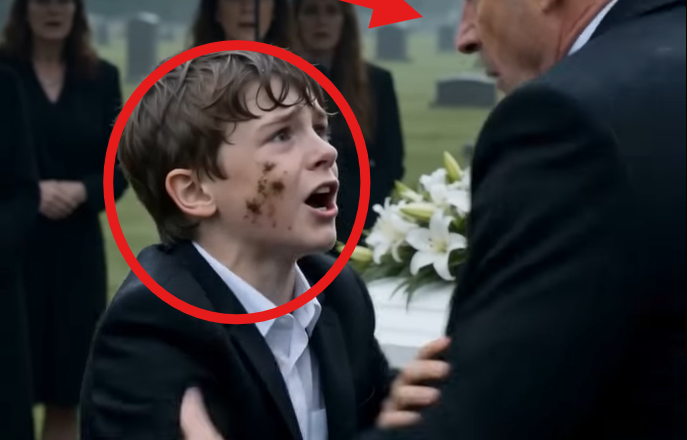
Nobody paid much attention to him at first. He was just a kid, after all. Poor-looking. Out of place. The kind of child that polished, grieving adults tend to look past without meaning to.
But he had not come to be seen. He had come because Emma was his friend, and Emma was not supposed to be dead.
The funeral had already begun when the father’s voice cut through the rain like a blade.
“Open it.”
It was not a request. It was not quite a command. It landed somewhere between the two — the voice of a man who had been holding himself together with nothing but the last fraying thread of hope, and who had decided, in that moment, to pull it.
The stepmother moved quickly, placing herself between the father and the coffin like she had every right to stand there.
“No,” she said, her voice low and steady. “Don’t do this to her memory.”
The father turned to face her slowly, and something in his expression made several people in the crowd take a small, unconscious step backward.
“If there is even one chance my daughter is still breathing,” he said quietly, “I will not bury her for your comfort.”
The funeral director approached the coffin with trembling hands. He had never been asked to do something like this before. He was not certain it was legal. He was not certain it mattered.
The boy stood in the rain and did not move. He stared at the white lid the way a person stares at something when their whole life feels like it is balancing on the edge of a single moment.
The stepmother leaned toward him slightly and whispered, just loud enough for those nearby to hear, “He’s lying. Don’t listen to him.”
The boy turned and looked at her. His voice did not shake the way you might expect a child’s voice to shake.
“You told me no one would believe a poor kid,” he said.
The father went completely still.
And then the lid opened.
For one long, suspended second, there was nothing but the sound of rain against white satin.
Then Emma’s fingers moved.
Just slightly. Just enough. A slow, trembling curl of four small fingers against the lining of the coffin — the most beautiful and terrible thing anyone present had ever witnessed.
A woman in the crowd let out a scream that seemed to come from somewhere deep in her chest, somewhere primal and raw.
The father dropped to his knees beside the coffin. His expensive suit hit the wet grass and he did not notice, did not care, would never care again about something so small.
“Emma?”
His daughter’s lips parted. A sound escaped — barely a breath, barely a whisper, but unmistakably alive.
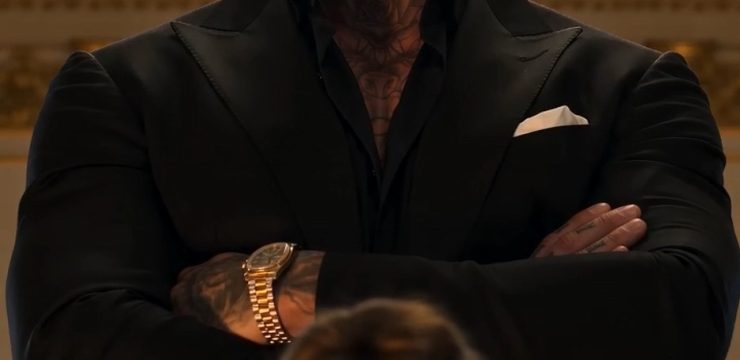
The father came apart completely. The composed, powerful man who had stood at the head of that funeral like a statue dissolved in an instant into something far more human — a father, on his knees in the rain, weeping over a child who had come back from the edge of something unthinkable.
“She’s alive. Someone call an ambulance. Now!”
The stepmother backed away from the coffin slowly. Her face had gone the color of the white lilies arranged around the casket. Her umbrella slipped from her fingers and no one moved to pick it up.
The boy reached into the pocket of his muddy jacket with shaking hands. He pulled out a small silver bottle cap, the kind of ordinary object that becomes extraordinary when it is the only evidence of the truth.
“She dropped this,” he said, his voice finally breaking the way a child’s voice is supposed to break when they have been carrying something far too heavy for far too long. “After she made Emma drink from it. I kept it because Emma told me — she told me that if anything ever happened to her, I needed to run. I needed to get help. I needed to tell somebody.”
The father looked at his wife. He looked at her the way a person looks at a stranger wearing the face of someone they once loved — with a kind of sorrow that goes beyond anger, beyond betrayal, into something quieter and more devastating.
“Why?” he asked. Just that one word. Just that single syllable carrying the weight of every dinner, every holiday, every moment he had trusted her with his daughter’s life.
The stepmother’s voice dropped to something barely audible.
“She was going to change the will.”
The rain seemed to pause around them, as if even the sky needed a moment to absorb what had just been said.
The father gathered his daughter’s cold hand into both of his own and bent over it, his shoulders shaking with the kind of grief that only transforms into relief when you realize, at the very last moment, that you have not lost everything after all.
The boy stood alone at the edge of the small circle that had formed around the coffin. He was still soaked. Still shaking. Still the poor kid that nobody was supposed to believe.
Then Emma’s eyes opened — just barely, just a sliver — and found him through the rain and the crowd and the chaos, the way a person’s eyes always find the one face they are truly looking for.
Her voice was barely air, barely sound.
“He saved me.”
The father raised his head. He looked at the boy — this small, muddy, trembling child who had walked into a funeral with nothing but fear, loyalty, and the truth — and he understood everything that words could not have explained.
He reached out and pulled the boy close, holding him with the same fierceness he would have held his own child.
“No,” he whispered, his voice rough and broken and full of something that felt like the beginning of healing. “You saved us both.”