He stood at the end of the alley with his hand raised halfway toward a photograph, frozen — as if moving another inch might cost him everything he had left.
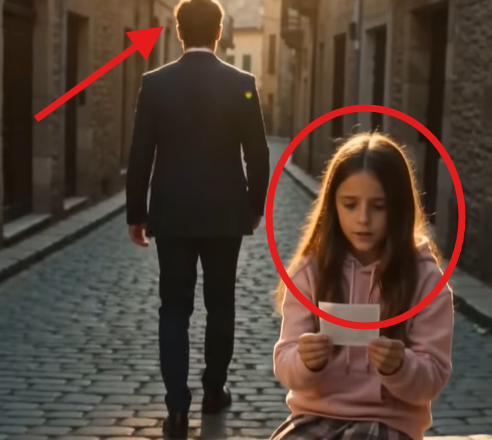
The little girl watched him from the stone step where she’d been sitting alone, her small fingers wrapped tightly around the picture. She didn’t run. She didn’t cry. She simply looked at him the way children sometimes do when they’ve been trusted with something far too heavy for their age.
“Where is she?” he managed, his voice barely a sound.
The girl climbed down from the step and stood before him, her chin lifted with quiet courage.
“She told me to wait here,” she whispered. “For the man in the striped tie.”
Something inside him collapsed.
No one knew that detail. No one living, anyway. It had been their thing — hers and his — a small, private joke from the morning of their wedding when she’d laughed and said she’d always find him in a crowd because he was the only man on earth who still wore a striped tie with any real confidence.
He hadn’t worn one since the fire.
He was wearing one today.
His knees bent without permission, dropping him to her level, face to face with this child he had never seen before — and yet felt, somehow, as if he’d always known.
“What is your mother’s name?” he asked, though some part of him already understood, already feared, already hoped in a way that felt dangerous.
The girl swallowed once.
“Elena.”
His face — the carefully composed face he had carried like a mask through six years of grief — simply fell apart.
Elena. His Elena. The woman the fire had taken. The woman he had buried in an empty coffin because they said there was nothing left to bury. The woman he had mourned in silence, in therapy, in two a.m. conversations with a glass of whiskey and a photograph on the nightstand.
His wife.
He looked at the child again, really looked — the way you look when you’re trying to determine if your own heart is lying to you.
The eyes. Brown, deep, and slightly too serious for a child her age. Elena’s eyes.
The way her mouth trembled but refused to cry. Elena’s stubbornness, worn on a face barely tall enough to reach his shoulder.
The way she held sadness — not breaking under it, just carrying it — like she’d been taught that sorrow was something you bore quietly, with dignity.
“How old are you?” he whispered.
“Five.”
He pressed his hand over his mouth and turned away for just a moment, because a man can only absorb so much before he needs one second to remember how to breathe.
Five years old. And Elena had been gone for six.
There were facts his mind refused to calculate, and yet his heart was already doing the math, arriving at an answer that made the world feel entirely reordered.
The girl reached into the pocket of her coat — a small, neat coat, carefully buttoned, the kind a mother with attention to detail would choose — and pulled out a folded piece of paper. The edges were worn soft, as if it had been handled many times, carried and re-folded, kept safe through many days of waiting.
“She said,” the girl whispered, “that if you cried, I should give you this.”
He hadn’t even realized he was crying.
He took the note with hands that wouldn’t stop shaking, and he opened it the way a person opens something they’re afraid might disappear if they’re not careful enough.
The handwriting hit him like a physical thing.
He would have known it anywhere. Loopy at the capitals, careful at the endings, the particular way she dotted her i’s just slightly to the right of center. He had a box of her letters at home. He had read them so many times the paper had gone thin.
If Anna finds you, don’t let them take her back. I never died. I was hidden.
He read it twice. Then a third time.
Then he looked up at the child — at Anna — and the name felt like a key turning in a lock he had given up on ever opening.
“Anna?” he said softly.
She nodded once, both hands still folded together in front of her, patient and steady in the way of children who have been waiting for something important and finally see it arriving.
“That’s me.”
He wanted to speak. He wanted to ask a thousand questions that had lived in him like wounds for six years — why, how, who did this, what happened in that house before the fire, who told him she was gone — but before any of it could surface, the girl turned and glanced quietly toward the far end of the alley, where the evening light was beginning to glow gold against the brick.
She looked back at him with those eyes. Her mother’s eyes.
And she said — with a calm so complete it broke him entirely open — “Mommy said if you came… we could go save her now.”
He rose to his feet.
He didn’t ask where. He didn’t ask how far. He didn’t ask whether it was safe or whether he was ready or whether the world made any sense anymore.
He simply reached down and took her hand.
And together, a father and the daughter he never knew he had walked toward the light at the end of the alley — toward a woman the world believed was gone, toward a truth that had been buried under silence and fear for far too long.
Some loves don’t die in fires.
Some loves just wait, hidden in the hands of a five-year-old girl, folded into a note worn soft with hope, until the right man shows up wearing a striped tie — because she always knew he would.