The father caught the wheelchair just as it jolted forward, his hands gripping the handles so tightly his knuckles went white. His heart was pounding so hard he could hear it in his own ears, a drumbeat of panic and confusion that drowned out every sound in the crowded restaurant around him.
And then the whole place went completely silent.
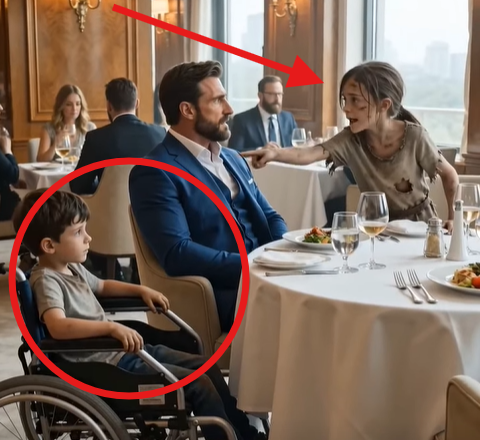
Every fork stopped mid-air. Every conversation dissolved. Every single person in that room turned to look at the small, ragged girl standing beside his son’s wheelchair — the girl nobody had noticed walk in, the girl with the torn hem on her dress and the hollow look of someone who had not eaten a proper meal in far too long.
She was holding his son’s hand like she had known him her entire life.
The boy’s breathing had changed. His chest was rising and falling quickly now, and he was staring down at his own legs with an expression his father had never seen on him before — not hope exactly, but something close to it, something fragile and terrifying all at once.
“Dad…” the boy whispered.
The father dropped to his knees right there beside the wheelchair, not caring about the restaurant, not caring about the stares. His voice came out broken, scraped raw from somewhere deep inside him.
“Son… what are you feeling?”
The boy swallowed hard. His eyes were glistening.
“My foot.”
Two small syllables. That was all. But they landed in the father’s chest like a boulder dropped from a great height, because those two words meant everything — they meant the doctors might have been wrong, they meant the years of doubt and grief and long nights of his son crying quietly into his pillow might not have been the end of the story.
The father looked up at the little girl then. Anger and fear were fighting each other across his face, two forces pulling him in opposite directions.
“What is this?” he demanded. His voice came out sharper than he intended.
The girl finally looked at him directly. And what he saw in her eyes stopped him cold. There was no triumph there, no manipulation, no mischief. What he saw was hurt. What he saw was hunger. What he saw was the kind of truth that only children carry, because they haven’t yet learned how to disguise it.
“My mother said if I ever found the boy who stopped walking,” she said quietly, “I had to tell him he wasn’t broken.”
The father went completely still.
The boy tightened his grip on her small hand, and then, slowly, shakily, with every ounce of strength his body possessed, he pressed down on the armrests of the wheelchair. The chair creaked under the shift of weight. His body began to rise.
A gasp moved through the restaurant like a wave.
The father reached toward his son instinctively, terrified to help and terrified not to, frozen in that awful space between wanting to protect and knowing he had to let go. The boy rose halfway — his legs trembling so violently it looked physically impossible — and then higher still.
The father’s eyes filled with tears he didn’t bother to hold back.
The little girl stood close. She wasn’t holding the boy up. She was only holding his hand.
“Why?” the father whispered to her, his voice barely audible. “Why would you help us?”
The girl looked down at the floor. Because now that the miracle was unfolding in front of everyone, her own pain had nowhere left to hide. She had been so focused on her mission that she had kept herself together through sheer will, and now the will was running out.
She spoke so quietly the father had to lean in.
“Because my mother cleaned your house.”
He stared at her.
“She got sick,” the girl continued, her voice barely holding. “She said your son cried every night because nobody believed him when he said he could still feel his legs.”
The father’s face lost all color. He had hired a cleaning service years ago, before everything fell apart, back when the house was still full of laughter. He barely remembered the woman’s face. And yet this woman — sick, struggling, barely surviving — had sent her own daughter across the city to find a little boy she had only heard weeping through the walls of a house she scrubbed clean for a wage that barely covered their rent.
The boy took one shaking, trembling, miraculous step away from the wheelchair.
The restaurant erupted. A woman covered her mouth with both hands. A waiter standing nearby dropped a tray without even noticing. Someone started clapping and then stopped, because the moment was too tender, too sacred for applause.
The father was crying openly now, tears streaming down his face without apology.
The boy looked at the little girl as though she had handed him back everything he had lost — his future, his dignity, his own belief in himself.
And then the father asked the question that had already begun to fill him with a different kind of dread.
“Where is your mother?”
The girl’s lip trembled. Her brave face, the one she had been wearing like armor since she walked through that door, finally broke.
“In the hospital,” she whispered. “She told me to find you if she got worse.”
The father looked at her torn clothes. At her hollow cheeks. At the hunger she had quietly traded in exchange for someone else’s miracle. He looked at his son standing on his own two feet for the first time in years. And in that single aching second, he understood something that nearly brought him to his knees all over again.
This child had not come looking for money. She had come because she had run out of time.
He stepped toward her, his voice barely above a whisper.
“What’s your mother’s name?”
The girl looked up at him with wet, exhausted, relieved eyes — and she answered.
And the father’s entire face collapsed.