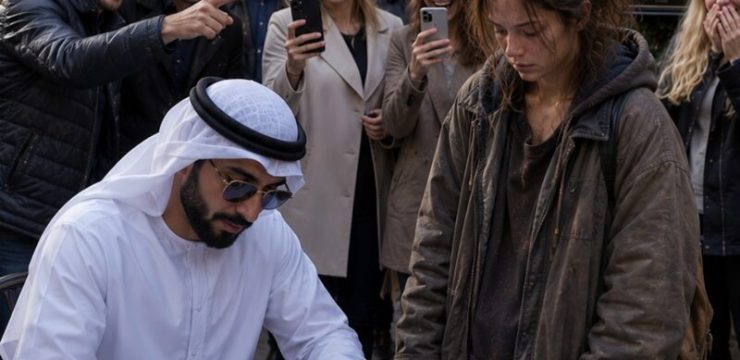
The old man rose slowly from his chair, his knees unsteady beneath the weight of a moment he had never imagined would come. Beside him, his elegantly dressed wife had gone completely pale — the color draining from her face the way light disappears just before a storm.
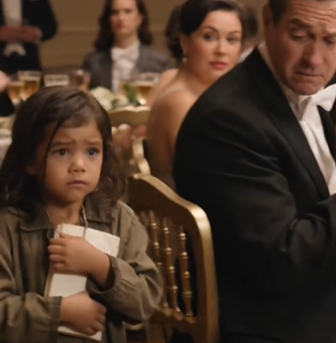
Everyone in that room had spent years believing the same story. A little girl, gone too soon. A closed casket. A grieving father who had placed all of his trust in the doctors — and in the woman he called his wife. The loss had hollowed him out in ways that money and status could never fill. He had learned to smile at galas, to shake hands at charity events, to stand at podiums and speak of compassion as though his heart had not been quietly breaking for years.
And then the girl walked in.
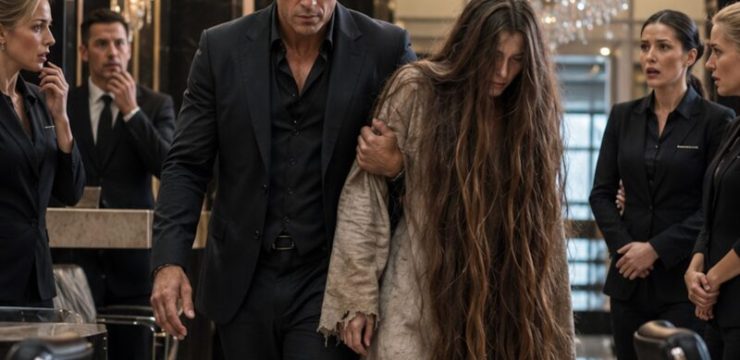
She was thin. Her clothes were worn. She looked like someone who had learned very early that the world was not going to be gentle with her. But in her hand, she held something small — something that made the air leave every corner of the room.
It was a pendant. Delicate, distinctive, and unmistakable. He had designed it himself, piece by piece, with intention and love, as a birthday gift for his daughter. There was not another one like it anywhere in the world.
The girl spoke quietly. She explained that the woman who had raised her had once worked at the hospital. An ordinary woman with an extraordinary secret she had carried for decades. Before passing away, she had finally confessed the truth — a truth that would shatter an entire family’s history and rewrite everything they thought they knew.
The child had not died. She had never died.
The wealthy man’s wife had arranged for the baby to be taken away. She had paid someone to make sure that little girl would disappear from their lives forever.
The room — full of people who had been applauding speeches about love and generosity only minutes before — fell into a silence so heavy it was almost unbearable.
Why would a mother do such a thing?
Because she was not the child’s mother. Because she saw in her husband’s eyes the depth of love he had for that little girl, and she feared what that love meant for her own future. She feared losing his attention. She feared the inheritance being divided. She feared that her carefully constructed life — the one built on appearances and control — would slowly crumble if that child remained.
So she made a choice that no one in that room could have imagined.
“I paid to have the baby taken away,” the wife finally whispered, her voice barely audible. She could not look at her husband. She could not look at anyone. “But the woman I hired… she couldn’t go through with it. So she kept her. She raised her instead.”
The guests stood frozen.
The man did not speak right away. He stepped forward — slowly, deliberately — and looked at the girl standing before him. Her eyes were his. The way she held her chin, the small mark just below her ear — the same one he used to trace gently when she was an infant. Time had changed everything around them. But it had not changed those things.
Decades of grief pressed against his chest as he stood inches away from the daughter he had mourned, the daughter he had buried in his heart, the daughter whose absence had shaped every remaining year of his life.
Tears moved down his face without apology.
“Forgive me,” he said. His voice cracked with the kind of pain that cannot be performed — only truly felt. “I did not find you in time.”
The girl looked up at him. Her voice was small. Uncertain. The voice of someone who had spent a lifetime wondering if she was worth finding.
“If I grew up poor,” she said softly, “do you still want me?”
It was the question underneath the question. Not just do you want me now — but would you have wanted me if I had stayed gone? Would I have been enough even without the right clothes, the right address, the right last name?
He did not hesitate.
He pulled her into his arms, and he held her the way fathers hold children when they realize how much time has already been lost and they refuse to lose a single second more.
“I never lost you because of who you became,” he said, his voice steady now — clear with a certainty that filled the whole room. “I lost you because I believed a lie.”
She wept against his shoulder. And he let her.
The evening had begun with champagne and polished shoes and people congratulating themselves on their generosity. It ended with something none of them had expected to witness — a truth so raw and so human that it made every performance of the night feel hollow by comparison.
No one looked at the chandeliers. No one admired the floral arrangements or the catering or the evening gowns.
Every eye in the room was fixed on one thing.
A small, broken pendant, resting in the palm of a young woman who had grown up with nothing — and who had just discovered that she had always been irreplaceable.
That night, in a room full of wealth and status and carefully maintained appearances, the most valuable thing present was not made of gold or diamonds.
It was the truth. Long overdue, quietly devastating, and more powerful than anything money could ever buy.