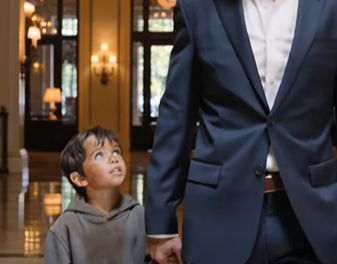
He walked through the front door holding roses and a small velvet box, expecting a quiet afternoon.
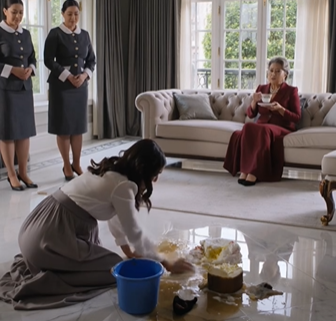
What he found instead stopped him cold.
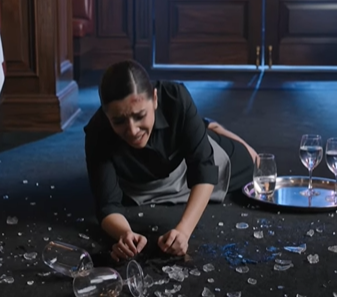
His wife, Emma, was on her knees on the marble floor, scrubbing with a wet cloth, her pregnant belly visible beneath her loose blouse, her hair falling loose around her face. Around her were scattered pieces of a destroyed cake — smears of pink icing, crushed layers of sponge, sugar flowers ground into the grout between the tiles. A blue plastic bucket sat beside her. One of the household maids stood frozen near the kitchen doorway, eyes cast downward. Another had her back turned, pretending to arrange something on the counter. His mother sat at the dining table, teacup in hand, perfectly composed, as if nothing unusual was happening in the room at all.
He looked at Emma.
He looked at the floor.
He looked at the roses in his own hand, and suddenly they felt ridiculous.
Something in his chest tightened — not quite understanding yet, but sensing it. That particular silence in a room that has already witnessed something terrible and hasn’t yet recovered from the weight of it.
He stepped closer. And that’s when he saw it.
In the smeared icing on the marble, where the cake had been destroyed, two words were still barely legible through the mess.
Baby Boy.
The breath left his lungs.
He stared at those two words for a long moment. A celebration cake. Someone had baked a cake to announce the gender of their child. And it was here, ruined, on the floor, with his pregnant wife on her knees cleaning it up.
His mother saw the moment he understood.
She set her teacup down with precise, unhurried calm.
Emma pressed one hand gently to her stomach, the way a woman does when she is trying to protect something fragile, something that cannot yet protect itself. She steadied herself with her other hand on the wet floor.
The room stayed silent. Nobody moved. Nobody spoke. Even the sound of the wet cloth had stopped.
“Mom,” he said.
Only that single word. But the way he said it — slowly, deliberately — changed the temperature of the entire room. It was no longer a question. It was the beginning of something his mother recognized immediately.
She answered without looking at him directly.
“She needs to learn,” she said, her voice steady and unbothered. “Having a child doesn’t make her the mistress of this house.”
One of the maids closed her eyes. The other still didn’t turn around.
Emma’s face crumpled, and he watched it happen, watched the composure she had been holding onto finally slip, and he understood in that moment that she had been holding it for a long time. Long enough for the fear to settle into the room itself. Long enough for the maids to learn not to speak. Long enough for silence to become the safest option for everyone present.
He stared at the blue bucket. At the ruined cake. At his wife, kneeling on marble, pregnant and exhausted and ashamed in a way she should never have been made to feel in her own home. At his mother, still seated with the composure of someone who believed entirely in her own authority.
Then Emma spoke.
Quietly. Almost in a whisper.
“She pushed the table,” Emma said. “And then she told me to clean it.”
The room went absolutely still.
His gaze moved slowly from Emma’s face to the hem of his mother’s red dress, where a small smear of pink icing had dried against the fabric.
He didn’t need to ask another question.
The small velvet box slipped from his fingers and hit the marble. It opened when it landed. Inside, resting against white satin, was a tiny silver bracelet — delicate and small, sized for a newborn wrist. Engraved on the surface of the bracelet was a single name.
Noah.
Their son’s name.
The name he and Emma had chosen together, quietly, privately — a name he had never once shared with his mother.
He lifted his eyes to her face.
Because the cruelty had just become something larger than he could have prepared for. It was no longer only about humiliation. No longer only about power and control and a daughter-in-law being made to kneel. She had known the name. She had destroyed a cake celebrating the arrival of a child whose name she had somehow learned, a child she had already claimed an opinion about before he had even taken his first breath.
Emma’s voice came again, barely audible now, from the floor.
“She said,” Emma began, and paused, gathering herself. “She said that if it’s a boy — if it’s a son — that you’ll love us too much. And that you’ll stop listening to her.”
Nobody breathed.
He stood in the middle of the room with roses in one hand and nothing in the other, looking at the woman he had married — the woman carrying his child — still on the floor, still holding the wet cloth, still waiting to see what he would do now that he finally knew the truth.
The roses were no longer a surprise.
The small box was no longer a celebration.
They were a mirror, held up to show him clearly what had been happening in his home while he was away, what his silence had quietly permitted, and what his love for two women — one who had raised him, one who was carrying his son — was finally going to cost him.
Because a man cannot unknow what he now knows.
And a mother cannot undo what the icing on the floor has already said.