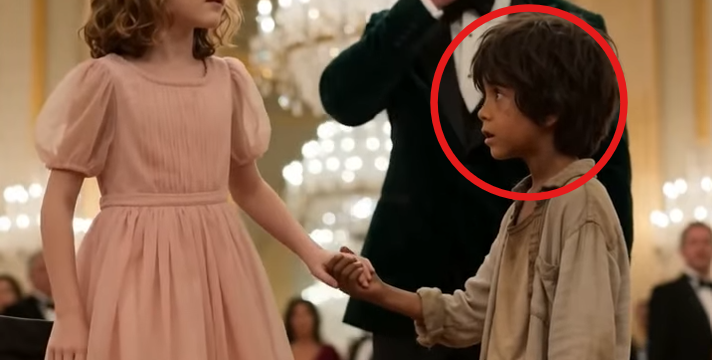
The terrace was everything money could buy.

Soft candlelight flickered across linen tablecloths. Champagne flowed freely. Men in tailored suits laughed too loudly, and women in designer gowns smiled with just the right amount of effort. It was one of those evenings that looked effortless only because someone had worked very hard to make it appear that way.
She was one of those people.
Most guests had assumed she was part of the event staff. She moved quietly, checked on details, made sure glasses were refilled and that nothing went wrong. She wore simple clothing. She carried no title in her posture, no wealth in her expression. She was the kind of woman people look past at parties like this one — and she knew it. She had always known it.
What no one knew was that her father had built this company from nothing. That he had poured thirty years of his life into every brick, every contract, every late night and early morning. And that before he passed, he had left it all to her — not to the board members circling the room, not to the investors raising their glasses, and certainly not to the woman in the gold dress who had spent the last hour treating the evening like her personal stage.
The moment broke open without warning.
A little boy — no older than six — had wandered too close to one of the display tables. He knocked something over. It wasn’t serious. It wasn’t even expensive. But the woman in the gold dress turned on him with the kind of sharpness that had no business being aimed at a child, raising her voice in front of a terrace full of strangers, her words landing like stones.
The boy froze. Then he did what frightened children do — he ran toward the one person who had made him feel safe that evening.
He ran to her.
She caught him without hesitation, pulling him close, letting him press his face into her shoulder while the noise of the party swirled around them. She held him the way you hold someone who has already lost too much. Steady. Certain. Unashamed.
The woman in the gold dress followed, indignant, her heels clicking sharp against the stone floor. She looked at the child, then at the young woman holding him, and said what people like her always say when they’ve been witnessed doing something unkind.
“He was making a scene.”
The younger woman looked up.
“He was scared,” she said. “Because you shouted at his mother in front of strangers.”
A flicker of confusion crossed the older woman’s face.
“His mother?”
The younger woman’s jaw tightened for just a moment, but her voice never wavered.
“I found him three months ago in one of our shelters,” she said. “His mother had died waiting for assistance from a charity program. A program your committee voted to reject.”
The terrace went absolutely still.
No one reached for their champagne. No one laughed. Even the soft background music seemed to hold its breath.
The boy lifted his face from her shoulder. His eyes were red, but he wasn’t crying anymore. He looked at the woman in gold the way children look at people who have confused loudness with authority, and he said, in the quietest voice imaginable — “She promised I could stay.”
The younger woman pressed a gentle kiss to the top of his head.
“And I keep my promises.”
Then she turned her attention back to the older woman — the one who had walked into this evening assuming she owned it — and said something that no amount of wealth or social standing could soften.
“You can leave,” she said. “The event will continue without you.”
It wasn’t a threat. It wasn’t a performance. It was simply the truth, delivered by a woman who had earned every right to speak it.
The older woman looked around the terrace. She waited for someone to step in. For someone to laugh it off, or change the subject, or offer her an exit that didn’t feel like defeat. She waited for the room to take her side the way rooms at parties like this always had before.
No one moved.
No one spoke.
And so she walked away from the candlelit tables, past the guests who had stopped pretending not to watch, through the golden light she had arrived in so confidently, and out into the evening.
The younger woman didn’t watch her go.
She was already kneeling down, bringing herself to eye level with the little boy, her hands gentle on his small shoulders.
“You’re safe,” she told him softly.
It wasn’t a dramatic declaration. It wasn’t meant for anyone else in that room. It was just a quiet promise made between two people who had both learned the hard way that the world doesn’t always keep its word — but that some people still do.
For the first time that night, the boy believed her.
And sometimes, that is the only thing that matters. Not the champagne, not the golden lights, not the names on the invitation list. What matters is the child who needed someone to stay, and the woman who chose — without hesitation, without audience, without applause — to be exactly that person.
True class has never needed an audience. It only needs a moment — and the courage to do the right thing inside it.