The whole arena went still.
Not the kind of quiet that falls between events, when the crowd shifts and stretches and waits for the next spectacle. This was something different. Something heavier. The kind of silence that only comes when people sense, all at once, that what they are witnessing is no longer entertainment.
A weathered old ranch hand named Wade had stopped at the edge of the ring. His face had gone pale beneath years of sun and dust. His chest rose and fell hard, like a man who had just been punched somewhere words could not reach.
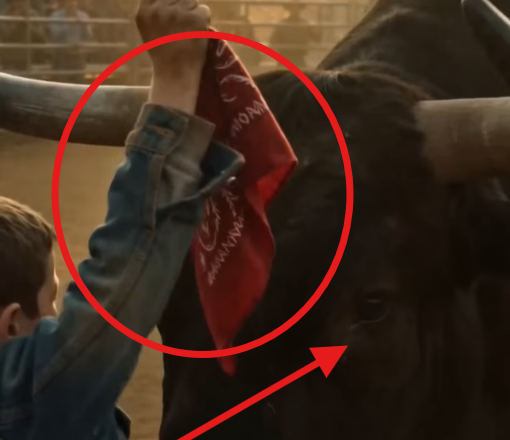
Beside the enormous black bull named Ranger stood a small boy — thin arms, dirty boots, tear-streaked cheeks. One hand rested gently against the side of the animal’s massive head. In his other fist, he clutched a faded red bandana like it was the last solid thing left in his world.
“What did you say?” Wade asked, his voice barely holding.
The boy wiped his face with his sleeve, but the tears did not stop.
“My dad said you promised Ranger would be ours,” the boy said. “He said if anything happened to him, you’d keep Ranger safe until you came for me.”
A murmur moved through the bleachers like a slow wave.
Wade looked like the ground beneath his boots had cracked open.
The boy’s name was Eli. And his father had been Jacob Miller — one of the most gifted riders this rodeo had ever known. Reckless in the way that made crowds lean forward. Stubborn in the way that made other men shake their heads with reluctant admiration. And famous for something that no one else in the circuit could claim: Jacob had loved Ranger, not as a beast to overpower, but as a partner.
He had rescued the bull as a half-wild calf from a failing ranch, raised him with patience and something that looked a great deal like devotion. Jacob used to say that Ranger understood pain better than most people ever would.
Then came the accident. A single bad ride. A broken neck. A rider who never got back up.
After Jacob died, the story that spread through the rodeo world was simple and convenient: no wife, no child, nobody left. Ranger stayed with the circuit. He became a legend. A headline. A reliable source of income for the men who controlled the arena.
And now a homeless child was standing in the dust, proving that story had been constructed on purpose.
Wade climbed carefully into the ring. Eli stiffened, but he did not back away.
“Where’s your mother, son?” Wade asked quietly.
Eli’s chin trembled.
“She passed last winter.”
The words hit Wade like a fist to the chest.
“And after that?”
Eli looked down at his boots.
“We lost our home. I’ve been sleeping behind the feed store in town.” He tightened his fingers around the bandana. “Before everything fell apart, my dad hid this in his jacket and told me — if things ever got real bad — I had to find Ranger. He said Ranger would remember our family, even when people didn’t.”
Not one person in those bleachers made a sound.
Even the announcer had quietly lowered his microphone.
Wade turned and looked at Ranger. The great bull stood perfectly still beside the child, calm in a way that seasoned handlers had not seen from him in years. And in that moment, everything Wade had pushed aside, every doubt he had buried for the sake of convenience, came flooding back.
Jacob had not simply been forgotten.
He had been erased.
Because after his death, a certain group of men had built their profits around turning Ranger into a brutal spectacle. A rider with a living son would have meant complications — inheritance, ownership disputes, public sympathy, difficult questions no one wanted asked. So the story had been smoothed over, and a child had been left to sleep behind a feed store while the bull his father loved was used to fill someone else’s pockets.
Wade raised his eyes toward the owner’s box above the arena.
Behind the glass stood Daryl Boone, the man who controlled the operation. He was already stepping backward into shadow.
Wade pointed at him. His voice rose and steadied at the same time.
“That man told us Jacob had no one,” he said. “He kept the paperwork. He kept the earnings. And he kept this bull.”
A stunned ripple rolled through the crowd. People were rising to their feet.
Eli looked toward the box, confused and small.
“My dad sent letters,” he said softly. “He said nobody ever answered.”
Wade’s jaw tightened. He understood now exactly why.
He walked to Eli and lowered himself to one knee in the dirt.
“I failed your father,” he said. “I believed the lie because it was easier than asking questions.” His voice broke at the edges. “I am sorry, son. I am truly sorry.”
Eli tried to hold himself together, but his face fell apart anyway.
“He just wanted Ranger back,” the boy whispered. “He always said Ranger was family.”
Wade nodded slowly, his throat tight.
“Then family comes home.”
The crowd erupted — not with cheers, but with the kind of raw, rising anger that fills a space when ordinary people recognize a wrong that has been sitting in plain sight. People were filming, shouting toward the box, calling for security, demanding answers that were long overdue.
But Eli heard almost none of it.
Because Ranger had lowered his great head just enough for the boy to wrap both arms around his neck. The bull did not flinch. Did not resist. He simply stood there, breathing slow and deep and steady, as though he had been waiting through every long and lonely year for the one person whose presence carried the memory of the man he had loved first.
Wade got to his feet and turned toward the gate.
“Open it,” he said.
Nobody moved.
He said it louder, and this time there was no mistaking his intention.
The latch snapped. The gate swung open.
Ranger lifted his head, looked once toward the exit, and then back at Eli — as if needing to be sure this moment was real.
Eli nodded through his tears.
“Come on, Ranger. Let’s go home.”
And the most feared bull in the rodeo followed that small boy out of the arena. Not charging. Not raging. Walking quietly beside him, the way a loyal old friend walks beside someone who has finally come back.
The crowd watched in complete silence as the smallest figure in that arena led the largest animal out through the open gate, carrying nothing but a worn red bandana and the last promise a good man had managed to leave behind for his son.
For the first time since Jacob Miller had drawn his final breath, Ranger was no longer a spectacle built for other people’s profit.
He was going home — and this time, nobody was going to stop him.