There are moments in life when a single name can stop time itself. When four letters can unravel a man’s carefully composed expression and replace it with something raw, unguarded, and terrifyingly real. This was one of those moments — and everyone inside that small roadside diner felt it happen, even if they didn’t yet understand why.
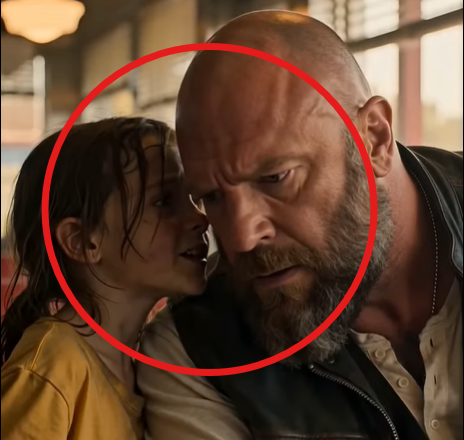
The afternoon had been unremarkable. The kind of quiet Tuesday that stretches long and forgettable, the smell of fried food hanging in warm air, the low hum of a television mounted crookedly above the register. A handful of regulars sat at the counter nursing their coffee. A group of bikers occupied the corner booths, their leather vests worn soft from years of road and weather, their laughter easy and comfortable among themselves.
Then the door opened, and everything shifted.
A young man walked in with a little girl at his side. She couldn’t have been more than six years old, her hair tangled, her eyes wide and darting toward every corner of the room like a small animal searching for an exit. She wasn’t holding his hand willingly. Anyone paying attention could see that. Her small fingers weren’t wrapped around his — they were simply caught there, and her body leaned subtly, instinctively away from him with every step.
The young man approached the counter with a casual confidence that didn’t quite fit the situation. He smiled at the cashier. He ordered. He acted, in every surface way, like a man with nothing to hide.
But the little girl’s eyes found the nearest biker.
She didn’t say anything at first. She just looked at him the way frightened children sometimes look at strangers they’ve decided, in their wordless wisdom, to trust. There was something about his presence — solid, unhurried, familiar in the way that certain people carry safety on them without trying — that made her stop pulling away and simply stand still.
The biker looked down at her.
He noticed the small wolf-shaped patch sewn onto the collar of her worn jacket. It was a particular design — hand-stitched, old, the kind of thing passed down rather than purchased. His breath caught.
He crouched to her level.
“Where did you get that patch, sweetheart?”
Her voice was barely above a whisper. “My mom gave it to me. She said it meant I was protected.”
The biker’s jaw tightened. He stood slowly and turned to face the young man at the counter, who was still smiling — that easy, unbothered smile of someone who believed he was in control of the room.
“What’s her mother’s name?” the biker asked. His voice was calm. Dangerously calm.
The young man glanced over his shoulder, apparently unbothered. “Rose. Why does it matter?”
The diner went quiet in the way places do when the air changes.
Rose. The name landed like a stone dropped into still water, and the ripples moved fast and wide across every face in that corner booth. The bikers exchanged a single look — wordless, immediate, and full of shared understanding.
The biker reached into the inside pocket of his vest and drew out a photograph, old and soft at the edges from years of being carried close. It showed a young woman, perhaps twenty, laughing at the camera with her whole face. Around her neck, on a simple cord, hung a wolf patch — identical to the one on the little girl’s collar.
He held it out toward the child.
She looked at it for only a second before she reached out and touched the photo with one small finger.
“That’s Mom,” she said simply, as though it were the most obvious thing in the world.
Something moved through the biker’s expression then — not breaking, exactly, but shifting. A grief old enough to have grown roots. A wound that had simply learned to stay quiet.
“Rose is my sister,” he said. The words came out low and steady, but they carried the full weight of years in them. Years of searching, of wondering, of hoping for a phone call that never came.
Every man in that corner booth rose to his feet without a word spoken between them.
The door chimed softly. Two more men stepped inside from the parking lot, positioning themselves near the exit with the calm, practiced ease of people who had done this kind of thing before. Not with aggression. Not with theatrics. Simply present, and immovable.
The young man’s smile finally faltered.
He looked at the biker. Then at the men near the door. Then back at the biker, who had not moved an inch but somehow seemed to have grown larger in the room.
The little girl had stopped trembling. She stepped away from the young man and moved quietly to the biker’s side, pressing herself against his arm. He placed one large, gentle hand on her shoulder.
“Now,” the biker said, his voice carrying the absolute stillness of a man who no longer had patience for pretending, “you’re going to tell me exactly where my sister is. And you’re going to tell me right now.”
The young man opened his mouth. Closed it. His eyes moved to the door, then back again, calculating odds that were no longer in his favor.
And then the little girl looked up, her voice steady and clear in the silent diner.
“She’s still in his car.”
No one moved for the span of a single heartbeat.
Then everyone moved at once.
Because family is not always the people you are born to. Sometimes it is the people who stop everything — their coffee, their conversation, their ordinary Tuesday afternoon — and stand up without hesitation when someone who belongs to them needs protecting. And sometimes the smallest voice in the room is the one that changes everything.
The wolf patch meant she was protected.
Today, that promise was kept.