The morning sun was already bearing down hard when every soldier in the unit was called out to the parade ground. Rows lined up with military precision, shoulders squared, boots perfectly still against the cracked pavement. Nobody said a word. But every single person standing in those ranks could feel it — something was coming. Something that wasn’t in any training manual.
At the center of it all stood just two people.
The colonel. And a young recruit named Anna.
Anna had only been with the unit for a handful of days, but she had already made an impression. She came from the top of her graduating class at the military academy — sharp-eyed, disciplined, and physically strong. She never complained. She never lagged behind. She hit her targets with the kind of precision that made seasoned veterans raise an eyebrow in quiet respect.
But on just her second day, something happened that would set the entire chain of events in motion.
During a training exercise, one of the soldiers took a bad fall. A young man landed wrong after a jump and came down hard against the ground, crying out as his back took the impact. He couldn’t get up.
The colonel gave the order to keep moving.
“He’ll shake it off,” the colonel said, voice cold and even. “Men don’t break that easily.”
Anna stepped out of line.
She walked calmly but quickly toward the injured soldier. “He needs medical attention,” she said, loud enough for the ranks to hear.
“Get back in line. Now,” the colonel ordered.
“He needs help first,” she replied, kneeling beside the young man.
The words hung in the air over dozens of witnesses. For the colonel, it wasn’t just disobedience. It was a personal wound. No one had ever challenged him in front of his soldiers — not like that. And he was not the kind of man who let something like that go.
A few days passed. Then he made his decision.
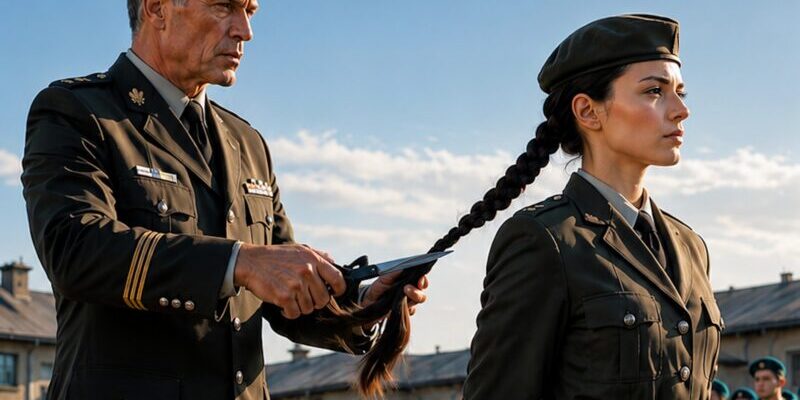
He called the entire unit out to the parade ground again. When every soldier had found their position, he called Anna forward in front of everyone. She stepped out from the ranks without hesitation, her expression unreadable, composed. Her long dark braid hung nearly to her waist, thick and striking. Everyone in the unit knew how much she valued it.
The colonel produced a large pair of scissors.
A ripple of unease moved through the crowd. Some of the soldiers had already guessed what was about to happen, but seeing it in front of them was different entirely.
Anna did not flinch.
The colonel reached out and grabbed the braid, holding it up as if presenting evidence of a crime. He spoke loudly so no one could miss a single word.
“This,” he said, “is what happens when you think you’re above the rank above you.”
The scissors closed.
The braid fell to the ground.
Silence swallowed the parade ground whole.
The colonel watched her face, waiting for the reaction he expected — the trembling lip, the tears, the crumbling composure. He wanted the moment. He had planned for it.
But Anna did not cry. She did not shake. She did not beg.
She stood exactly as she had before, eyes forward, face still as a winter morning. The only thing that had changed was the braid on the ground between them.
That stillness seemed to unsettle the colonel more than any outburst could have.
He stepped forward, dropping his voice lower, more deliberate.
“You think you’re special, don’t you.”
She said nothing.
“You’re just a recruit. Nothing more.”
Not a flicker.
“People like you are always the first ones to fall apart.”
She kept her gaze fixed somewhere past him.
“Without all that pretty hair, you finally look like a real soldier instead of a spoiled little girl.”
A murmur of discomfort moved through the ranks. Men and women who had spent years following orders were struggling to watch. The scene had crossed a line that everyone could feel but no one was naming.
The colonel still wasn’t finished.
“Know your place.”
He reached out and grabbed her sharply by the shoulder — a shove disguised as command, the kind of physical punctuation some men use when words stop feeling like enough.
What happened in the next two seconds stunned everyone present.
Anna had trained in close-quarters combat for years. Her body responded before her mind even finished processing the motion. She caught his arm, shifted her weight, turned — and used the colonel’s own momentum against him in one clean, controlled movement.
He hit the ground.
The collective breath of hundreds of soldiers was audible. Eyes wide. No one moved.
The colonel pushed himself up slowly, and Anna had already stepped back into attention stance — arms at her sides, chin level, posture perfect.
What the witnesses saw was not aggression. Every soldier on that ground understood exactly what they had just watched. It was a reflex. It was self-defense. It was the training they had all been put through, working exactly as intended.
Several officers moved in from the sides.
And then a voice from the back of the assembly said, quietly and with absolute authority: “That’s enough.”
A general had arrived unannounced that morning for an inspection. He had been watching from a distance since before the scissors ever came out. He had seen everything.
He walked forward slowly and looked first at the colonel still pulling himself to his feet, then at Anna standing at attention.
“A soldier is expected to respect rank,” the general said, his voice carrying easily over the silence. “And a commanding officer is expected to respect the dignity of those beneath him.”
Not a sound from anyone.
“Punishment does not give anyone the right to humiliate another human being.”
The colonel looked down at the ground.
For the first time in a very long time, he had nothing to say.
Anna never raised her voice. She never lost control. She stood her ground in every way that mattered — and in the end, the ground shifted beneath someone else entirely.