It was late. The kind of late where most decent people are already home, doors locked, lights dimmed. The gas station sat quietly under its canopy of buzzing fluorescent lights, their pale glow bleeding out across rain-slicked asphalt in watery streaks of red and white. Inside the small convenience store, a cashier was fighting a losing battle against sleep, his head bobbing up and down behind the counter like a buoy on a still lake.
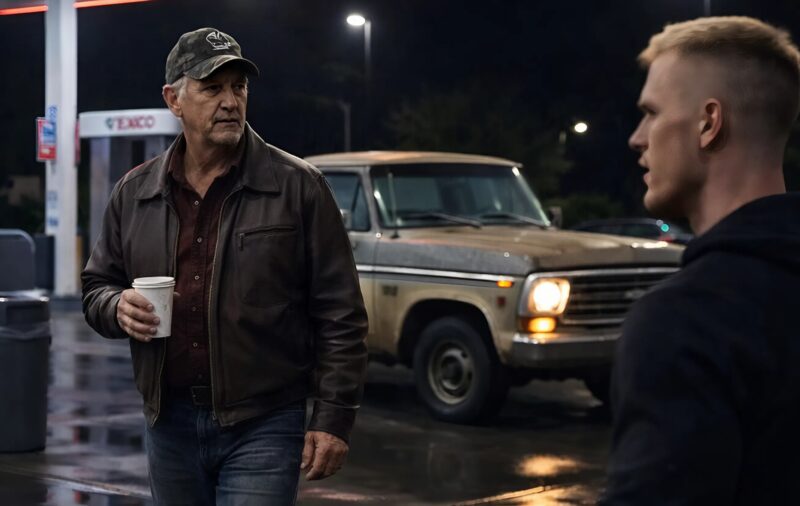
Outside, near one of the fuel pumps, an old light-colored pickup truck sat idling. Walking slowly toward it was an elderly man, moving with the unhurried pace of someone who had lived long enough to stop chasing time. He wore a worn leather jacket, dark cap, and a pair of well-used jeans. In one hand, he carried a paper cup of hot coffee — a simple comfort for a long drive ahead.
He looked to be around seventy. Maybe a few years past that. But there was something about the way he carried himself — steady, deliberate, unbothered — that spoke of a man who had weathered far more than most people ever would. From the outside, he looked like exactly what he appeared to be: an ordinary older gentleman who had pulled off the highway to fill up his tank and grab a warm drink for the road.
That quiet, unassuming appearance was precisely what caught the wrong kind of attention.
From the shadows at the corner of the store, a figure emerged. Young, tall, and heavily built, with a shaved head and tattoos snaking up his neck and across both forearms. This was not a man waiting for a ride or killing time. He had been watching, calculating, and the moment he saw the elderly man walking alone toward that old truck, he made a decision. An easy mark. An old man, alone, at a quiet gas station. What could possibly go wrong?
He stepped directly into the elderly man’s path with a smug, practiced confidence.
“Hey, old man,” he said, crossing his arms. “Got a few bills on you? Hand them over.”
The elderly man stopped walking. He looked at the younger man slowly, the way someone looks at something they have seen a hundred times before and have long grown tired of.
“No,” he said simply. “I don’t have any money for you.”
The bully laughed and stepped in closer, invading his space.
“What if I check for myself? What do you think happens then?”
The older man said nothing. He simply attempted to step around him and continue walking to his truck. That quiet refusal — that complete absence of panic — seemed to irritate the younger man far more than any argument could have.
He stepped sideways again, blocking the path.
“I’m talking to you. Hand it over. Right now.”
The elderly man lifted his eyes calmly and asked one simple question.
“Or what?”
Those two words, delivered without a single tremor of fear, snapped something inside the bully. His expression darkened. His jaw tightened. He reached out and snatched the paper cup straight from the old man’s hand — and in one sudden, vicious motion, he hurled the hot coffee directly at the elderly man’s face.
The lid popped free. The steaming liquid poured down over his forehead, his cheeks, his jacket collar. The bully stepped back and laughed, loud and satisfied, as if he had just demonstrated something important about who held the power in that empty parking lot.
The elderly man did not scream. He did not stumble backward or cry out. He stood completely still. Very slowly, he reached up and wiped the hot liquid from his face with the back of his hand. And when he lowered that hand and looked at the younger man again, his expression had changed entirely.
It was no longer patient. It was something else. Something quieter, and far more serious.
The bully did not notice the shift. He grabbed the old man by the collar and pulled him forward.
“Now do you understand who you’re dealing with?”
What followed happened so fast that if there had been anyone watching, they might have blinked and missed it entirely.
The elderly man moved with a speed and precision that belonged to someone with decades of practiced muscle memory behind it. He caught the younger man’s arm, rotated sharply, and delivered a controlled, devastating strike directly to the joint beneath his elbow. The bully cried out — a sharp, involuntary sound of genuine pain.
Before the younger man could process what had happened, the old man pulled him forward, swept his leg cleanly out from under him, and sent him crashing flat onto the wet asphalt with a force that echoed under the canopy.
The bully’s phone skittered out of his pocket and slid across a puddle toward the pump. He found himself face down on the ground, arm pinned behind him at an angle that made movement nearly impossible, and an old man’s knee planted firmly between his shoulder blades.
He struggled. He jerked. He tried to push himself up. The old man simply pressed harder.
“Listen to me carefully,” the elderly man said, his voice low and completely steady. “Being old does not mean being helpless.”
All the arrogance drained out of the younger man instantly. Pain and humiliation are remarkably efficient teachers.
The elderly man leaned down slightly and continued, “If I ever see you pulling something like this again, it will hurt a great deal more. And since you clearly did not do your homework tonight — I am a former sheriff. I spent the better part of my career putting men exactly like you behind bars. You all make the same mistake. You see someone who looks weaker, and you assume that makes you powerful. It does not. It only makes you reckless.”
He released the younger man, rose slowly to his feet, and walked calmly back to his old pickup truck. He started the engine. He pulled out of that gas station without looking back once.
Behind him, the bully lay on the wet pavement — phone in a puddle, pride in pieces — staring up at the flickering lights with absolutely nothing left to say.
Some lessons arrive gently. Others arrive at a gas station, late at night, wearing a worn leather jacket and carrying a cup of coffee. Either way, the ones that stick are the ones you never saw coming.