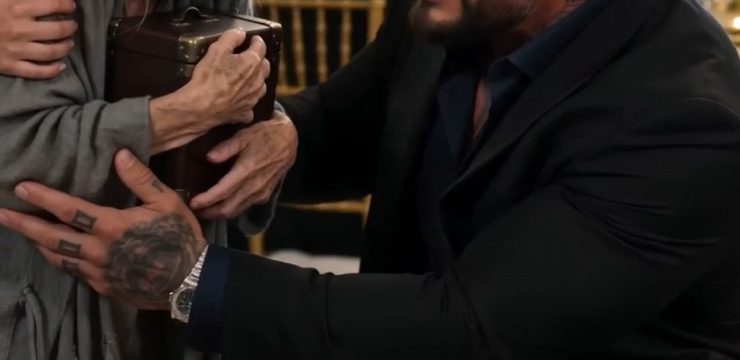
Arthur Wayland was the kind of man who believed that wealth gave him the right to treat people however he pleased. His mansion was legendary — marble floors so polished you could see your own reflection, chandeliers that cast golden light across rooms filled with the most powerful people in the city. Every weekend, he opened his doors to businessmen, politicians, celebrities, and socialites who came to see and be seen. Being invited to Arthur’s home meant something. It meant you had arrived.
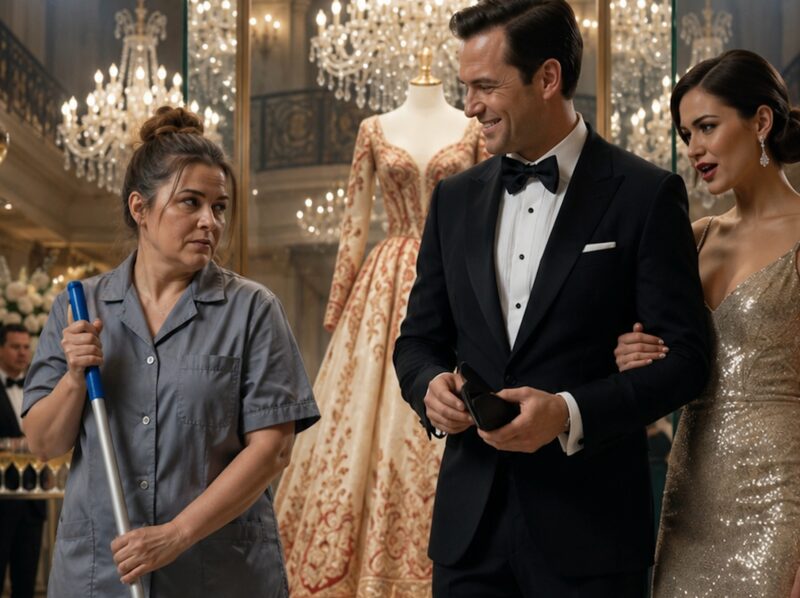
But behind the glamour, there was something darker that his guests only whispered about when they thought no one could hear.
Arthur Wayland had a habit of humiliating the people who worked for him.
Layla had been his cleaning lady for several years. She was in her mid-forties, quiet and unassuming, the kind of woman who moved through a room without drawing attention to herself. She never complained. She never argued. She simply did her work with dignity and kept her head down. Arthur noticed this about her — and he exploited it every single chance he got.
His favorite game was cruel in its simplicity. He would reach into his jacket, pull out a thick stack of hundred-dollar bills, and scatter them deliberately across the spotless floor she had just cleaned. Then, with that smirk of his that never quite reached his eyes, he would say, “Looks like you missed a spot. Pick it all up.” And Layla would. Quietly, carefully, she would gather every bill, stack them neatly, and hand them back to him without a word. His guests would laugh. Arthur would laugh the loudest.
He thought her silence meant she had no power.
He was about to learn how catastrophically wrong he was.
On the evening that changed everything, the centerpiece of Arthur’s latest dinner party stood beneath a glass dome at the heart of the grand hall — a breathtaking golden-red gown, hand-embroidered and adorned with precious gemstones, purchased at a private European auction for several million dollars. Historians believed the dress had once belonged to a European queen, a genuine artifact of royalty and centuries of history. Arthur had placed it where no one could miss it, right in the center of the room, because that was what Arthur did with beautiful things — he used them to remind people of what he could afford and they could not.
Layla was walking through the hall carrying her mop and bucket when she stopped in front of it. Just for a moment. She studied the dress with quiet wonder and whispered to herself, “What an incredible story… just imagine how many years this dress has existed.”
Arthur’s voice cut through the silence like a blade.
“Don’t you have any work to do?”
He was standing behind her with his date and a circle of friends, already enjoying themselves at her expense. Without a word, he reached into his jacket, pulled out a bundle of bills, and tossed them into the air. They fluttered down across the gleaming floor like falling leaves.
“Now get back to work.”
Layla turned to face him. Her voice was steady. “I was just admiring it. It’s not just a dress. It’s a piece of history.”
Arthur laughed. “History? That’s funny, coming from a cleaning lady.”
The room erupted. His date covered her mouth, laughing behind perfectly manicured fingers. Guests nudged one another with delighted grins.
Then Arthur stepped closer to the dress, raised his voice so everyone could hear, and made the offer that he was absolutely certain would provide the evening’s greatest entertainment.
“If you like it so much,” he said, loud and confident, “then wear it tonight and come greet my guests. And if you manage to pull that off, I’ll grant you any wish you want. Absolutely any wish.” He let the words hang in the air before adding the twist he was most proud of. “But if you don’t show up in that dress tonight, you’ll work for me for free for as long as I decide.”
The room went silent.
Everyone looked at the dress. It was small, narrow, and clearly tailored for a woman of an entirely different build. There was not a single person in that hall who believed Layla could wear it. Arthur had already begun savoring his victory. He was imagining the spectacle — the embarrassment, the laughter, the story he would tell for years.
Layla looked at the dress for a long moment. Then she looked at Arthur.
“Very well,” she said quietly. “I’ll be here tonight.”
She bent down, gathered every scattered bill from the floor, placed them calmly into Arthur’s hands, and walked away.
Arthur threw his head back and laughed. “This,” he announced to his guests, “is going to be an unforgettable evening.”
He had no idea just how right he was.
What no one in that room knew was the life Layla had lived before.
Before her family fell on hard times and she was forced to take whatever work she could find, Layla had spent years working as an assistant in a museum restoration workshop. She understood historical textiles the way a doctor understands the human body — with trained eyes that noticed details invisible to everyone else.
When she had paused in front of that dress, she had not simply been admiring it.
She had seen something was wrong.
The ancient embroidery along the inside seam had begun to come apart. Under the bright lights of Arthur’s hall, the centuries-old fabric was already being damaged. A few more hours and the deterioration could have been irreversible. The dress — priceless, irreplaceable, a piece of human history — would have been ruined. And no one in that room full of wealthy, powerful, educated people had noticed a thing.
Layla made one call.
She contacted a world-renowned museum conservator, explained precisely what she had observed, and insisted that he come immediately. She refused to touch the dress herself without a specialist present.
When the grand doors opened that evening and guests turned expecting humiliation, they found instead something none of them were prepared for.
Layla stood in the entrance wearing the historical gown — not because it fit the way Arthur had imagined it would never fit, but because the conservator had made emergency repairs to stabilize the fabric enough for it to be safely worn for the occasion.
Walking beside her was the conservator himself.
He stepped forward and addressed the room with quiet authority.
“Before anyone continues with the evening,” he said, “I need to say something. A few hours ago, this woman noticed a serious problem that no one else in this room had caught. The embroidery had begun to come apart. Without immediate intervention, the centuries-old fabric would have been damaged beyond repair by morning.”
He paused, letting the weight of his words settle across the silent room.
“She didn’t simply notice it. She refused to act without a specialist and made sure I was called immediately. Because of her, this priceless historical artifact has been saved.”
The silence broke into a wave of astonished murmurs, and then — applause.
The very people who had laughed at her hours earlier now pressed forward to shake her hand.
Arthur stood frozen at the edge of the room. The color had drained from his face. He remembered what he had said. He remembered the promise he had made in front of every single person in that hall.
The room turned toward Layla. Everyone waited.
She looked at Arthur. Her voice was calm. Completely calm.
“I don’t want your money,” she said. “And I don’t want your mansion. I want only one thing.” She let the silence hold for just a moment. “Never humiliate people again simply because you have the power to do so. And tonight, in front of everyone here, it shouldn’t be the cleaning lady who apologizes. It should be the owner of this house.”
The hall went so quiet that the faint sound of crystal glasses could be heard from across the room.
Arthur stood there for a long time. Something moved across his face — something unfamiliar, something that looked almost like genuine shame.
Then, for the first time in more years than anyone could count, Arthur Wayland lowered his eyes.
“I’m sorry, Layla,” he said quietly.
The room erupted into applause — not the laughter of people enjoying someone else’s embarrassment, but the kind of applause that comes when people witness something real. Something rare. A moment when dignity wins.
And Layla simply nodded. Because she had never needed his approval. She had only ever needed her own.