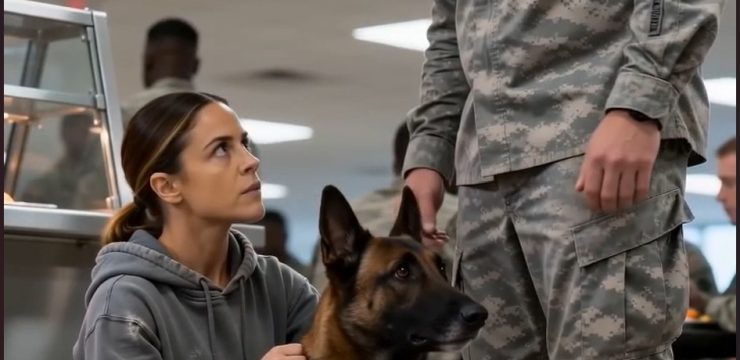
The morning fog hadn’t lifted yet when she walked through the gates of the marine base, bag slung over one shoulder, chin steady, eyes forward. The air was thick with the smell of damp concrete, motor oil, and strong coffee drifting out of the cafeteria. Everywhere around her, soldiers moved with purpose — boots hammering the pavement, voices carrying across the training yard, machinery humming inside massive metal hangars.
And then dozens of eyes landed on her.
Nobody smiled. Nobody welcomed her. A few marines exchanged knowing smirks. Others made no effort to lower their voices as they cracked jokes about women having no business being in a unit like this. Some simply stared with open contempt. This was a world built on toughness, discipline, and reputation — and to many of the men there, her arrival was less an event than an inconvenience.
Lieutenant Daniel Harper felt that way most of all.
He was the kind of man a room notices immediately — tall, broad-shouldered, with a weathered face and the kind of cold, calculating stare that had spent years practicing authority. He understood that the other soldiers were watching him closely, waiting to see how he’d respond. To Harper, leadership meant dominance, and dominance meant making sure everyone understood the hierarchy from the very first moment.
So he wasted no time.
From the moment she stepped onto the base, he rode her. Every small thing became a target. She walked too slowly. She stood in the wrong place. She took too long with her gear. His comments came in a steady rhythm, each one designed not to correct but to humiliate — to chip away at her confidence in front of anyone within earshot. But the young woman didn’t flinch. She followed every order quietly, kept her distance from the group, and trained in silence.
Which, somehow, made Harper even angrier.
By midday, the tension had been quietly simmering for hours. The cafeteria was alive with noise — trays clattering, voices overlapping, laughter bouncing off metal walls. Long tables filled with marines eating, arguing, joking. It was the kind of loud, chaotic energy that came with dozens of high-strung people crammed into one room after a hard morning.
She sat alone at the far edge of the room, eating her lunch without a word.
Harper walked over slowly, deliberately, making sure people noticed. He stopped beside her table, looked down at her the way a man looks at something beneath him, and said flatly — get up. Lunch is over. This is my seat.
The entire section of the cafeteria went quiet almost immediately.
She raised her eyes to meet his and replied, calmly and clearly, that everything in this space was shared, and she would leave when she was finished eating.
For a single breath, nobody moved.
Then Harper’s expression shifted. His jaw tightened. Without another word, he reached down, grabbed her tray, and slammed it onto the floor with full force. Plates shattered. Food and liquid splashed across the ground, spattering the boots of nearby soldiers. A burst of laughter erupted through the room. A few people even started clapping.
She looked at the mess on the floor for a moment — then quietly knelt down and began picking up the pieces with her bare hands.
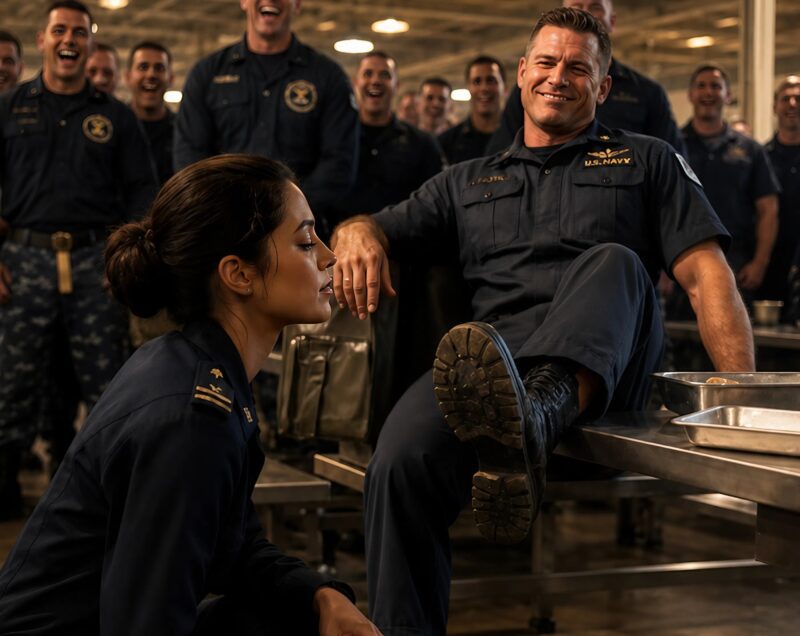
Harper sat in her seat with a wide, satisfied grin. He leaned back, placed his boot deliberately up on the table, grabbed a dirty rag from nearby, and tossed it directly at her. His words were simple, slow, and meant to be heard by every person in that room.
Get on your knees. Wipe my boots. Know your place.
More laughter. Phones came out. People were already positioning themselves to record what they assumed would be the final, defining moment of her humiliation.
She picked the rag up from the floor. Took a breath. Slowly moved toward his boot.
Harper’s smile stretched wider.
And then everything changed in an instant.
With one sharp, precise motion, she grabbed his leg and yanked it downward. The weight shift was sudden and total — Harper lost his balance completely and crashed off the chair, hitting the floor between the tables with a force that echoed through the entire cafeteria. The laughter stopped like a light switch flipped off.
He tried to scramble back to his feet. She was already moving. In one fluid motion — faster than anyone in the room could process — she twisted his arm behind his back and drove the large man face-first into the floor, holding him there with controlled, effortless pressure. The entire room stood frozen.
Harper struggled. He was strong, experienced, and furious. None of it mattered.
She leaned close and spoke quietly, just loud enough for those nearby to hear. She told him that men like him always chose targets they assumed were weaker. That his mistake today was choosing wrong.
Then she let him go, stood calmly, and faced the room.
Her voice was steady when she spoke. Before being transferred to this base, she had served as a combat instructor in a naval special operations unit. Taking down multiple trained men at once had been a standard part of her morning warm-up routine.
A few nervous laughs scattered through the room. Most people just went still.
She picked the rag up one final time, set it gently on the table directly in front of Harper, and told him he was welcome to clean his own boots.
Then she turned, walked toward the cafeteria exit, and didn’t look back.
Behind her, the room stayed silent.
Because for the first time since she arrived that morning, not a single person was laughing — and more than a few of them were looking at her the way soldiers look at someone they’ve just realized they completely underestimated.
Respect, it turns out, doesn’t ask for permission. It simply shows up — and when it does, the whole room feels it.