Nobody wanted her there. That much was clear from the moment she stepped through the doors of a unit that had never before seen a woman in its ranks. The air shifted when she arrived — not with curiosity, not with welcome, but with the kind of cold, dismissive energy that only comes from men who have already decided you don’t belong.
The whispers started small. A raised eyebrow here. A smirk there. The kind of quiet ridicule that doesn’t need words to cut deep.
But the words came soon enough.
“Seriously? She’s going to serve with us?” one soldier muttered, loud enough for everyone — including her — to hear.
“Think she can even lift a rifle?” another added, drawing laughter from the group like he’d just delivered the punchline of the year.
It wasn’t funny. It was never funny. But no one in that room had the decency to say so.
She was excluded from serious missions. She was placed deliberately into uncomfortable situations. Every obstacle course came with a wisecrack. Every training session came with a new attempt to break her down.
“Be careful not to chip a nail out there,” they’d call after her.
“Maybe you’d be more useful in the infirmary. You could hand out tea,” someone laughed one afternoon, and the crowd around him erupted like it was the cleverest thing they’d ever heard.
She never reacted. She never snapped back, never complained, never tried to prove herself with grand gestures or angry speeches. She simply did her work. Quietly. Consistently. Completely.
And somehow, that silence made them more irritated than anything else she could have done.
Then came the day everything changed.
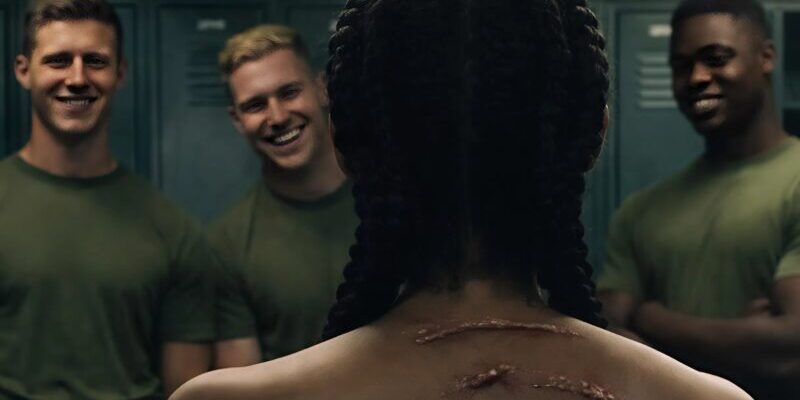
After a particularly grueling training session, she was changing in the locker room. Her uniform was soaked through, her back turned. One of the soldiers happened to glance her way — and he froze.
“Hey… you guys see that?” he said slowly, his brow furrowing.
The others drifted closer. And then it began.
Across her back were deep, uneven scars. Old wounds, rough and ragged — the kind that don’t come from accidents or carelessness, but from something that had once tried to destroy a person and hadn’t quite managed it.
For just a second, there was silence.
Then someone laughed.
“What is that… did something tear you apart?”
“Or did you lose a fight with a chainsaw?” another mocked.
“Maybe she just had a rough fall,” a third added, grinning openly as the laughter filled the room.
She lowered herself slowly onto the bench. Then further, until she was sitting on the floor. She pressed her hand over her face, trying to hold back what her body could no longer contain. Her shoulders trembled, but she made no sound.
“Aw, what’s wrong? You upset?” one of them said, still grinning. “We’re just messing around.”
The door slammed open.
The General stepped in. He stood in the doorway for a long moment, surveying the scene with a gaze that was heavy and absolutely cold. The laughter died instantly. Every man in that room straightened without being told to.
“Quiet. All of you.” His voice was low. Measured. And somehow more frightening for it. “Do any of you actually know who she is?”
No one answered.
He walked slowly into the room, looked down at the young woman sitting on the floor, and then turned that gaze — deliberate, unflinching — back to the soldiers.
“You’re laughing at her scars,” he said. He let that sit for a moment. “Do you have any idea where they came from?”
The silence in the room thickened like something you could feel against your skin.
“The person sitting in front of you has saved more lives than every single one of you combined.” His voice didn’t rise. It didn’t need to. “She was on reconnaissance. Her group was ambushed — fire from every direction, communications cut, survival almost impossible.”
He took one step forward.
“She didn’t run. She didn’t hide. She went back into that fire and pulled out the wounded. One. Two. Three. She kept going.”
Someone in the back swallowed hard enough to hear it.
“Those scars are not from carelessness. They are shrapnel wounds. Burn marks. The physical evidence of what happens when a person uses their own body to shield others from the blast.”
Not one man lifted his eyes from the floor.
“Her entire unit survived because of her. Every last one of them.” He paused. “And here you all stand… laughing.”
One soldier spoke, his voice barely above a whisper. “We… we didn’t know.”
The General turned to him sharply.
“You didn’t need to know any of that to treat her like a human being.”
The room was so still you could hear water dripping from their uniforms onto the floor.
Then, slowly, one man stepped forward. The same man who had mocked her worst. He couldn’t meet her eyes at first. But he tried.
“Why… why didn’t you ever say anything?” he asked. No trace of mockery left. Only something raw and ashamed.
She lifted her head. Her eyes were red. But there was no anger in them. No bitterness. Just a kind of quiet steadiness that none of them had earned the right to understand yet.
“What would it have changed?” she said softly. “I just did what needed to be done.”
Those words settled over the room like something final.
The soldier looked down at his hands. Then he reached out and offered her one.
“I’m sorry. I mean that.”
The others followed. One by one, they stepped forward.
“We were wrong.”
“Thank you. For everything.”
She hesitated for just a moment — the kind of hesitation that comes not from weakness, but from deciding whether people are worth the grace you’re about to give them. Then she took his hand and stood.
From that day forward, no one in that unit made another joke at her expense. Because they finally understood the truth — that the quietest person in the room had been carrying the heaviest thing all along, and she had never once asked anyone to help her hold it.
Strength doesn’t always announce itself. Sometimes it just shows up, does the work, and bears the scars without ever asking for recognition.
And some lessons can only be learned the hard way.