She was a young woman who believed she had found the love of her life. What she didn’t know was that she had actually signed away her entire future on a single piece of paper.
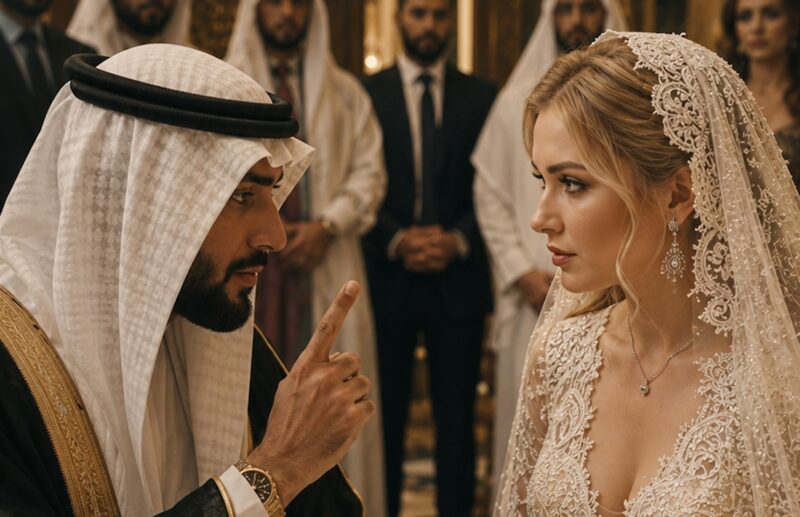
Emma grew up in a working-class family where money was always tight and comfort was never guaranteed. From the time she turned eighteen, she barely knew what a day off felt like. She juggled classes during the day and evenings waitressing at an upscale restaurant inside one of the city’s finest hotels. It wasn’t glamorous work, but it was honest, and Emma carried herself with quiet dignity through every long shift.
That was where everything changed.
Sheikh Omar walked into the restaurant one evening during a business trip, the kind of man who commanded attention simply by entering a room. He was polished, confident, and surrounded by the quiet authority that comes with old money and real power. He had seen beautiful women his entire life. But that night, it was Emma who stopped him in his tracks.
She accidentally mixed up his order. Her face flushed crimson as she stumbled through her apologies, embarrassed and flustered in a way that was completely genuine. Omar didn’t get angry. He smiled.
He came back the next evening. Then the evening after that. Within days, Emma realized the Sheikh was no longer visiting the restaurant for the food.
He began courting her with a world she had only ever seen in magazines. Private dinners at restaurants where a single meal cost more than her monthly rent. Drives through the city in sleek cars with uniformed drivers. Jewelry that sparkled with a price tag larger than her parents’ apartment. To Emma, it felt like stepping into a dream she hadn’t dared to dream before. And then, just months after they first met, Omar asked her to be his wife.
She said yes.
The wedding was held at his family’s palace, a breathtaking venue filled with hundreds of guests, walls draped in fresh flowers, crystal chandeliers catching the light overhead, and golden tableware set across long banquet tables. It was the kind of ceremony most women only imagine. But just as the marriage contract was placed before them, Omar paused the entire celebration.
He looked at Emma with calm, steady eyes and spoke quietly but clearly.
He told her there was one condition. She was required to carry a child every year until their firstborn turned eighteen. The condition was non-negotiable. If she disagreed, she was free to walk away right then. If she agreed, he would provide her and their children with everything they could ever need.
The room went completely silent.
Emma stared at him. Eighteen years? The number was staggering. But in that moment, surrounded by flowers and candlelight and a man she believed loved her deeply, she told herself it was simply his cultural way of expressing a desire for a large family. She convinced herself that with time, he would come to see how unreasonable the expectation truly was. She loved him. She trusted him.
She signed.
The first year of their marriage was everything she had hoped for. Emma became pregnant and gave birth to a beautiful boy they named Adam. Omar was overjoyed, the kind of happiness that fills an entire household. A daughter named Mia followed the next year, and then another son, Leo, the year after that.
Three children in three years.
Despite a full staff of nannies and on-call doctors, the physical and emotional toll on Emma was immense. She had barely recovered from one pregnancy before the next began. She was exhausted in ways she didn’t know how to put into words. Still, she pushed through because she loved her children and she believed her husband loved her in return.
Then came the fourth year, and everything shifted.
Months passed without the news Omar had come to expect. He said very little. Each month, he asked the family doctor the same quiet question. Each month, he received the same answer. Emma grew increasingly anxious. One evening, she asked her husband directly what would happen if she was unable to fulfill the condition she had signed.
He looked at her for a long moment and said only this: she had agreed to his terms herself.
He offered nothing more.
On the final day of that fourth year, Emma was called down to the main hall of the palace. Omar sat at a long table surrounded by his parents, the family attorney, and several relatives. The original marriage contract lay open in front of him.
She asked what was happening.
He told her calmly that the year had ended and she was not pregnant.
Emma’s hands trembled. She reminded him that she had tried, that the doctors had advised her body needed rest, that she had given him three children back to back without complaint.
He said he knew.
She asked why they were even having this conversation.
He slid the contract across the table and told her she had broken the condition.
Emma laughed nervously, certain this was some kind of test, some dramatic moment that would end with him pulling her close and telling her he was only joking. But the laughter faded when the attorney began producing additional documents. He informed her that the marriage contract had been annulled, the marriage considered legally dissolved under the terms she had agreed to.
She could not breathe.
She stepped toward Omar and told him what she had sacrificed. Her country. Her career. Her family. Four years of her life lived entirely on his terms. Three children carried in her body. And now he was ending everything because her body had needed one year to heal?
Omar looked down. He did not change his decision.
Within minutes, Emma’s suitcases were brought into the hall. They had already been packed. He had not waited for the last moment hoping things would change. He had prepared for this in advance.
Through tears, she asked about the children.
He told her they would leave with her.
Even his own mother looked at her son with something close to disbelief. Emma said nothing more. She went upstairs, gathered her three small children, and dressed them in the quiet hours of the night. Within the hour, the woman who had woken up that morning as mistress of a palace stood outside its enormous iron gates with three little ones and a row of suitcases.
The gates closed behind her.
She looked back at the palace windows. Omar stood in one of them, watching. He did not come outside. He did not wave. He simply stood there and watched them go.
Emma finally understood, in that cold and devastating moment, exactly what she had been all along.
Not a wife. Not a partner. Not the woman he loved.
Just a clause in a contract.
Months later, a photograph arrived from someone still inside the palace. In it, Omar sat at that same long table. Beside him was another young woman in a wedding dress. In front of her lay a brand-new contract.
And suddenly, Emma understood that her story had never been a fairy tale at all. It had only ever been the beginning of someone else’s.