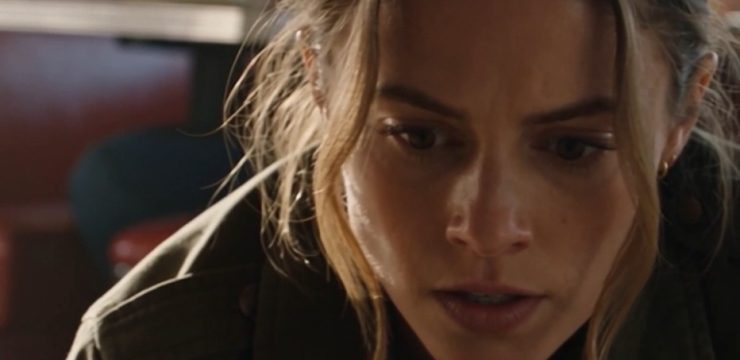
No shoes on his feet. A hoodie so torn it barely counted as clothing anymore. Eyes that had seen things no child should ever have to carry. He stood in the middle of a roadside diner just off the highway, and every single person inside went still — the kind of still that happens when something deep in your chest recognizes danger before your brain does.
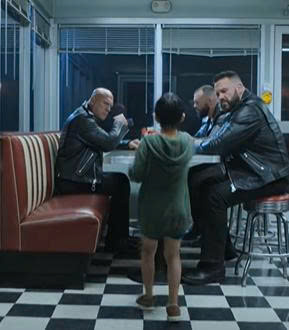
He was crying. But not loud. Not the way children cry when they want to be heard. He cried quietly, like a boy who had already learned that making too much noise brings consequences.
“She isn’t dead,” he whispered to no one in particular, his voice barely holding together. “He keeps her somewhere. She told me to run when he fell asleep.”
Nobody moved. Nobody spoke.
At the far end of the counter, a man named Rooster sat with a cup of cold coffee and a photograph he hadn’t put down since the boy walked in. His hands weren’t steady. His jaw was tight. Because the woman in that photograph — the one with the warm eyes and the crooked smile — was his younger sister, Mae.
Mae, who everyone in town had been told overdosed and disappeared somewhere out on the highway. No body recovered. No funeral. No real goodbye. Just the kind of silence that settles over a community when nobody wants to ask the questions that might unravel something much darker underneath.
Rooster had never believed the story they told him. Not once. And now a child was standing in front of him with Mae’s exact eyes — that specific shade, that specific shape — trembling in a diner at the edge of nowhere, while a black car sat idling in the parking lot outside.
The driver stepped out slowly.
Long dark coat. Clean shoes. No urgency whatsoever.
That last part was the worst detail. Panicked men are dangerous, but men who move slowly in situations like this — men who take their time — they’re the kind who believe they already control how everything ends. They’ve never had reason to rush because nothing has ever stopped them before.
One of the bikers near the window started moving toward the door, instinct kicking in. Rooster raised one hand without even looking over. “Not yet.”
He crouched down in front of the boy, bringing himself to eye level the way you do when you want a frightened child to understand they are not alone.
“What’s your name, son?”
The child swallowed hard, like even that small act of trust cost him something.
“Eli.”
Rooster nodded slowly, keeping his voice low and steady. “Did your mom tell you who was driving that car?”
Eli’s lips trembled. His small hands curled at his sides.
And then he said a name.
In the kitchen, a plate shattered on the floor.
Judge Harlan Voss.
The name landed in that diner like a stone dropped into still water. Ripples everywhere. Because everyone in that county knew Harlan Voss. Had seen him on television. Had watched him speak at fundraisers and press conferences and charity events — always talking about protecting children, supporting shelters, bringing missing kids home. Half the town considered him a hero. The other half had simply never had a reason to think otherwise.
Rooster stood up so fast his barstool hit the tile with a crack.
Outside, Judge Voss was already walking toward the diner entrance. Unhurried. Composed. Wearing the same expression he probably wore in courtrooms — the face of a man who has never once been told no by anyone who had the power to make it stick.
Eli grabbed Rooster’s hand and pulled close, his voice dropping to barely a breath.
“He always said nobody would ever believe a dirty kid over him.”
Rooster looked down at the boy. Then at the door. Then back at the photograph of Mae still sitting on the counter in front of him.
When the bell above the door rang and Judge Voss stepped inside — smiling, relaxed, already scanning the room like he owned it — Rooster didn’t raise his fists. He didn’t shout. He didn’t give the man the satisfaction of making this look like a confrontation between equals.
He did something far more powerful.
He picked up the photograph and set it flat on the counter where every single person in that diner could see it clearly. Then he turned and looked around the room — at the truckers, the waitresses, the bikers, the elderly couple near the window — and he spoke in a voice that carried to every booth, every corner, every person present.
“You all know this man. So before he says a single word — look at this boy’s face. Look at his eyes. And tell me who he belongs to.”
The room went completely silent.
The judge’s smile disappeared for the first time.
From the back, through the kitchen doorway, the older waitress emerged slowly. She had worked that diner for decades. Hands that had served a thousand meals, eyes that had seen people come and go. She was shaking now, staring at Eli with tears streaming freely down her face.
“I know this child,” she said, her voice cracking under the weight of years of silence. “I was there the night Mae gave birth. I held him.”
She raised one trembling finger and pointed it directly at the judge standing in the doorway.
“You told everyone the baby died.”
The diner didn’t erupt. It didn’t turn into chaos. It went the kind of quiet that only happens when a truth too large for words finally surfaces after being buried for a very long time.
And Judge Harlan Voss — who had walked into that room certain he controlled the ending — stood very still, because for the first time in years, the room was no longer his.