Nobody in that hospital room moved for what felt like the longest second any of them had ever lived through. Not the doctors standing at the foot of the bed. Not the old man gripping the chrome rails like they were the last solid thing in his world. Not even the boy — small, steady, and carrying something far heavier than the stone he had used to shatter the cast wide open.
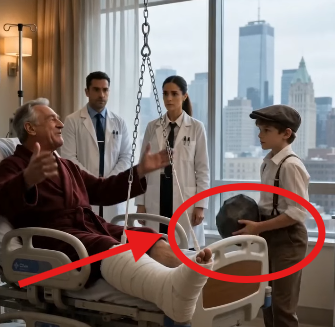
Because in that single frozen moment, everyone in the room understood the same terrible thing at the exact same time.
The lie was bigger than the leg.
The male doctor reached toward the split cast with fingers that weren’t quite steady. He pulled free a folded piece of paper wrapped carefully in plastic, tucked inside where no nurse would ever think to look during a routine check. The old man’s face changed the moment he saw it come loose. It wasn’t embarrassment that crossed his features. It wasn’t shame. It was something rawer and more desperate than either of those things.
It was pure panic.
Because that cast had never been about hiding a healthy foot. It had been hiding evidence. The female doctor took the paper from her colleague’s hands, peeled back the plastic with careful fingers, and unfolded it slowly. Her eyes moved once across the page. Then they went wide.
It was not a medical document.
It was a transfer authorization — three forged signatures across the top, two offshore account numbers in the middle, and one date circled in red ink at the bottom. The same date as the so-called accident that had left the old man supposedly unable to stand, unable to walk, unable to do anything except lie in his private luxury suite and receive the endless sympathy of everyone around him.
The boy standing at the side of that bed already knew everything.
He had known before he ever walked through the hospital doors that morning. His mother had been the one to find out first. She cleaned that private room every night, quiet and invisible the way working people are always invisible to men with money. Two nights before, she had come in during the late hours and seen something she was never supposed to see. The old man had been standing beside the window, straight and steady, staring out at the city lights below. No cast. No limp. No pain. Just a man perfectly capable of walking, choosing not to — because being seen as broken kept everyone looking the wrong direction.
By sunrise she had been fired. By midday her name had vanished from the staff records entirely. By evening, the boy had taken a stone from the garden outside and made a decision that most grown adults would have been too afraid to make.
He was going to break the lie in front of witnesses.
The male doctor stared at the moving toes, then at the paper, then slowly back at the old man in the bed.
“You can walk.”
He didn’t say it like a question. He said it like a man reading a verdict out loud.
The old man’s breathing had gone ragged and shallow. When he finally spoke, the confidence that had filled that room for weeks was completely gone.
“You don’t understand,” he said.
That was precisely the wrong answer to give.
Because the boy understood. And worse than that — so did both doctors now. The picture assembled itself piece by piece right there in the room. The cast, the fake paralysis, the private suite, the manufactured sympathy, the canceled board meetings that nobody questioned because what kind of person pressures a man who cannot walk. The delayed investigations. The signed documents that sailed through without scrutiny because everyone was too busy feeling sorry for him. All of it had been purchased with a performance. All of it had bought him time — time to control what needed controlling, time to sign what needed signing, while the people around him grieved for a suffering that never existed.
The boy stepped forward and looked at the old man without flinching.
“My mom said you walked at night,” he said quietly. “She said you only limp when people are watching.”
That sentence emptied the room of everything else.
Because the doctors were no longer standing there as medical professionals witnessing an unusual scene. They were witnesses to fraud. Real, documented, deliberate fraud. And the old man, still gripping those chrome rails in his expensive room with his expensive view, faced the cruelest part of his unraveling.
He had not been brought down by a rival with resources. Not by a lawyer with a case. Not by a detective with years of evidence. He had been undone by the son of a cleaning woman — the woman he had dismissed before dawn because he believed that people without power have no voice worth fearing.
The female doctor set the paper down on the bedside table like she was placing something sacred.
The male doctor moved to the bedside with an expression that had nothing professional left in it. Just disgust. Clean and honest and impossible to misread.
The old man looked at the boy one final time. His voice came out as barely a whisper.
“Who sent you?”
The boy answered without hesitating, without raising his voice, without needing anything more than the four words he had carried with him all morning.
“The truth sent me.”
And in that moment, everything in that luxury suite — the polished floors, the private bed, the window overlooking the skyline, the carefully maintained illusion of a powerful man struck down by fate — all of it stopped looking like power.
It looked like a stage set with no audience left to fool.
Because the real miracle in that room was never about healing. It was never about a leg or a cast or a dramatic recovery.
The miracle was a boy who had nothing but the truth, and the courage to walk it straight into the heart of the lie.
Some people spend their whole lives waiting for justice to arrive dressed in authority, wearing a badge, carrying official papers. But sometimes justice is quieter than that. Sometimes it walks in wearing worn-out shoes, carrying a rock, and it doesn’t need anyone’s permission to speak.
The room bore witness. And the truth, as it always does when someone finally refuses to let it stay buried, filled every corner and left nowhere left to hide.