The room was still glowing with candlelight when I realized my son had lied to me.
His wife had just placed a $4,500 Gucci bag into her mother’s hands—and I was holding a $2 grocery-store Christmas card. Worse, I knew exactly where the money for that handbag had come from.
I didn’t cry.
I didn’t raise my voice or knock over a wineglass. I simply sat very still while the roast steamed in the center of my dining table, rosemary and browned butter hanging warmly in the air.
Outside, snow gathered along the porch railing. Across the street, the Hendersons’ inflatable snowman leaned sideways in the wind, just as it did every winter.
Everything looked like Christmas.
Nothing felt like it anymore.
Brooke, my daughter-in-law, had reached beneath my tree and handed the gold-wrapped package to her mother, Margaret. It had been sitting there all evening, tied with an expensive satin ribbon that caught the chandelier light.
I watched from my favorite armchair—the one my late husband, Daniel, had bought me thirty years ago after a terrible blizzard.
Brooke hated that chair.
She once called it “visually heavy” and suggested I move it to the basement.
Tonight was supposedly Brooke’s Christmas dinner. She had sent the group text, chosen the wine, and rearranged my centerpiece because mine apparently wasn’t “festive enough.”
But I cooked the roast.
I made every side dish, polished the glasses, bought the groceries, and paid for everything.
And somehow, inside the house I had lived in for decades, I felt like the guest nobody had invited.
Margaret ripped through the wrapping while Brooke hovered beside her, almost giddy.
Then the cream-colored Gucci bag appeared.
“Oh my goodness!”
Margaret lifted it like treasure.
Everyone admired it.
Everyone except me.
The price tag was gone, but I recognized the bag.
$4,500.
Exactly the amount my son Julian had borrowed from my savings one month earlier for “unexpected car repairs.”
My eyes moved toward him.
Julian sat beside Brooke, smiling while Margaret examined the handbag. He lifted his wineglass, nodded approvingly—
and carefully avoided looking at me.
That hurt more than the bag.
Brooke was Brooke. Years ago, I had stopped expecting warmth from her.
But Julian was my son.
He knew where that money came from.
Brooke wrapped an arm around Margaret.
“Only the best for the best mom in the world.”
Laughter and smiles moved around the room.
Then Brooke looked at me.
Something changed in her face.
The warmth disappeared, replaced by a thin, polite smile—the kind you give someone you barely know.
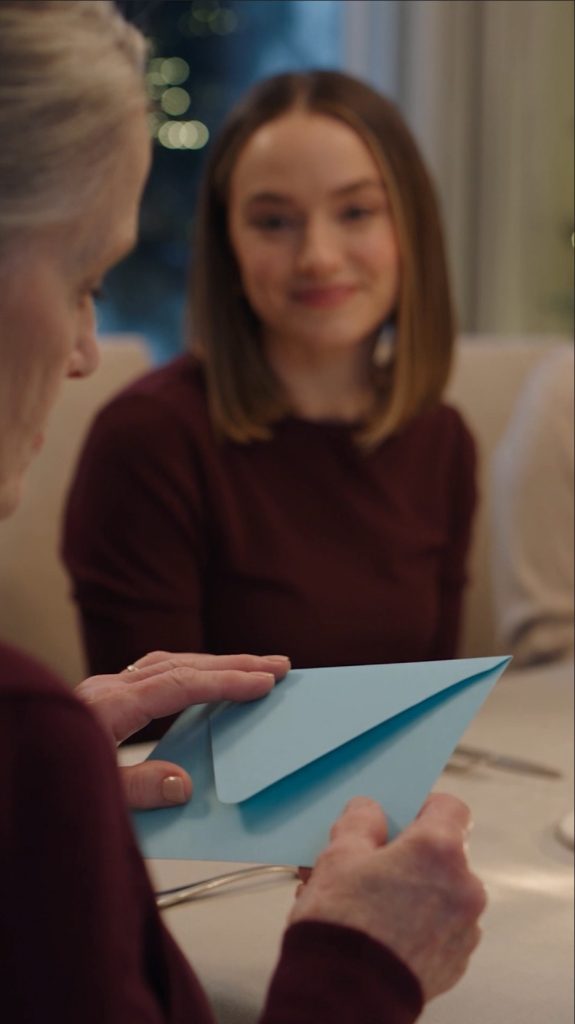
She reached beneath the tree and picked up a small light-blue envelope.
“And this is for you, Clara. Thanks for hosting tonight.”
Clara.
Not Mom.
Not even something affectionate enough to pretend.
I opened the envelope.
Inside was a generic grocery-store Christmas card with snowy mountains printed across the front.
“Season’s Greetings.”
That was it.
No handwritten message.
No thoughtful note.
Not even Julian’s signature.
For several seconds, I stared at the card.
And strangely, I didn’t feel sad.
I didn’t even feel angry.
What came instead was colder.
Clearer.
Clarity.
The card wasn’t an oversight. Brooke hadn’t forgotten because she was busy.
It was a statement.
Margaret deserved luxury.
Brooke deserved admiration.
Julian deserved access to my savings whenever he wanted it.
And me?
I supplied the house. The dinner. The emergency money. The forgiveness.
I was useful.
But I was not valued.
Carefully, I folded the card and slipped it into my cardigan pocket.
Then I stood.
The legs of Daniel’s old chair scraped softly across the rug.
Conversation died almost instantly.
Julian finally looked at me.
“Mom?”
For the first time that evening, uncertainty crossed Brooke’s face.
“Everything okay, Clara?”
I looked at her.
Then at my son.
Years of swallowed words, excuses, forced smiles, and quiet humiliation seemed to rise inside me all at once.
Julian’s wineglass stopped halfway to his mouth.
Brooke’s smile disappeared.
And for the first time in years, I had no intention of protecting either of them from what I was about to say.
I opened my mouth.
Nobody in that room was prepared for what came next. 👇
“Julian,” I said, and my voice came out so calm that it seemed to frighten him more than shouting would have. “Tell me what was wrong with the car.”
His fingers tightened around the stem of his wineglass. Brooke turned toward him too quickly.
“Clara, it’s Christmas,” she said. “Can we not do this tonight?”
I kept my eyes on my son. “What was repaired?”
The fire cracked behind us. Julian lowered his glass without drinking.
“Mom, I can explain.”
“Then explain.”
Brooke gave a short, brittle laugh. “This is ridiculous. You’re really going to make everyone uncomfortable because you didn’t like your card?”
Margaret’s hands stopped moving over the leather bag.
I touched the thin edge of the card inside my pocket. “This has nothing to do with the card.”
Julian closed his eyes.
“There were no car repairs,” he said.
The room seemed to shrink.
Margaret lowered the Gucci bag. Brooke’s face hardened—not with surprise, but with anger.
“I needed the money,” Julian continued. “Brooke wanted to do something special for her mom. We were already stretched. I thought I could replace it after my year-end bonus.”
“You borrowed from me by lying to me.”
“I know.”
“He was going to pay you back,” Brooke snapped. “Stop making it sound like he robbed you.”
I turned to her. “Did you know he told me the money was for the car?”
Her mouth opened.
For one second, I watched her search for the safest answer.
Then she made the mistake that ended everything.
“Of course I knew,” she said. “What difference does it make? You were going to give Julian that money eventually anyway.”
Nobody moved.
Margaret stared at her daughter. “Brooke.”
“What? I’m saying what everyone is thinking.”
“No,” Margaret whispered. “You’re saying what you were thinking.”
She placed the Gucci bag on the table between the candles and the untouched cranberry sauce.
“I don’t want this.”
Brooke blinked. “Mom.”
“I said I don’t want it.”
“You’re seriously taking her side?”
Margaret’s eyes shone, but her voice held. “There shouldn’t be sides when the truth is this ugly.”
Julian pushed his chair back.
“I lied to my mother,” he said. “That part is mine.”
Brooke stared at him. “Julian, don’t.”
He looked at me. “She told me you wouldn’t care. She said you had more than enough, that you liked helping me, that making me explain was your way of keeping me dependent.”
Brooke stood so fast her napkin fell.
“You agreed with me.”
“I agreed because I wanted the argument to stop.”
“Oh, please.”
“No.” His voice rose, then dropped again. “That’s what I keep doing. I agree so the argument stops. I lie so the argument stops. I let Mom absorb the cost so the argument stops.”
His eyes lowered.
“And somebody else always pays for my cowardice.”
Brooke went still.
“You’re choosing her over your wife.”
Julian shook his head. “I’m choosing to stop lying.”
Brooke looked around the room and found no one willing to rescue her.
Margaret pushed the bag toward her.
“Return it.”
Brooke’s lips trembled. “Fine.”
“And when the refund clears,” I said, “the $4,500 comes back to my account.”
Julian nodded immediately.
Brooke folded her arms. “So now you’re putting conditions on family?”
I looked at the blue card peeking from my pocket.
“No. I’m putting boundaries around being used.”
Something in Brooke’s face broke—not into remorse, but into the realization that the old arrangement was over.
She grabbed her coat. “Julian, let’s go.”
He stayed seated.
“Aren’t you coming?”
“No.”
Her face emptied.
“I’m staying here tonight.”
“You’ll regret this.”
He swallowed. “Maybe. But I already regret tonight.”
Brooke left with the bag under her arm. The front door slammed hard enough to shake the brass bell on the knob.
Margaret pressed both palms against the tablecloth.
“I’m sorry,” she said. “She told me you didn’t enjoy gifts. She said you preferred practical things and hated attention.”
I let out a tired breath.
Margaret looked toward my pocket. “That card wasn’t from Julian, was it?”
He shook his head.
“I didn’t even see it until tonight.”
For a moment, I saw the little boy he had once been after breaking something.
But he was not a boy anymore.
“I love you,” I said. “And I am furious with you.”
His eyes filled.
“Those can both be true.”
Three days later, the refund appeared in my account.
Julian had already moved into a small furnished apartment across town. He paid the deposit himself.
By New Year’s, he and Brooke had separated. There was no dramatic announcement. Just paperwork, difficult conversations, and the quiet end of a marriage held together by avoidance.
Brooke called me once.
“You got what you wanted.”
I stood beside the kitchen window, watching snow slide from the porch railing.
“No,” I said. “I wanted my son to tell me the truth. What happened to your marriage belongs to the two of you.”
She was silent.
She never apologized.
But she never asked me for anything again.
Julian did not transform overnight. He came every Sunday for months. Sometimes we talked. Sometimes he repaired a loose hinge or carried groceries.
One afternoon, he stared into his coffee and said, “I kept calling it keeping the peace because admitting I was afraid sounded worse.”
“Peace bought with somebody else’s dignity isn’t peace.”
He nodded. “I know that now.”
Margaret came too. The first time, she stood in my doorway holding a pie wrapped in a dish towel.
“Would it be all right if I came in?”
It was such a small question.
Maybe that was why it meant so much.
By spring, the house felt like mine again. I moved the centerpiece back where I liked it, repainted the dining room, and left Daniel’s old chair exactly where it had always been.
Then one Sunday, I told Julian, “I changed my will.”
He froze.
“I removed you as the sole beneficiary of my savings. Some will go to you. Some will go to the hospice that cared for your father. And some I intend to spend while I’m alive.”
For one terrible second, neither of us spoke.
Then Julian smiled.
Not the polished smile from Christmas night.
A small, relieved one.
“Good.”
I stared at him.
“Mom, spend it. Take the train trip Dad always wanted you to take. Fix the roof. Buy another ridiculous chair.”
I glanced toward Daniel’s enormous armchair.
“Another visually heavy one?”
Julian laughed.
And there it was—the truth I had needed.
The money had never been the real inheritance.
What I wanted to leave my son was the knowledge that love could survive the word no, that truth could cost you something and still save you, and that a family could break a pattern without breaking apart.
The next Christmas, Julian arrived early with groceries he had paid for himself. Margaret came later carrying the same pie dish.
There was no gold wrapping paper beneath the tree.
No expensive satin ribbon.
No performance.
After dinner, Julian handed me a small envelope.
For half a heartbeat, my fingers went cold.
He noticed.
“I know,” he said softly. “Open it.”
Inside was a plain card with a snow-covered house on the front.
In Julian’s handwriting were four lines.
Thank you for loving me when I made it difficult.
Thank you for saying no.
Thank you for making me grow up.
I’m glad you’re my mom.
I read it twice.
Then a third time because the words had blurred.
I reached across the table and took his hand.
No speech.
No perfect forgiveness.
Just his hand tightening around mine.
Later, after Margaret had gone home, snow began falling again.
Julian stood in the doorway with his keys. “See you Sunday?”
“Sunday.”
He crossed the room and hugged me.
Over his shoulder, I saw Daniel’s old chair beside the window, broad and worn and stubbornly out of fashion.
Suddenly I remembered something I had forgotten.
The night Daniel brought that chair home after the blizzard, he had dropped into it laughing and said, “Every home needs one place where you never have to earn your right to sit down.”
I had forgotten those words.
Now I understood why they had come back.
After Julian left, I carried his card into the living room and lowered myself into Daniel’s chair.
Outside, snow softened every roof and porch.
Inside, the tree lights reflected faintly in the dark window.
I rested Julian’s card in my lap, placed one hand on the worn arm of the chair, and let the house settle quietly around me.
There was nothing left to prove. Nothing left to excuse. No one left who needed me to become smaller so they could feel larger.
I was home.
And this time, I knew my place in it was mine.