The boot struck my ribs before I understood what Colonel Victor Kane was doing.
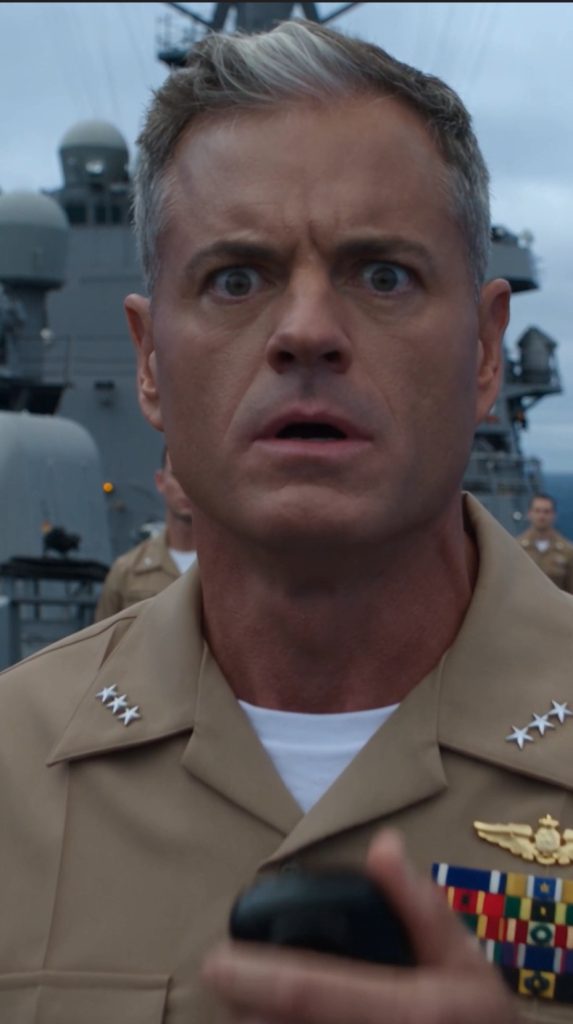
One violent impact. One flash of pain. Then the railing of the USNS Resolute disappeared beneath me, and nearly five hundred troops watched as I went over the side.
For half a second, Kane and I locked eyes.
Then there was nothing beneath my boots.
Someone screamed my name.
The Pacific hit like concrete.
Freezing water swallowed me whole, punching the air from my lungs as my uniform dragged me deeper. My body seized almost instantly, every muscle fighting the cold while I clawed toward the surface.
When I finally broke through, choking for breath, the Resolute was already moving away.
Hundreds of faces crowded the rail.
And above them stood Kane.
Hands planted on his hips. Completely calm.
“Trash taken care of.”
He thought the ocean would finish what he had started.
He thought my body would disappear beneath the wake and take his secret with it.
What he didn’t know was that beneath my mattress sat a sealed NCIS evidence packet.
Across the front were two words.
DECK FOUR.
Only three hours earlier, the flight deck had felt like an oven.
Heat shimmered above the steel beneath a merciless sun. Rows of troops stood motionless in formation, uniforms soaked through, while Kane sat comfortably in the shade eating steak.
Condensation slid down the ice-cold bottle in his hand.
Everyone could see it.
That was the point.
Three sailors had already been logged for heat exhaustion, yet Kane refused to unlock the emergency water supply below deck.
“Ration control,” he called it.
Nobody aboard believed him anymore.
The young signalman beside me began to sway.
He couldn’t have been older than twenty. His lips were cracked white at the edges, his eyes unfocused, his body already losing the argument with the heat.
I leaned toward him without turning my head.
“Hold your line.”
He tried.
God, he tried.
But Kane noticed.
His footsteps crossed the deck slowly, almost casually. Aviator glasses covered his eyes as he approached, and the entire formation seemed to stop breathing.
“Can’t stay on your feet?”
“Sir… yes, sir.”
The kid’s knees buckled.
Kane looked down at him.
“Dead weight doesn’t get water.”
The signalman collapsed.
I stepped forward before I could talk myself out of it.
I put myself between Kane and the sailor lying on the steel.
“Sir. He needs water.”
Five hundred troops heard me.
Kane turned.
Slowly, he removed his sunglasses.
His stare landed on me with such cold precision that I could feel everyone around us trying not to move.
“Who the hell do you think you are, Petty Officer?”
I kept my back straight.
“The only person here still speaking to you like a human being.”
Silence.
Absolute silence.
Somewhere behind us, a plastic cup rolled across the deck.
Clack.
Clack.
Clack.
Kane smiled.
But nothing in his eyes changed.
That was when I knew he had made his decision.
Before nightfall, he was going to break me.
What Kane couldn’t possibly know was that being broken was part of the assignment.
Officially, I was Petty Officer First Class Hannah Mercer Cole, maritime interdiction specialist.
That was the name printed on the records. The identity everyone aboard had been given.
But it wasn’t why I had been placed on the Resolute.
The beating, the humiliation, even Kane’s growing hatred of me—NCIS had known those risks before I ever stepped aboard.
Because hidden beneath my bunk was the classified file I had been sent there to protect.
And whatever Kane was hiding on Deck Four was important enough that he had just tried to throw me into the Pacific to keep it buried.
What he still didn’t know was how close I had come to uncovering it. 👇
A white life ring hit the water hard enough to splash my face.
I grabbed it with fingers that barely worked and looked up. The young signalman was leaning over the rail, one hand still extended from the throw. Kane had him by the back of his uniform as the kid shouted, “He kicked her! I saw him kick her!”
Then other voices joined him.
Not one. Dozens.
The ship’s alarm cut through the noise. An order came over the loudspeaker to reduce speed, and the Resolute’s wake began to soften. Kane was screaming now, but for the first time, nobody seemed frightened by the sound of his voice.
A rescue boat dropped toward the water.
By the time they pulled me aboard, my teeth were knocking so hard I couldn’t form words. A corpsman wrapped me in thermal blankets while another checked my ribs and breathing. I kept trying to sit up.
“Deck Four,” I managed.
The executive officer appeared in the hatchway, his face pale.
“Petty Officer, Colonel Kane says you lost your footing.”
Behind him, the young signalman stood with a bruise darkening where Kane had grabbed him.
“He’s lying,” the kid said.
I had one choice left. Protect my cover and risk letting Kane reach the evidence first, or burn the operation in front of everyone and end this before someone else got hurt.
“Sir,” I said, gripping the blanket around me, “secure Colonel Kane. Lock down Deck Four. And send someone to my bunk before he does.”
The room went still.
Kane appeared behind the executive officer. “She’s delirious.”
I met his eyes.
“NCIS.”
For the first time since I boarded the Resolute, Victor Kane stopped looking untouchable.
Then he turned and ran.
Boots hammered through the passageway. I followed despite the corpsman’s protest, one arm wrapped around my ribs, every breath cutting like broken glass.
We reached Deck Four to find the security door open.
Kane stood beneath harsh fluorescent lights, surrounded by pallets of bottled water, medical kits, field rations, and sealed relief supplies. Enough to have prevented every heat casualty on the flight deck.
In his hand was my NCIS packet.
The mattress in my compartment had been sliced open.
Kane held the packet over a metal disposal drum where orange flame licked at shredded paper.
“Stay back.”
Nobody moved.
His hand trembled.
“You think this proves anything?” he asked. “A few inventory sheets? Complaints from weak sailors? You have no idea what command requires.”
The young signalman stepped forward.
“You let us collapse beside water you had locked away.”
Kane’s jaw tightened.
“And then you tried to kill the person who stopped me from dying.”
Something changed in the faces around us. People who had spent months looking down when Kane passed were looking directly at him now.
Kane glanced at the fire.
The master-at-arms moved first. Kane jerked backward and tried to throw the packet into the drum, but I lunged. Pain exploded through my side as my hand closed around his wrist.
“You should’ve stayed in the water,” he whispered.
“No,” I said. “You should’ve opened the door.”
The master-at-arms took him down.
The packet hit the deck but never reached the flames.
When the cuffs closed around Kane’s wrists, he began shouting ranks and regulations, anything that still sounded like authority. Nobody answered. Behind him, thousands of unopened water bottles gleamed beneath the lights.
Then the executive officer opened the packet.
His eyes moved across the first page, then stopped.
“These aren’t just supply records.”
He handed me the page.
There were falsified manifests, diverted emergency stores, payments routed through a private logistics contractor, and signed orders linking Kane to months of missing government relief supplies.
But beneath them was something I had never seen.
A casualty report.
Two sailors from an earlier deployment had been hospitalized after Kane ordered water restrictions during another heat emergency. Their original medical statements had disappeared from the official record.
Copies were in my file.
So was the name of the person who had preserved them.
The executive officer.
Kane stared at him. “You?”
“I sent the first complaint to NCIS eight months ago.”
The words landed harder than a shout.
Kane had spent months believing fear had bought everyone around him. In reality, the first man beneath him in the chain of command had been documenting him the entire time.
The executive officer looked toward the troops gathering outside Deck Four.
“I should have stopped you sooner.”
His voice broke.
No one rushed to comfort him. Some truths deserved silence before forgiveness.
The signalman walked to one of the pallets, tore open the plastic, and pulled out a bottle of water. His fingers shook as he twisted the cap.
He handed it to me.
“You first,” I said.
A faint smile moved across his cracked lips. He drank half, wiped his mouth, and passed it over.
Only then did I drink.
Kane watched from the deck, cuffed and powerless, as the emergency stores were opened.
By sunset, every sailor who had stood baking in formation had cold water in their hands.
The investigation moved quickly because Kane had left too much behind. Deck Four held the inventory he claimed did not exist. My packet held the paper trail. The ship’s exterior cameras had captured the moment his boot drove into my ribs, and nearly five hundred witnesses had seen what followed.
He was removed from command before we reached port.
Weeks later, I sat in a quiet hearing room while the charges were read into the record: assault, attempted murder, falsification of official records, theft and diversion of government property, obstruction, and conduct connected to the earlier heat casualties.
Kane never looked at me.
He looked at the floor.
That was how his power ended—not with a final threat, but with a man who had once controlled an entire deck unable to make a single person in the room look away.
The young signalman testified after me. When he found me in the hallway, he twisted his cap between both hands.
“I thought I embarrassed myself that day,” he said. “Falling like that.”
“You were dehydrated.”
“I know. But I kept thinking I should’ve been tougher.”
I stopped the cap from turning.
“Toughness isn’t staying upright until you die.”
His eyes lifted to mine.
“It’s throwing the ring when the man behind you can punish you for it.”
He looked down quickly, blinking hard.
Months passed.
The two sailors whose reports had been buried received formal corrections to their records. The executive officer helped investigators reconstruct every altered manifest and suppressed complaint.
My ribs healed before the rest of me did.
For a while, the sound of water against a hull woke me at night. I would sit upright before I was fully awake, lungs searching for air that was already there.
Then one morning, a package arrived from the Resolute.
Inside was the same kind of cheap plastic cup that had rolled across the flight deck during my confrontation with Kane.
There was a note folded inside.
We thought you should know why that cup was there.
My hands went still.
The note had been signed by dozens of sailors. The signalman had written the final paragraph.
The cup had belonged to him.
Before formation, another sailor had slipped him a little water in it because he was already struggling. When Kane approached, he had set it down rather than let the colonel see someone had broken ration orders.
That tiny act of disobedience had been happening all over the ship.
Sailors sharing mouthfuls. Corpsmen hiding electrolyte packets. Crew members checking locked storage logs. People protecting one another quietly because the person in charge would not.
I had spent the mission believing NCIS had sent me aboard to save them.
The truth was harder and better.
They had been saving one another long before I arrived.
And when Kane kicked me into the Pacific, they saved me too.
A year later, I stood on a pier beneath a mild evening sun as the Resolute returned from another deployment under new command.
The signalman came down the gangway looking older, steadier. He spotted me and lifted a cold bottle of water in salute.
I raised one back.
Around us, families rushed forward. Children disappeared into uniforms. Someone laughed so hard they started crying. The ship’s steel hull caught the last gold light of the day, and for once, the dark water beside it did not tighten my chest.
The signalman reached me and handed over that battered plastic cup.
“You kept it?”
“Figured it belonged to the person who heard it.”
I turned it in my hand, tracing the scratches along the rim.
Then I set it on the pier between us, opened both bottles, and poured a little water into it.
He understood without asking.
We stood there quietly while the sun lowered over the harbor, surrounded by people finally coming home, and watched the cup fill to the brim.