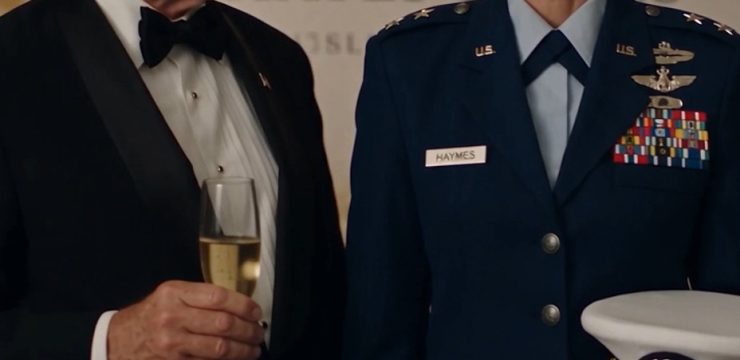
The place card disappeared from the table before anyone had the courage to object.
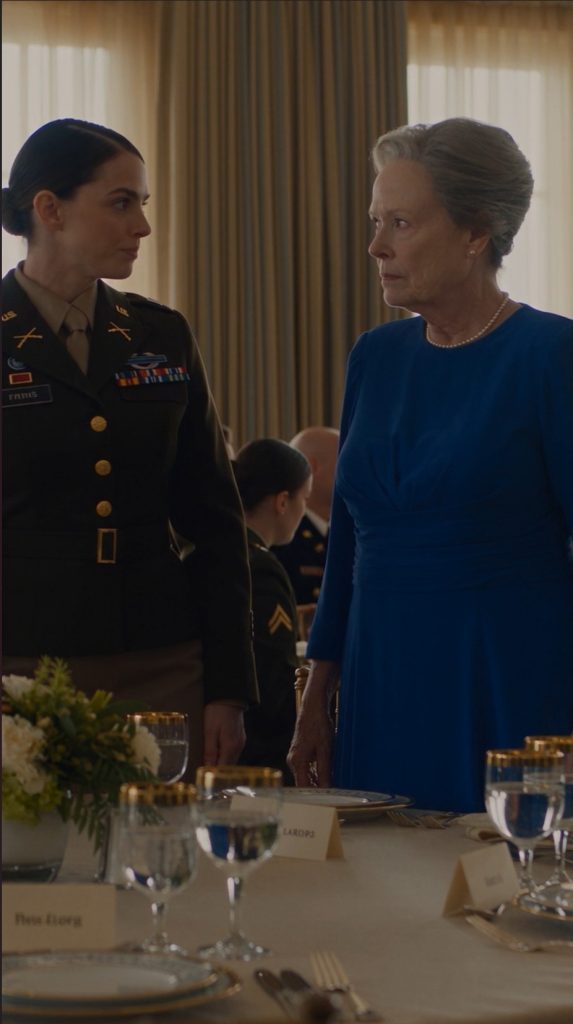
Silverware stopped moving. Conversations died mid-sentence. And in the polished silence of the ballroom, one woman was being quietly told that everyone else belonged there more than she did.
“You’re sitting in the wrong seat.”
Margaret Hayes looked up from table one.
Lieutenant Colonel Vanessa Stone stood beside her chair, immaculate in uniform, wearing a practiced smile that never reached her eyes.
Margaret kept one hand on the cream-colored invitation beside her plate.
“I don’t think I am.”
Vanessa glanced at the place card. Then at Margaret’s plain navy dress, modest pearl earrings, and inexpensive black shoes.
Something in her expression changed.
“This table is reserved.”
Margaret calmly offered her invitation.
“My name is printed on it.”
Vanessa read it. Then checked the place card again.
Same name.
For one brief second, there was nothing left to question.
A brigadier general across the table shifted uneasily. Two officers nearby had gone completely still.
Vanessa placed the invitation back down.
“The planning staff must have made a mistake.”
Margaret studied her face.
“What kind of mistake?”
Vanessa’s gaze moved slowly over her clothes before drifting toward the decorated uniforms surrounding table one.
“This table is intended for distinguished guests.”
Margaret’s fingers remained beside her untouched water glass.
“And I’m not considered one?”
At the next table, a young captain lowered his eyes.
Vanessa smiled faintly.
“There are other seats available.”
Then she picked up Margaret’s place card.
No one stopped her.
She turned toward the rear of the ballroom, where several tables sat near the swinging kitchen doors.
“Table eighteen should be more comfortable for you.”
The words sounded polite.
Their meaning wasn’t.
Margaret glanced toward the kitchen.
“By the kitchen?”
Vanessa shrugged.
“It’s still part of the ballroom.”
Someone coughed behind them. Another guest suddenly became fascinated by his napkin.
Margaret looked around table one.
Nobody held her gaze.
Slowly, she pushed back her chair.
The scrape against the polished floor cut through the room louder than the orchestra.
She stood.
“Thank you for understanding,” Vanessa said.
Margaret picked up her invitation and followed her.
They crossed the ballroom beneath dozens of watching eyes.
Some guests pretended not to notice. Others made no effort to hide their curiosity.
Margaret noticed all of them.
She had spent enough years around military families to understand disciplined silence. Sometimes silence was respect.
Sometimes it was cowardice wearing perfect posture.
At table eighteen, Vanessa placed the card beside an empty chair only a few yards from the kitchen.
Warm air drifted through the swinging doors carrying the smell of roasted chicken. Servers hurried past with trays, nearly colliding beside the table.
“There,” Vanessa said.
Margaret looked toward the stage.
Tall floral arrangements partially blocked the podium. The military band was barely visible.
“You should have everything you need here.”
Margaret met Vanessa’s eyes.
“Everything?”
“Dinner. A clear view of the stage. Plenty of space.”
“That sounds very generous.”
Vanessa’s smile tightened.
“I try.”
Margaret sat.
Vanessa lingered, almost as though she were waiting for embarrassment. Anger. Perhaps even a scene.
Margaret gave her nothing.
That seemed to bother her most.
“Enjoy your evening, Mrs. Hayes.”
Margaret unfolded her napkin.
“I plan to.”
Only after Vanessa walked away did Margaret release the breath she had been holding.
Her hands were steady.
Her heart wasn’t.
It had begun pounding the instant Vanessa touched that place card—not from fear, but from memory.
Margaret knew how public humiliation worked.
It rarely began with shouting.
Usually, someone decided where you belonged.
Someone else stayed silent.
Then another person looked away.
Soon, an entire room accepted the decision.
A young server approached carrying a water pitcher. His name tag read ETHAN.
“Ma’am, may I get you some water?”
“Yes, please.”
He filled her glass, hesitated, then leaned closer.
“I saw what happened.”
Margaret glanced toward table one.
Vanessa was already laughing with two colonels.
“You and half the ballroom.”
Ethan flushed.
“That wasn’t right.”
Margaret looked back at him.
“What would you have done?”
He hesitated.
“I don’t know.”
“That’s an honest answer.”
“I’m sorry.”
“You don’t owe me an apology.”
His eyes shifted toward Vanessa.
“Somebody does.”
For the first time that evening, something almost like a smile touched Margaret’s face.
“Bring me coffee later.”
“Yes, ma’am.”
“Strong.”
“Very strong.”
Ethan walked away.
Margaret remained perfectly still, her eyes returning to table one as laughter carried across the ballroom.
The evening was far from over—and nobody in that room yet understood what had just been set in motion. 👇
A microphone squealed near the stage.
The laughter at table one stopped. Vanessa turned toward the podium, still smiling, until the announcer unfolded a card.
“Before dinner begins, we would like to recognize the woman whose work made tonight possible. Mrs. Margaret Hayes, would you please join us onstage?”
For one second, nobody moved.
Then every face in the ballroom turned toward table one.
Vanessa’s smile disappeared.
The brigadier general across from Margaret’s empty chair closed his eyes briefly. Ethan, halfway across the room with a coffee pot in his hand, stopped walking.
“Mrs. Hayes?” the announcer repeated.
Margaret pushed her chair back at table eighteen.
The scrape across the floor sounded almost identical to the first one.
Only this time, no one looked away.
Vanessa crossed the room quickly and stopped beside her.
“Mrs. Hayes, I believe there’s been a misunderstanding.”
Margaret looked at the place card beside her plate.
“No. You understood my name perfectly.”
“I was given incomplete information.”
“You were given my invitation.”
Vanessa glanced toward the stage, suddenly aware that the microphone was still live and the room had gone quiet enough to hear glass touch linen.
“This is neither the time nor the place.”
Margaret met her eyes.
“You decided it was the time and place when you moved me.”
The brigadier general stood.
“Lieutenant Colonel Stone. Did you relocate Mrs. Hayes from table one?”
Vanessa straightened automatically.
“There was a seating discrepancy, sir.”
“Was her name on the place card?”
“Yes, sir.”
“Was her invitation valid?”
A pause.
“Yes, sir.”
“Then what discrepancy?”
Vanessa looked around as though searching for an answer that might survive the witnesses.
“She did not appear to be one of the designated distinguished guests.”
Someone inhaled sharply behind Margaret.
The general’s face changed.
Not anger at first.
Shame.
He looked at Margaret’s empty chair at table one.
“I was sitting across from that chair,” he said. “I watched this happen, and I said nothing.”
The young captain stood.
“Neither did I, sir.”
His voice shook.
Another officer rose. Then another.
Vanessa’s expression hardened.
“Sir, with respect, this is becoming unnecessarily theatrical.”
The general looked at her.
“No. What happened to Mrs. Hayes was unnecessary. This is accountability.”
He reached into the leather folder at his place setting and removed the seating chart.
“I approved this yesterday. You approved it this morning.”
He held up the final page.
Beside Margaret’s name, in bold type, were three words.
GUEST OF HONOR.
Vanessa stared at them.
Her initials were beside table one.
For the first time all evening, she had nothing to say.
“You are relieved of your responsibilities for this event effective immediately,” the general said. “Report to my office at 0800 tomorrow. Until the command review is complete, you will have no supervisory role in family outreach.”
“Sir—”
“That is not a discussion.”
Vanessa looked at Margaret.
The contempt was gone. So was the polished smile.
“Mrs. Hayes,” she said quietly, “I apologize.”
Margaret studied her.
“Are you sorry you did it?”
Vanessa blinked.
“Or are you sorry everyone saw?”
The question remained unanswered.
Vanessa walked from the ballroom alone.
No one applauded.
Margaret was grateful.
Justice did not feel like victory while the bruise was still forming.
The general stepped toward her.
“I owe you more than an apology.”
“Yes,” Margaret said.
He nodded.
“I should have spoken when it mattered.”
“So should a lot of people.”
Behind him, the young captain stared at the floor.
Margaret softened slightly.
“Learn from the fact that you didn’t.”
His throat moved.
“Yes, ma’am.”
Ethan appeared with a cup and saucer.
The coffee trembled just enough to make a dark ring near the rim.
“Strong,” he said.
Margaret took it.
“Very strong?”
“Possibly illegal.”
A quiet laugh moved through the room.
Margaret carried the coffee to the stage.
At the podium, she gently stopped the announcer before he could read her prepared introduction.
“I’d rather do this without it.”
She looked over the ballroom.
“My husband used to say you could learn more about an institution by watching how it treats someone who has nothing to offer it.”
No one shifted.
“Tonight, some of you believed I had nothing to offer.”
She paused.
“And for several minutes, that mattered more than whether I was being treated with dignity.”
Margaret placed both hands on the podium.
“The Hayes Family Center was built for military families when rank, ceremony, and polished uniforms are no help at all. It is what my husband needed after his last deployment. It is what I needed after we lost him.”
Her eyes moved toward table eighteen.
“So tonight’s lesson cannot be that I deserved table one because my name is on a building.”
Her voice softened.
“The lesson is that nobody deserves table eighteen as punishment for looking ordinary.”
Ethan began clapping.
The young captain joined him.
The applause rose slowly until the room was standing.
Margaret did not smile until she saw the kitchen staff standing in the doorway too.
The command review began the next morning.
The ballroom incident was not the only complaint. Once people realized someone was listening, old reports resurfaced. Junior officers described being mocked for accents and backgrounds. Military spouses described being dismissed from committees because they did not “fit the image.” Two civilian employees produced emails they had saved because they had never known where else to take them.
Vanessa had not been undone by one bad night.
She had been exposed by a pattern she had believed nobody important would ever care enough to see.
Within weeks, she was formally removed from the family outreach program and relieved from her leadership assignment. The findings became part of her permanent record.
Her power had depended on rooms staying quiet.
They no longer did.
One rainy afternoon, the brigadier general came to the Hayes Family Center without an aide or dress uniform.
He carried two coffees.
Margaret looked at the cups.
“Strong?”
“I was told that matters.”
They sat in the center’s small kitchen while rain tapped against the windows.
Finally, he said, “I keep seeing your empty chair.”
Margaret wrapped both hands around her cup.
“I knew something was wrong,” he continued. “I waited for someone else to stop it.”
“Most people think courage feels like certainty.”
He looked at her.
“It usually feels like deciding while you’re still afraid.”
His eyes dropped.
“I’m sorry.”
This time, Margaret believed him.
The young captain began volunteering twice a month at the center’s overnight family assistance desk.
Ethan came too.
He was saving for community college while working banquets, and one evening Margaret found him tightening the screws on a loose waiting-room chair between classes.
“We have maintenance people,” she told him.
“Yeah, but I saw it wobbling.”
Margaret smiled.
Three months later, the center held a small dinner.
No uniforms were required.
No head table existed.
Every chair was the same.
Before everyone sat down, the brigadier general handed Margaret a sealed envelope.
“The board found this in the original center records.”
Inside was a note written in her husband’s unmistakable block lettering.
Margaret sat down before her knees could decide for her.
If this place ever gets built, don’t put my rank on the wall.
Put Margaret’s name there.
She notices the people everyone else walks past.
Margaret pressed her fingers to her mouth.
For years, she had believed the board named the center after the Hayes family because of her husband’s service.
“He asked them before his last deployment,” the general said softly. “They kept the note because you always refused personal recognition.”
A tiny coffee stain marked one corner.
Margaret laughed once through her tears.
Ethan leaned over her shoulder.
“Strong?”
“Probably terrible.”
The room laughed.
This time, she laughed with them.
Later, Margaret stepped outside beneath the covered porch.
The rain had stopped. Warm light spilled through the windows behind her and stretched across the wet pavement.
Inside, Ethan stacked cups. The young captain helped an elderly military spouse into her coat. The general carried plates toward the kitchen despite someone insisting he did not have to.
Nobody was seated according to importance.
Nobody had been sent to the back.
Margaret folded her husband’s note and slipped it beside the cream-colored invitation she had carried home from the ballroom.
For the first time, the invitation no longer felt like proof of where she had been allowed to sit.
It felt like proof that a room could change once somebody finally refused to look away.
She closed the folder, listened to the laughter inside, and walked back through the door toward the people waiting for her.
This time, there was no table one and no table eighteen.
There was only home.