The celebration inside the house should have felt like a beginning.
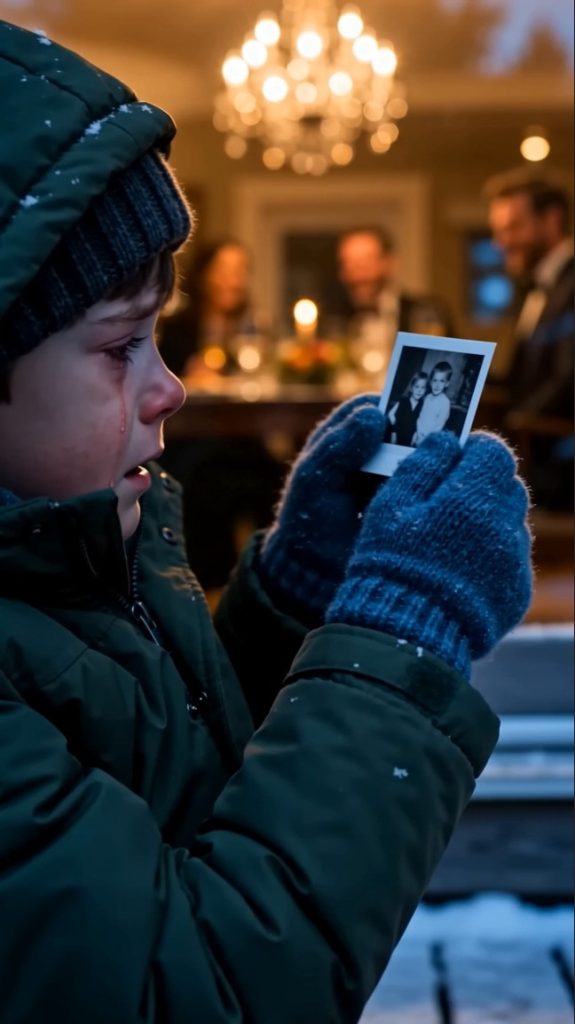
Instead, beyond the glowing windows, a little boy sat alone in the snow, sobbing so violently he could barely pull air into his lungs. And somewhere between the laughter inside and the photograph trembling in his hand, he realized something was terribly wrong.
The chandelier burned warm above the dining table, scattering golden light across crystal glasses and polished silver.
Voices overlapped in easy laughter. Plates were full. Shoulders relaxed. A large family lifted their drinks together, smiling like people who had survived something painful and finally earned the right to forget it.
Outside, the cold told a different story.
The boy sat curled against the porch railing, his small body shaking beneath his coat. Snow gathered on his sleeves and hair. His cheeks had gone raw and red, and his gloves were soaked where he kept wiping tears from his face.
Every few seconds, he looked through the window.
Every time, it hurt worse.
Because those people were not strangers.
At least, they weren’t supposed to be.
His fingers tightened around the folded photograph he had carried all evening. He had gripped it so hard inside his glove that the corners had bent and the paper had softened with moisture.
At first, his tears had been simple.
Loneliness.
Cold.
The humiliation of sitting outside while warmth, food, and laughter existed only a few feet away.
Then he opened the photograph again.
Only halfway.
Just enough to see her face.
His breathing stopped.
The crying didn’t disappear. It changed.
Something colder than the snow slipped through him.
Fear.
The woman in the photograph was younger, but there was no mistaking her. She stood beside a man the boy had never seen before, smiling in front of this very house.
Behind them was the same porch.
The same windows.
And through the glass, the same chandelier.
One of the woman’s hands rested gently over her stomach.
The boy turned the picture over.
Four faded words stared back at him.
“If they celebrate, run.”
His lips parted, but no sound came.
Slowly, he raised the photograph toward the bright dining-room window and compared the faces.
The house matched.
The chandelier matched.
And there she was.
Older now.
Sitting at the table.
Smiling.
For one terrible second, the boy wondered whether he should obey the warning.
Run.
Disappear into the snow.
Never ask the question that had been tearing through him since he arrived.
Then the woman glanced toward the window.
Her smile vanished.
Not faded.
Vanished.
Her entire face seemed to lock in place as she stared at the boy outside—and then at the photograph raised in his shaking hand.
A crystal glass slipped from someone’s fingers.
It struck the table and shattered.
Conversation died instantly.
Nobody moved.
The only sound was the faint hiss of the fire and the wind dragging snow across the porch.
The boy pushed himself to his feet.
His knees trembled.
Inside, the woman remained frozen.
Someone beside her followed her stare toward the window. Another person frowned. Confusion moved around the table in silence, passing from face to face.
The boy stepped closer to the glass.
His voice came out cracked and small.
“Why are you celebrating…”
He swallowed.
“…if my mother is still alive?”
Every trace of color left the woman’s face.
A chair scraped violently backward.
Someone stood too fast.
Another family member turned toward the woman, waiting for an explanation she suddenly seemed incapable of giving.
The boy raised the photograph higher.
That was when the older man seated at the head of the table finally saw the writing along the bottom edge.
He leaned forward.
His eyes narrowed.
Then he recognized the handwriting.
His dead brother’s handwriting.
The blood seemed to drain from his face as he read the sentence beneath the woman’s photograph.
“This child is hers. Not ours.”
And in the silence that followed, nobody in that house was prepared for what came next. 👇
The older man did not blink.
For several seconds, he simply stared at the photograph through the glass, as if the dead had reached into the room and placed a hand around his throat. Then he pushed back his chair and said, too quietly, “Bring him inside.”
The boy stepped backward.
The woman was already moving. She crossed the dining room so quickly that her chair toppled behind her, shoved open the front door, and ran into the snow without a coat.
Cold air tore through the house.
She stopped three feet from the boy.
Up close, he could see that she was crying now. Her eyes moved over him with desperate precision—his hair, his nose, the small scar above his eyebrow—as though she were trying to recognize a life someone had stolen before she had been allowed to know it.
“What is your name?” she whispered.
The boy hesitated, then told her.
Her knees gave way.
She sank into the snow and covered her mouth with both hands.
Behind her, the older man appeared in the doorway.
“Enough,” he said.
The woman turned.
Something in her face hardened.
“No.”
He came onto the porch, one hand extended toward the photograph. “Give me that.”
The boy clutched it against his chest.
The woman stepped between them.
“No,” she said again. “You don’t get to take one more thing from him.”
A murmur moved through the people behind the doorway.
The older man’s expression tightened. “You have no idea what that paper means.”
“I think I do.”
She looked at the boy, then pulled a thin chain from beneath her dress. A small brass key hung from it.
The older man went still.
For years, she explained, she had been told that the baby she carried in that photograph had died before she ever held him. She had been sedated after the birth, kept away from the hospital records, and taken back to the house while everyone told her grief had confused her memory.
She had believed them because her husband had died only weeks later.
A car accident, they had said.
The older man’s jaw flexed.
“No,” the woman whispered. “Not an accident.”
She held up the key.
Her husband had given it to her the night before he died. She had never known what it opened.
The older man moved suddenly.
He lunged for the key.
The boy screamed.
Two relatives caught him before he reached her. Chairs scraped. Someone shouted for the police.
The older man twisted against their grip.
“You don’t understand what he was doing!” he shouted. “He was going to destroy this family!”
The woman stared at him.
“No. He was trying to save mine.”
The brass key opened a narrow drawer beneath the dead brother’s old desk upstairs.
Everyone followed except the boy, who stayed near the staircase until the woman reached back for his hand.
She did not pull him.
She simply offered.
After a moment, his fingers slipped into hers.
Inside the drawer were hospital documents, bank transfers, a sealed envelope, and a small cassette recorder wrapped in an old handkerchief.
The older man stopped fighting.
His face changed before anyone pressed play.
The dead brother’s voice filled the room.
He said he had discovered that his brother had paid a nurse to alter the birth record and arrange for the baby to be removed. The child had been placed with people outside the family under another surname. The plan was to keep the mother convinced the baby had died until an inheritance tied to her bloodline could be controlled through the family trust.
He had found the boy.
He was bringing him home.
And if anything happened to him first, the documents in the drawer were to go to the police.
The recording clicked.
Nobody spoke.
The older man looked suddenly smaller beneath the yellow study light.
Then the woman asked, “Did you kill him?”
His eyes lifted to hers.
He said nothing.
But the final proof was in the envelope.
Inside was a mechanic’s report showing deliberate damage to her husband’s brake line. Attached to it was a payment receipt bearing the older man’s signature.
Someone sat down hard on the floor.
Another relative turned away.
The woman did neither.
She stood perfectly still, holding the boy’s hand.
When the police arrived, the older man did not resist.
At the doorway, he looked back at the family as if waiting for someone to defend him.
Nobody did.
“I kept this family together,” he said.
The woman’s voice barely rose above a whisper.
“You kept it afraid.”
Then the door closed behind him.
For a long time, nobody moved.
The celebration table downstairs remained untouched. Melted ice thinned the drinks. The broken glass still glittered among the plates.
The woman sat on the bottom stair beside the boy.
She did not call herself his mother.
Not yet.
Instead she asked where he had lived, who had cared for him, what foods he hated, whether he still had nightmares.
His answers came slowly.
Eventually the boy asked, “Did you leave me?”
She looked at him.
“No.”
The word broke in the middle.
“I thought you were dead.”
He studied her face for a long time.
Then he placed the photograph between them.
“I thought you didn’t want me.”
Her hand trembled, but she did not touch him until he leaned against her first.
When he did, she folded around him carefully.
Not like someone reclaiming what belonged to her.
Like someone being trusted with something precious.
The weeks that followed were not simple.
Police reopened the death investigation. The altered hospital records were recovered. The nurse testified. Financial records tied the older man to the false adoption and the damaged car.
His power disappeared piece by piece—not through revenge, but through evidence.
Some relatives left, unable to bear what they had ignored. Others stayed and admitted the smaller ways fear had made them obedient.
The woman did not forgive everyone.
But she listened.
The boy moved into a small room overlooking the back garden.
For the first month, he slept with the photograph under his pillow.
Then one evening, the woman found it sitting openly on his desk.
Beside it was the brass key.
Months later, another envelope surfaced among the dead brother’s belongings at the solicitor’s office.
The woman opened it at the same dining table where the celebration had ended.
Inside was one final letter addressed to the boy.
Her hands shook too badly to read it aloud, so he read it himself.
His father had written that he knew the child might grow up believing he had been abandoned. He had tried to reach him before his death. The warning on the photograph had never meant that every person in the house was dangerous.
“If they celebrate, run” referred to one specific night.
The night the older man planned to announce that the woman had signed away her remaining claim to the family trust.
But she never signed it.
Her husband had hidden the real document.
And beneath the letter was the deed transferring his share of the house—not to the family, and not to the trust.
To his wife and child.
The boy looked up.
For the first time since arriving, he smiled without uncertainty.
The woman laughed softly through her tears.
The house had never belonged to the man who ruled it.
It had been waiting for them.
That winter, they took down the heavy curtains in the dining room.
By spring, sunlight reached places that had been dark for years.
The family did not hold another grand celebration.
Instead, on the boy’s birthday, a handful of people gathered around the same table. No speeches. No crystal raised to old secrets.
Just food, awkward jokes, a crooked homemade cake, and too many candles because nobody could agree who had counted them.
At one point, the boy looked toward the window.
The porch beyond it was empty.
No child sat outside in the cold.
The woman noticed where he was looking and reached beneath the table.
Her hand found his.
He squeezed once.
Then he turned back toward the people who had chosen, finally, to tell the truth.
Outside, the last snow of the season softened along the porch steps.
Inside, the chandelier still glowed.
But this time, every door was open, every light was warm, and the boy was exactly where he belonged.