The moment I saw my dead mother’s wedding dress on my husband’s mistress, I nearly collapsed. Four hundred people were applauding, cameras were flashing, and the man I had loved for twenty-one years was smiling proudly beside the woman who had stolen something irreplaceable.
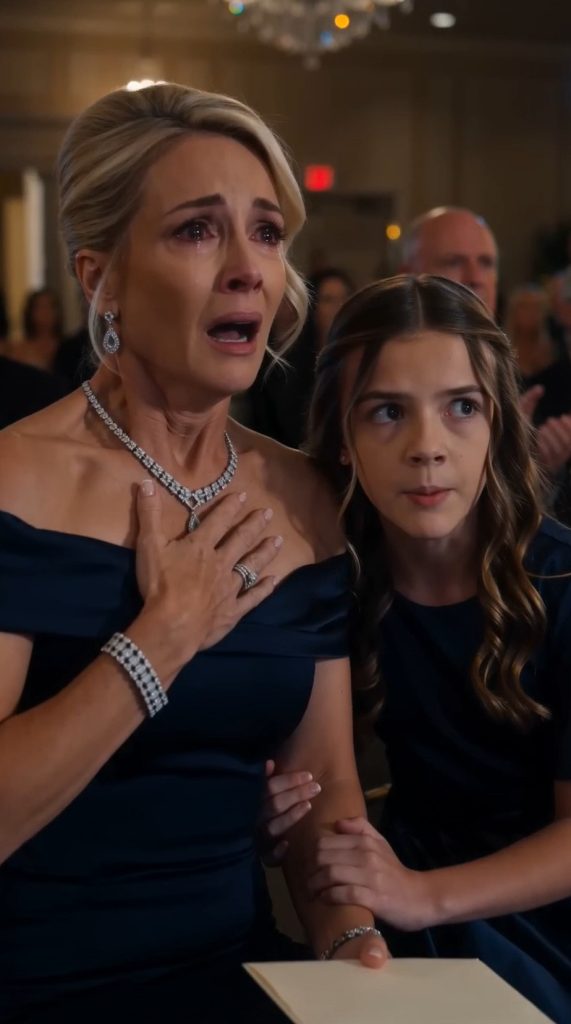
Then my fourteen-year-old daughter grabbed my wrist.
“Mom, don’t stand up. Let her take the bow.”
I turned toward Charlotte, barely able to breathe.
“Because Dad doesn’t know what Grandma left me,” she whispered.
The ballroom of Chicago’s historic Palmer House glittered beneath crystal chandeliers. Tonight marked twenty years of Whitmore Bridal, the company James and I had built from a rented storefront using my mother’s sewing machine and the money she’d left me.
Now James was being celebrated as its visionary founder. My name hadn’t even made the anniversary program.
But none of that mattered when Vanessa Clarke stepped onto the runway.
Thirty-two. Our creative director. The woman James insisted was merely a talented colleague.
She was wearing my wedding gown.
Ivory silk. Delicate lace sleeves. Tiny pearl buttons. And near her left wrist, a bluebird embroidered in pale blue thread.
My mother had stitched that bird to hide a mistake.
“Every bride needs something blue,” she’d told me, laughing.
She’d spent eleven months making that dress, working long after her customers went home. Even when her cancer returned three months before my wedding, she refused to stop.
On my wedding morning, her trembling fingers fastened every button.
Seven weeks later, she was gone.
For twenty-one years, I’d protected that gown inside a cedar chest, dreaming that Charlotte might someday wear it.
Six months ago, James offered to have it professionally preserved.
I’d kissed him for being thoughtful.
Now I watched him kiss Vanessa’s hand beneath the chandeliers.
The announcer introduced the gown as Vanessa’s original masterpiece.
My stomach turned.
Two years earlier, Vanessa had joined our company. Soon, James began calling my designs outdated. My office moved upstairs. My name vanished from advertising.
And now my mother’s final gift was being credited to another woman.
When James returned to our table at 8:45, he noticed my tears.
“Emily, please don’t embarrass me.”
“You gave her my mother’s wedding dress.”
“Lower your voice.”
“You told me it was being restored.”
“It was. Vanessa improved it. You should be grateful we’re giving it another life.”
Charlotte stood beside me.
“Dad, Grandma made that for Mom.”
James sighed impatiently.
“Adults make business decisions children don’t understand.”
“Dad—”
“Enough, Charlotte.”
He adjusted his tuxedo and walked back toward Vanessa.
I stared after him, struggling to recognize the man I’d married.
Beside me, Charlotte opened her purse and touched a cream-colored envelope.
“Mom, remember Grandma’s sewing box?”
Aunt Linda had found it while cleaning out my mother’s old house and given it to Charlotte last Christmas.
Inside were photographs, fabric samples, and handwritten notes documenting the creation of my wedding gown.
Charlotte had spent months arranging them for a school project about our family.
Suddenly, I understood why she’d brought that envelope.
“Charlotte, sweetheart…”
“Dad asked me to introduce the anniversary tribute, remember?”
Before I could respond, the announcer called her name.
My daughter kissed my cheek.
“Grandma deserves her name on that dress.”
Then she walked toward the stage.
James smiled for the photographers and extended his arm, but Charlotte passed him without stopping.
She approached Vanessa and pointed at the embroidered bluebird.
“Beautiful, isn’t it?”
Vanessa’s smile tightened.
“Thank you, sweetheart.”
Charlotte turned toward her father.
“Dad, before my speech, could you tell everyone who actually made this dress?”
James went silent.
Charlotte slowly withdrew the cream-colored envelope.
And as Vanessa instinctively covered the bluebird with her hand, my daughter stepped toward the microphone.
What she was about to reveal would change everything. 👇
James reached for the microphone, but Charlotte moved it closer to herself.
“Grandma Rose made this dress twenty-one years ago,” she said. “For my mom.”
The first few rows fell quiet.
James gave a strained laugh.
“Charlotte, darling, we’re celebrating the company’s anniversary. This isn’t the time for family stories.”
“But you just told everyone Vanessa designed it.”
Vanessa stared at the floor.
Charlotte opened the envelope and unfolded a photograph. Her fingers were shaking so badly that I almost stood to help her.
“This is Grandma sewing the sleeves. And this is Mom wearing the finished dress on her wedding day.”
She turned the photographs toward the nearest camera.
On the enormous screen behind her appeared my mother, younger and smiling, bent over the ivory gown at her sewing machine.
A murmur swept through the ballroom.
Then came another photograph.
My mother stood behind me on my wedding morning, fastening the pearl buttons with hands already weakened by cancer.
I pressed my fist against my mouth.
I hadn’t seen that photograph in years.
“Grandma wrote notes about everything she made,” Charlotte continued. “Even her mistakes.”
She held up a faded page.
“On this one, she wrote that she accidentally damaged the lace near the left wrist. So she embroidered a little bluebird over it.”
Every camera turned toward Vanessa’s sleeve.
Vanessa stepped backward.
James’s expression hardened.
“That’s enough, Charlotte.”
But my daughter wasn’t finished.
“I don’t understand something, Dad. If Grandma made this dress before Vanessa even worked here, why did you tell everyone it was Vanessa’s original design?”
Silence.
Four hundred people waited.
James looked toward the photographers, then toward me, his jaw tightening.
“Emily,” he said into the microphone, “perhaps you’d like to explain why our daughter is disrupting this celebration.”
He was trying to make it my fault.
Just as he had for years.
I stood slowly.
For the first time that evening, I wasn’t looking at the dress.
I was looking at my daughter, standing alone beneath those lights, doing something I had been too afraid to do.
“Charlotte,” I said, “come sit with me.”
She looked frightened.
“Mom, I haven’t finished.”
“You’ve done enough, sweetheart.”
James reached toward her shoulder.
“Listen to your mother.”
Charlotte stepped away from him.
That small movement hurt more than anything he had said.
I walked onto the runway.
The polished surface felt strangely cold beneath my shoes.
When I reached Charlotte, she pressed the envelope into my palm.
“I’m sorry,” she whispered. “I didn’t want everyone laughing at you.”
I wrapped my arm around her.
“None of this is your shame.”
Then I faced James.
“Tell them the truth.”
He lowered his voice.
“Emily, think carefully about what you’re doing.”
“I have. For twenty-one years.”
His eyes flickered toward the audience.
“We’ll discuss this privately.”
“No. You made it public when you put my mother’s dress on Vanessa and called it her creation.”
Vanessa suddenly reached for the microphone.
“I didn’t know everything about its history.”
I turned toward her.
“You knew it was mine.”
She swallowed.
“James said you’d agreed to donate it to the anniversary collection.”
I looked at my husband.
He said nothing.
“And you believed him?”
Vanessa’s eyes filled.
“At first.”
Two words.
Quiet enough that I almost missed them.
“At first?” I repeated.
Vanessa looked toward James, then at the cameras still recording.
“Three months ago, I found the original photographs in his office. I asked him about them.”
James took one step toward her.
“Vanessa.”
“He told me not to worry about it.”
“Stop talking.”
Her chin trembled.
“He said you weren’t involved in the company anymore. That nobody would question the design.”
A fashion editor in the front row lowered her notebook.
James’s face turned pale.
“You’re destroying your own career,” he told Vanessa.
She looked down at the dress.
“No,” she whispered. “I think you already did that.”
Then came the revelation I hadn’t expected.
Vanessa looked directly at me.
“He promised me your position, Emily. After the anniversary show. He said you were leaving the company.”
The room seemed to tilt.
I turned toward James.
“Were you going to tell me?”
He didn’t answer.
“Were you going to tell me you were replacing me in the business we built together?”
His voice dropped.
“You haven’t been contributing anything meaningful for years.”
Something inside me went terribly still.
I remembered thousands of fittings. The nights Charlotte slept on a little couch in my workroom. The brides whose gowns I finished while James entertained investors.
And I remembered my mother telling me that quiet work was still work worth respecting.
I took Charlotte’s hand.
“You’re right about one thing, James. I haven’t been fighting for my place here.”
I looked around the ballroom.
“But that changes tonight.”
A longtime employee named Margaret stood near the back.
She had worked beside my mother years before Whitmore Bridal existed.
“Emily,” she called, her voice unsteady, “we know who made that dress.”
Another employee rose.
Then another.
Nobody applauded.
Somehow, their silence was stronger.
James tried to address the room again, but the announcer had already stepped away from the microphone.
Near the front, one of our oldest investors approached the stage.
“James,” he said, “I believe the board needs to review how this collection was represented.”
James straightened.
“This is a family disagreement.”
“No,” the man answered quietly. “It’s a question about the company’s integrity.”
I watched James look across the ballroom, searching for someone willing to rescue him.
For years, he had been the person everyone turned toward.
Now people were turning away.
Vanessa carefully unfastened the gown’s decorative overskirt, her fingers trembling.
“I want to take it off,” she told me.
I looked at the silk my mother had once smoothed across my shoulders.
“Please have someone help you. The fabric is fragile.”
It was the first gentle thing I’d said to her all evening.
She nodded without meeting my eyes.
James reached for my arm as Charlotte and I stepped down from the runway.
“Emily, you can’t just walk away.”
I looked at his hand until he released me.
“Watch me.”
Outside the ballroom, Charlotte finally began to cry.
Not loudly.
She pressed her face against my shoulder and shook with the effort of holding herself together.
“Are you mad at me?”
I closed my eyes.
“Oh, sweetheart. No.”
“I knew it would hurt Dad.”
I stroked her hair.
“What your father did caused this. Telling the truth didn’t.”
She pulled back.
“Are you going to divorce him?”
The question sat between us.
I thought about the twenty-one years we’d shared, the little storefront, the nights we’d eaten takeout on the cutting table because we couldn’t afford furniture for the office.
Then I thought about him standing beside Vanessa while my mother’s dress was presented as someone else’s work.
“Yes,” I said softly. “I am.”
Charlotte nodded, crying harder.
“I still love him.”
“I know. You’re allowed to.”
She rested her forehead against mine.
“And you’re allowed to love me and be angry with him, too.”
The months that followed were difficult.
Our attorneys uncovered the records of the gown’s transfer and the anniversary collection’s promotional materials. During an independent company review, James’s instructions to credit Vanessa as the designer were documented.
Vanessa acknowledged what she’d known and resigned.
She sent me a letter apologizing for accepting credit for my mother’s work and for the relationship with James.
I read it once.
I didn’t respond immediately.
Some apologies deserve to be heard without requiring immediate forgiveness.
The company board removed James from his executive role. The anniversary collection was withdrawn from promotion, and Whitmore Bridal issued a public correction naming Rose Bennett as the gown’s original creator.
The divorce took longer.
James resisted every conversation that meant admitting what he had done.
But eventually, the settlement was signed. His marriage was over, his executive position was gone, and the public story he’d built about himself could no longer stand untouched.
One evening, he came to collect the last of his belongings.
Charlotte was upstairs doing homework.
He stood in the doorway of my workroom, staring at the old sewing machine.
“I really thought I was making the company better,” he said.
I kept folding fabric.
“Then why did you need to erase me?”
He had no answer.
For a long time, neither of us spoke.
Finally, he said, “I don’t know how to make Charlotte forgive me.”
I looked up.
“You don’t make her. You show up. You listen. And you give her time.”
He nodded.
When he left, I didn’t follow him to the door.
I sat beside my mother’s sewing machine and cried for the marriage I had once believed would last.
And then, for the first time in months, I slept through the night.
By spring, Charlotte and I had moved into a smaller house with a sunny room overlooking the garden.
Aunt Linda helped us unpack.
Margaret brought flowers.
And together we opened a little bridal studio under a name I’d never had the courage to use before.
Rose Bennett Bridal.
Our first appointment was with a young woman who couldn’t afford an elaborate gown.
As I adjusted the hem of a simple ivory dress, Charlotte sat nearby sorting pearl buttons into glass jars.
“Grandma would’ve liked her,” she whispered.
I smiled.
“She would’ve made her something beautiful.”
Charlotte looked up.
“Mom, can I show you something?”
She brought over Grandma’s old sewing box.
Inside, beneath the fabric samples, was a folded envelope I had never noticed.
My name was written across it.
I recognized my mother’s handwriting immediately.
My fingers trembled as I opened it.
Inside was a letter dated just before my wedding.
My mother had written about the dress, how she hoped it would remind me that love should never require me to become smaller.
Then I reached the final paragraph.
Emily, there is one thing I haven’t told you about your gown. I made the seams generous because I hoped one day your daughter might wear it. But I also left enough fabric inside for you to change it into something new, if life ever asked you to begin again. Nothing beautiful is lost simply because it changes shape.
I covered my mouth.
Charlotte read over my shoulder.
“Grandma knew?”
I shook my head, tears falling onto the paper.
“She didn’t know what would happen.”
I touched the folded letter.
“She just wanted me to know I could start over.”
That summer, the dress returned to our studio after careful conservation.
Charlotte and I examined every pearl, every seam, and the little bluebird near the wrist.
We decided not to remake it.
Not yet.
Instead, we placed it in a glass display with my mother’s photograph, her handwritten sewing notes, and a simple inscription bearing her name.
Weeks later, Charlotte brought James to see it.
I watched from the doorway as he stood silently before the gown.
He read the inscription twice.
Then he turned toward Charlotte.
“Your grandmother was a remarkable woman.”
Charlotte nodded.
“You should have remembered that.”
James lowered his eyes.
“Yes,” he said. “I should have.”
It wasn’t forgiveness.
But when they left to have lunch together, Charlotte reached for his hand.
I understood that some relationships heal slowly, with honesty and boundaries rather than grand promises.
That evening, I closed the studio and found Charlotte waiting beside the sewing machine.
“Mom,” she said, “do you think Grandma would’ve been proud of us?”
I looked at her, at the girl who had walked onto a stage trembling but refused to let her grandmother disappear from her own story.
I pulled her close.
“I think she’d be especially proud of you.”
Outside, the last sunlight fell across the workroom floor.
Charlotte rested her head on my shoulder, and I placed my mother’s letter beside the old sewing machine.
Through the glass display, the tiny bluebird caught the golden light.
For years, I’d believed my mother left me a dress to remember her by.
Now I understood she’d left me something greater.
A reminder that I was still allowed to make something beautiful of my own life.
And in our little studio, with my daughter beside me and my mother’s stitches shining softly in the evening sun, I finally felt at home.