“You need to move, ma’am.”
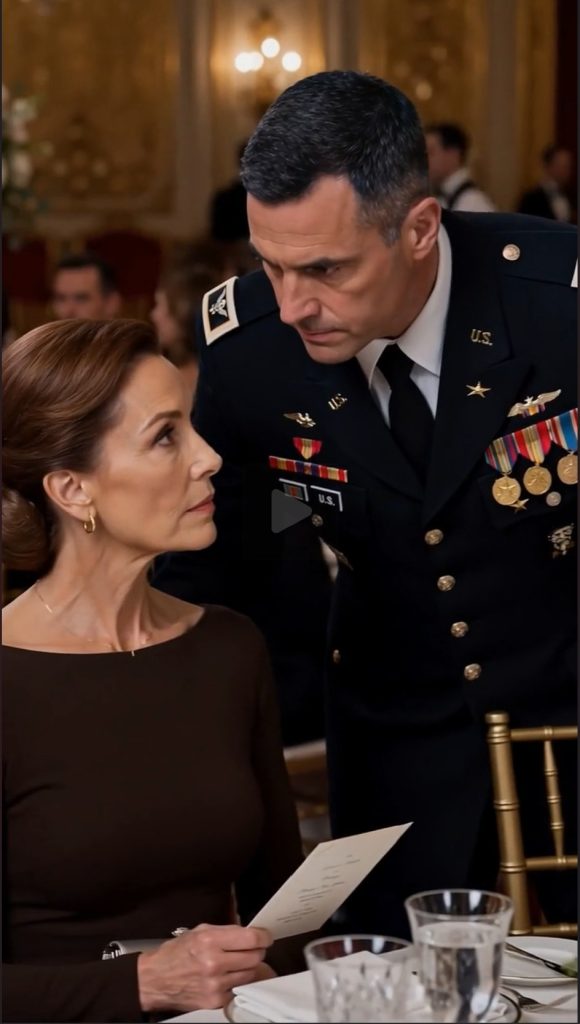
The words cut through the soft music before the elderly woman had even unfolded her napkin. Around her, hundreds of military families gathered to honor sacrifice, unaware that one officer was about to humiliate a woman whose name he had never bothered to learn.
Colonel Derek Maddox stood beside her chair, his expression cold and impatient.
Eleanor Bennett looked up from her place setting. At seventy, with silver hair, pearl earrings, and a modest navy dress, she appeared almost invisible among the decorated uniforms and expensive gowns.
“I believe this is my assigned seat,” she said quietly.
Derek glanced at the place card but refused to pick it up.
“This table is reserved for honored guests.”
Eleanor rested her hand beside her invitation.
“Yes,” she answered.
Something about her calmness irritated him.
“What rank was your son?”
For the first time, Eleanor’s fingers stopped moving.
“He isn’t serving anymore.”
Derek gave a thin, dismissive smile.
“Then you have even less reason to be sitting here.”
A young server slowed behind her. At the neighboring table, two guests fell silent.
Eleanor studied the colonel’s face.
“Are you certain?”
Instead of answering, Derek signaled to a banquet employee.
“Move her to the back.”
The employee hesitated.
Derek leaned closer, lowering his voice just enough to make the insult feel personal.
“You’re only the mother of a soldier.”
For a moment, Eleanor said nothing.
Then she reached for her purse.
“All right.”
Her chair scraped softly against the polished floor. She stood without protesting, while Derek stepped aside with the satisfaction of a man who believed he had restored order.
Several guests watched her walk away.
None intervened.
At the rear of the ballroom, a young banquet employee pulled out a chair.
“I’m terribly sorry, ma’am.”
Eleanor noticed his name tag.
“You didn’t make that decision, Caleb.”
He glanced toward the colonel.
“I still don’t think it was right.”
“That speaks well of you.”
Caleb managed a small, uncomfortable smile.
From her new seat, Eleanor could barely see the stage.
Fort Liberty’s annual military families memorial gala filled the Fayetteville convention hotel with officers, veterans, donors, and grieving families.
American flags framed the podium. Gold stars decorated the tables. Outside, photographs of fallen service members lined the entrance hall.
Eleanor had arrived alone twenty minutes earlier, carrying her invitation and asking for no special attention.
Now that invitation lay beside her water glass.
Across the room, Derek was laughing with wealthy donors.
He had spent months preparing for this evening.
A new military family scholarship foundation was being established, and its executive director would control a major privately funded education program.
Derek wanted that position after retirement.
The salary, influence, and national connections promised everything he desired.
Tonight, he believed he was impressing the people who could give it to him.
Eleanor watched silently.
He never looked back.
A woman wearing a small Gold Star pin leaned toward her.
“I saw what happened. Did they change your table?”
“It seems so.”
“My name is Susan Parker.”
“Eleanor Bennett.”
Susan’s expression shifted.
“Bennett?”
“Yes.”
She studied Eleanor more closely.
“Have we met before?”
“I don’t believe so.”
Susan seemed about to say something else when the string quartet abruptly stopped.
An announcement echoed across the ballroom, asking everyone to take their seats.
Near the stage, Brigadier General Marcus Hale remained seated beside two defense industry executives.
Derek straightened his dress uniform, smiling confidently.
At the back, Susan was still staring at Eleanor.
And the question she hadn’t asked was suddenly more important than anything being said onstage.
The evening’s most consequential moment was still ahead. 👇
Susan reached beneath the table and touched Eleanor’s wrist.
“Was your son Daniel Bennett?”
Eleanor’s breath caught.
For several seconds, she could only look at the woman beside her.
“Yes,” she whispered. “Did you know him?”
Susan’s eyes filled.
“My husband served with him.”
The ballroom seemed to recede around Eleanor. She could hear the microphone being adjusted onstage, but Susan’s next words were the only sounds that mattered.
“My husband came home because of your son.”
Eleanor lowered her eyes to Susan’s gold pin.
“I’m sorry,” she said softly. “You lost him afterward?”
Susan nodded.
“Three years later. Another deployment.”
Neither woman spoke for a moment.
Then Susan opened her small evening bag and withdrew a worn photograph.
Two young soldiers stood beside a military vehicle, smiling into the desert sunlight.
One was Daniel.
Eleanor covered her mouth.
“I haven’t seen this one.”
“He gave it to my husband. I recognized your name because he talked about Daniel for years.”
Eleanor touched the corner of the photograph.
Daniel had been twenty-eight when he died. For eleven years, she had kept his letters in a wooden box beside her bed, carefully tied with the blue ribbon from his final birthday gift.
She had received medals, official condolences, and folded flags.
But there were still photographs she had never seen.
Still stories she had never heard.
Onstage, General Hale approached the microphone.
“Good evening, everyone.”
Applause rose through the room.
Derek sat taller, smoothing his jacket.
The general welcomed the families, thanked the donors, and spoke about the responsibility of protecting the futures of children whose parents had served.
Then his voice changed.
“Before we announce the leadership of our new foundation, there is someone I would like to recognize.”
A photograph appeared on the enormous screen.
Daniel Bennett.
Eleanor’s fingers tightened around Susan’s hand.
Derek looked up.
His smile faded.
“Captain Daniel Bennett,” General Hale continued, “gave his life during a rescue operation that saved nine American service members.”
The room fell silent.
“One of those nine men was my younger brother.”
General Hale paused, swallowing visibly.
“For eleven years, my family has lived with a debt we can never repay.”
At the front table, Derek slowly turned toward the empty chair beside him.
The place card remained there.
ELEANOR BENNETT.
He finally picked it up.
General Hale looked toward the front row.
“Mrs. Bennett, would you please stand?”
Nobody moved.
The general looked again.
An event coordinator hurried toward him and whispered something.
His expression hardened.
“Where is Mrs. Bennett?”
Derek rose halfway from his chair.
“General, there appears to have been a seating misunderstanding.”
“A misunderstanding?”
Derek cleared his throat.
“She was moved to another table.”
“By whom?”
The silence stretched.
Derek stared at the microphone.
“By me, sir.”
General Hale’s gaze traveled to the rear of the ballroom.
Eleanor remained seated, her hand resting on Daniel’s photograph.
“Mrs. Bennett,” he said gently, “I’m sorry. Would you allow me to come to you?”
She nodded.
The general stepped down from the stage.
As he approached, the guests turned in their seats, creating a narrow path between the tables.
Caleb stood near the service entrance, motionless.
General Hale stopped before Eleanor.
“Ma’am, I owe your son my brother’s life. And I owe you an apology for what happened tonight.”
Eleanor stood slowly.
“You didn’t move me, General.”
“No. But this evening was supposed to honor families like yours. We failed to make you feel welcome.”
Eleanor glanced toward Derek.
“He told me I was only the mother of a soldier.”
A murmur spread across the ballroom.
General Hale became very still.
“Did he?”
“Yes.”
The general looked toward Derek.
“Colonel Maddox. Come here, please.”
Derek crossed the room under hundreds of watching eyes.
“Sir, I had no idea who she was.”
General Hale studied him.
“That’s precisely the problem.”
Derek opened his mouth, but the general continued.
“You believed she deserved respect only if she had an important connection.”
“I was protecting the seating arrangements.”
“You were protecting a table from a woman whose name was printed on its place card.”
Derek’s face reddened.
“I made an error in judgment.”
Eleanor spoke before the general could answer.
“Colonel, would you have treated me differently if you’d known who my son was?”
Derek hesitated.
“Of course, ma’am.”
Eleanor’s expression changed.
Not with anger.
With disappointment.
“Then you still don’t understand.”
No one interrupted her.
“My son wasn’t brave because a general’s brother survived. He wasn’t worthy because his photograph is on that screen.”
Her voice trembled slightly.
“He was worthy when he was a frightened little boy who couldn’t sleep during thunderstorms. He was worthy when he came home exhausted and called to ask whether I’d eaten dinner.”
She paused.
“And every mother in this room deserves to be treated as though the person she loves matters.”
Susan began crying silently.
Derek lowered his eyes.
General Hale turned toward the executives who had been seated beside the colonel.
One of them, the foundation’s board chair, rose.
“Colonel Maddox,” she said, “our selection committee met this afternoon. Your appointment was the final recommendation awaiting ratification.”
Derek looked up sharply.
“Ma’am—”
“We have now witnessed conduct that contradicts the purpose of this organization.”
She glanced toward her fellow trustees.
“We will not ratify your appointment.”
Derek’s hands dropped to his sides.
Months of calculated friendships, private meetings, and carefully managed appearances had collapsed because he could not offer basic courtesy to a stranger.
“General,” he began, “surely this can be handled privately.”
“It will be handled properly,” Hale replied. “The incident will be documented and reviewed through the appropriate command channels.”
Then he turned away.
For the first time that evening, Derek Maddox was no longer the most important person at his table.
He stood alone while the room slowly returned its attention to Eleanor.
But Eleanor wasn’t watching him.
She was looking at Daniel’s face on the screen.
General Hale extended his arm.
“Would you join me onstage?”
She hesitated.
“I didn’t come here for attention.”
“I know.”
His voice softened.
“That’s why I’m asking, not ordering.”
Eleanor looked toward Susan.
Susan squeezed her hand.
“Go. Please.”
The walk to the stage felt impossibly long.
When Eleanor reached the steps, Caleb appeared beside her and offered his hand.
She smiled.
“Thank you, Caleb.”
He helped her onto the platform.
The entire ballroom stood.
Applause began at the back, then spread until the chandeliers seemed to tremble with the sound.
Eleanor held Daniel’s photograph against her chest.
And cried.
Not because she had finally been honored.
Because, for a few precious moments, her boy was in the room again.
General Hale waited until she could breathe comfortably.
Then he offered her the microphone.
Eleanor shook her head at first.
But when she looked out at the tables, she saw Susan, the families wearing gold pins, and the young server who had treated her kindly without knowing anything about her.
She took it.
“My Daniel used to say that courage wasn’t always something extraordinary.”
Her voice was fragile but clear.
“He said sometimes it was just noticing when someone needed help and deciding not to walk away.”
She looked toward Caleb.
“Tonight, someone did that for me.”
Caleb stared at the floor, his ears turning red.
Eleanor smiled through her tears.
“I think Daniel would have liked him.”
The applause that followed was quieter.
More personal.
When Eleanor returned to her seat, Susan embraced her.
For a long moment, neither woman let go.
Across the room, Derek left through a side entrance without approaching Eleanor again.
In the weeks that followed, the command review formally recorded his conduct. The foundation selected another director, and Derek’s hoped-for second career vanished.
He sent Eleanor a handwritten apology.
She read it once.
Then she placed it beside the invitation.
She did not pretend that a letter could erase humiliation.
But she hoped he would learn something from the loss.
Two months later, Eleanor returned to Fayetteville for the foundation’s first scholarship ceremony.
This time, Susan met her at the entrance.
Caleb was there too.
He had received an unexpected offer of employment from the foundation, helping coordinate family events while completing his college degree.
“I hope you don’t mind,” he told Eleanor. “They asked how I knew you.”
She laughed.
“Whatever did you tell them?”
“That you remembered my name.”
Eleanor touched his arm.
“It’s a good name.”
Inside the smaller ceremony room, General Hale waited beside a table holding the foundation’s first scholarship certificates.
He handed Eleanor a sealed envelope.
“We’ve been meaning to give you this.”
Inside was a copy of the foundation’s charter.
Eleanor read the dedication at the top.
The Daniel Bennett Family Scholarship Fund.
Her eyes widened.
“General, I never agreed to have it named after Daniel.”
“I know,” Hale said. “And you can ask us to change it.”
She looked at him questioningly.
He continued.
“When we started this project, my brother suggested your son’s name. But when we contacted families Daniel had helped, we discovered something extraordinary.”
He handed her a folder.
Inside were letters from veterans, widows, and military children.
Some described Daniel’s rescue operation.
Others described much smaller kindnesses.
A paid electricity bill.
A repaired wheelchair ramp.
A child’s school supplies delivered anonymously.
Eleanor turned the pages slowly.
She recognized none of these stories.
“He never told me,” she whispered.
“He apparently didn’t tell anyone he didn’t have to.”
Then Hale showed her the final page.
It was a copy of a letter Daniel had written shortly before his last deployment, requesting that any unused personal savings be directed toward education for children of service members who had died.
At the bottom was a sentence in his handwriting.
My mother taught me that nobody should have to prove they’re important before somebody helps them.
Eleanor sat down.
She pressed her fingers against the words.
For eleven years, she had wondered whether she had given Daniel enough during their short time together.
Now, in a room filled with people he had helped, she finally understood what he had carried from their home into the world.
Susan knelt beside her chair.
“He sounds like you,” she whispered.
Eleanor shook her head, smiling through tears.
“No,” she said. “He sounds like himself.”
At the ceremony, the foundation awarded its first scholarships to six children.
Eleanor insisted on meeting every family.
She asked the children about their favorite subjects, listened to their plans, and remembered their names.
When the last certificate had been presented, Caleb brought her a cup of tea.
“Your usual, Mrs. Bennett.”
She raised an eyebrow.
“You’ve only made it for me twice.”
“I pay attention.”
She laughed, and Susan laughed with her.
That evening, the three of them sat together after the guests had gone, while late sunlight spilled across the empty chairs.
Nobody asked Eleanor to move.
Nobody checked whether she belonged.
Her place card stood beside a small framed photograph of Daniel.
And for the first time in many years, Eleanor looked at her son’s smiling face without feeling that the whole world had moved on without him.
She reached across the table, took Susan’s hand, and offered her other hand to Caleb.
Outside, the evening light softened over Fayetteville.
Inside, three people who had arrived in one another’s lives as strangers remained seated long after the ceremony ended, sharing stories, laughter, and the quiet comfort of knowing there was finally room for everyone at the table.