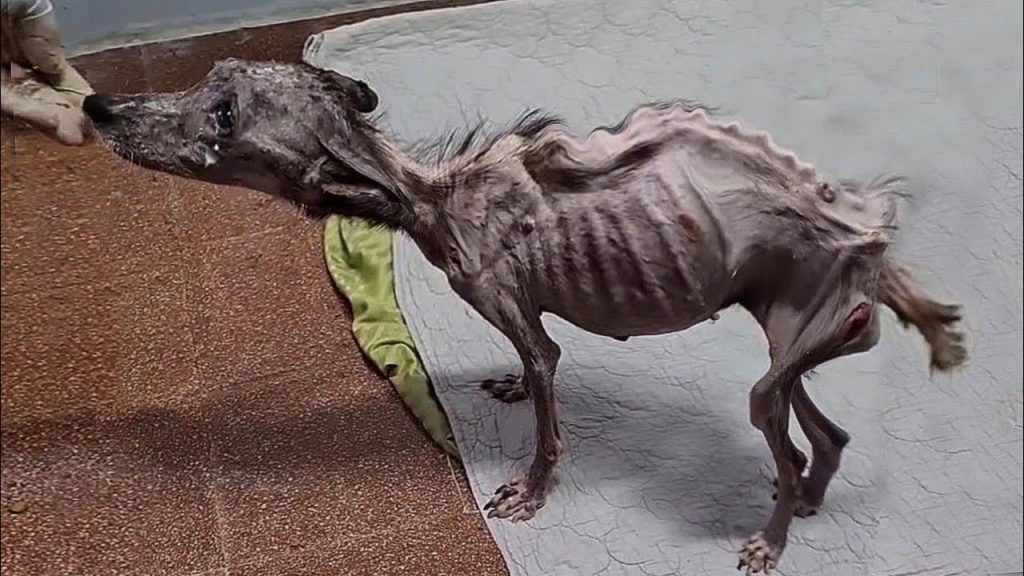
She had spent nearly her entire life inside a cramped cage. The place where she was forced to sleep was so unclean that she lay in her own waste. Along with the confinement came cruelty that no animal should have to endure. Instead of the ordinary care a dog needs, Angelina had known suffering and fear.
A dog’s life should hold room for rest, safety, affection, and the simple pleasure of being near people who care. Angelina had been denied those things for years. Her story was not merely about a cage. It was about what happens when a gentle creature is left without the protection every living being deserves.
By the time a rescuer reached her, the damage was plain to see. Angelina was painfully thin, her bones visible beneath her skin. Her strength was almost gone. She appeared overwhelmed by terror, with little reason to feel secure. Her condition spoke of a life spent surviving rather than living.
The rescuer did not look away. Angelina was taken straight to a veterinarian, where her condition was dire. She showed no interest in food or water. Her exhausted body seemed to be shutting down, and the outlook was uncertain.
Then came the words no compassionate rescuer wants to hear. The veterinarian believed Angelina was unlikely to survive the night and advised the rescuer to give up. It was a devastating assessment, made all the harder by how much this vulnerable dog had already endured.
The rescuer cried. After years of suffering, Angelina had finally reached someone willing to help her, yet there was no assurance that she would live long enough to enjoy a different kind of life. A rescue can begin with a door opening, but that alone cannot erase years of neglect or restore a body pushed to its limits.
Still, the rescuer refused to abandon her.
Rather than surrender to that grim prognosis, the person who had saved Angelina stayed close, prayed for her, and offered steady, unconditional love. There was no way to know what would happen. There was only a fragile dog in need of care and someone determined that she would not face her struggle alone.
Love could not undo her past, and devotion was no substitute for veterinary attention. But the patient presence of someone who cared mattered. For a dog who had spent so long surrounded by fear, being treated gently was itself a profound change. Angelina was no longer simply enduring what others had done to her. She had someone on her side.
Gradually, signs of progress began to appear. Angelina became more comfortable in her surroundings. The fear that had once seemed to fill every part of her life began to loosen its hold. Her recovery was more than a matter of weight or strength. It also meant discovering that the world could offer safety instead of harm.
One of the most meaningful changes was her ability to stand on her own legs. For a dog who had been so severely weakened, that simple achievement carried enormous weight. Standing was not an ordinary detail in Angelina’s journey. It was evidence that her body was regaining some of the strength that suffering had taken away.
She also began eating and drinking again. Her body grew stronger, and she gained weight. The painfully thin dog found in such desperate condition was changing. Each improvement mattered because it represented something she had been missing for so long: the chance to recover without being left behind.
There was another kind of healing, less easily measured but just as important. Angelina began to regain confidence. A dog once frightened by her own shadow was learning to feel safe. That change did not make her past disappear. Nothing could give back the years she had lost. But it meant those years no longer had to define everything that came next.
The rescuer’s refusal to give up had made room for possibilities that initially seemed painfully distant. Angelina’s survival was never something anyone could simply promise. The veterinarian’s warning had been serious. Yet her progress showed why tenderness and perseverance matter, especially when a suffering animal has so little strength left to offer.
As her health improved, Angelina began to enjoy the world beyond confinement. She liked the warmth of sunshine. She could run and play outdoors. These were ordinary pleasures, the kinds of things many beloved pets experience without anyone giving them a second thought. For Angelina, they marked an extraordinary contrast with the cramped, filthy cage that had held her for most of her life.
Sunlight did not change what had happened to her. Neither did the freedom to move outside. But together, those simple joys made her new life visibly different from the one she had known. She was no longer defined only by fear, exhaustion, and the need to survive. She could take part in the small, happy experiences that make a dog’s life feel full.
And there was more good news. Angelina found a forever home with wonderful new owners. The dog who had once lived without basic comfort now belonged to a loving family. She was safe, healthy, and surrounded by affection. Her journey had led not simply away from suffering, but toward the lasting security she had deserved all along.
It is impossible to return the years Angelina spent inside that cage. What can be honored is the life she has now, and the compassion that helped her reach it. Her story is a reminder that an older dog is never less worthy of kindness, patience, or a place to belong.
Angelina was given a second chance. At last, she could live as every dog should: safe, cared for, and loved.